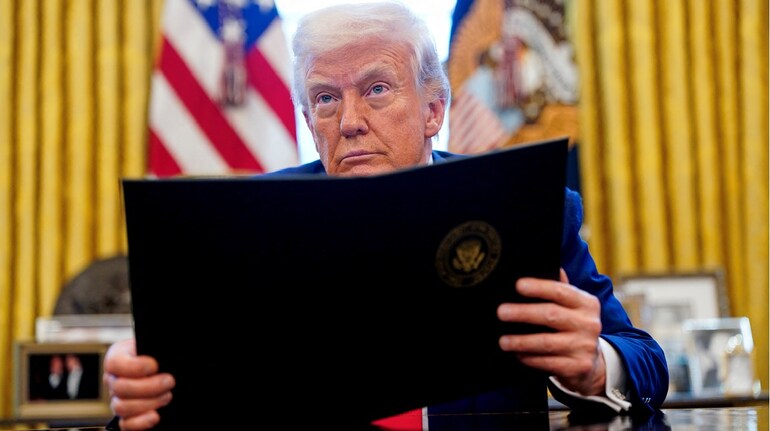
Officials across Asia reacted to US President Donald Trump’s 90-day pause on higher tariffs for dozens of trade partners with a mixture of relief, caution and a little mockery.
Some — like Vietnam that had been facing a 46% levy, and Japan with a 24% surtax — pressed ahead with efforts to ensure the reprieve becomes permanent for their economies.
The People’s Daily, the flagship newspaper of the Chinese Communist Party, carried a commentary that called for the US to cancel its unilateral tariffs and touted the benefits of “win-win” economic and trade relations. Trump upped his levies on imports from China yet again to 125% after Beijing announced plans to retaliate with an 84% duty on American goods set to begin Thursday.
Vietnam Deputy Prime Minister Ho Duc Phoc met with US Trade Representative Jamieson Greer in Washington and agreed to start negotiations on a “reciprocal” trade agreement, according to a post on the government website. The nation’s stocks surged in early trading Thursday.
Japan will continue to urge Trump to review his tariff measures, according to Ryosei Akazawa, the nation’s top trade representative. “There is no change in Japan’s policy,” Economic Revitalization Minister Akazawa said on Thursday.
Australia’s center-left Prime Minister Anthony Albanese, who is in the middle of a closely fought election campaign ahead of a May 3 vote, said the Trump administration’s tariff regime is an “act of self-harm” that’s damaging the US economy and that’s why the president opted for a pause.
Penguin Tariffs
Albanese also mocked some of the US administration’s tariff moves, including the imposition of import duties on Heard Island and McDonald Islands, a mostly barren Australian external territory inhabited by penguins.
“I’m not sure what they trade,” he said of the Antarctic islands, while adding more seriously “it is a very uncertain world that we live in.”
Albanese, speaking in a radio interview, pointed out that Australia doesn’t apply tariffs to the US and that Washington shouldn’t do so to Australian products “because that’s what our free-trade agreement says.”
About Face
The president’s about-face came roughly 13 hours after high duties on 56 nations and the European Union took effect, fueling market turmoil and stoking recession fears. Trump faced massive pressure from business leaders and investors to reverse course.
Countries that were hit with the higher, reciprocal duties that went into effect Wednesday will now be taxed at the earlier 10% baseline rate applied to other nations, with the exception of China, according to a White House official.
Tokyo is expected to be among nations taking priority in trade negotiations with Washington. US Treasury Secretary Scott Bessent said he would be speaking to officials from Japan, Vietnam, India and South Korea in the coming days.
Japan still faces a 25% tariff on cars, auto parts, steel and aluminum, while other goods remain subject to the 10% flat tax rate applied to all nations. Japan sees the pause on some of the reciprocal tariffs as a positive development while it will keep calling for a review of the tariffs still in place, said Akazawa, who was selected this week to lead trade negotiations with the US.
New Zealand Prime Minister Christopher Luxon is proposing the formation of a rules-based trading bloc in response to Trump’s tariffs. Luxon said the Comprehensive and Progressive Agreement for Trans-Pacific Partnership, a free-trade agreement between 12 nations including New Zealand, Japan, Canada and the UK, could be the basis for a wider agreement with the EU that seeks to “promote free trade as a path to prosperity.”
Discover the latest Business News, Sensex, and Nifty updates. Obtain Personal Finance insights, tax queries, and expert opinions on Moneycontrol or download the Moneycontrol App to stay updated!
Find the best of Al News in one place, specially curated for you every weekend.
Stay on top of the latest tech trends and biggest startup news.