For months, Wall Street brushed off Donald Trump’s trade war and the Federal Reserve’s higher-for-longer stance — confident a resilient economy would keep propping up US markets.
This week, that confidence began to unravel. Weak job growth and Trump’s latest volley of tariffs rattled investors, intensifying pressure on Fed Chair Jerome Powell to lower interest rates and exposing a new unease with the White House’s protectionist push.
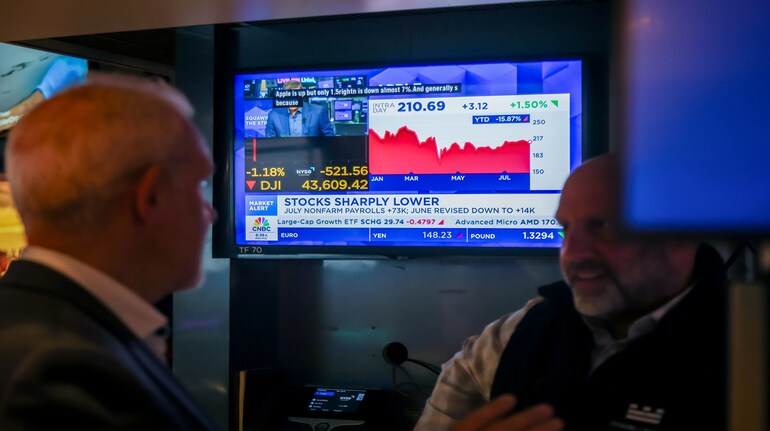
A three-month stretch of nearly unbroken market calm was shattered on Friday after a US report showed a sharp slowdown in the labor market. Traders rushed into the safety of government bonds — pushing down yields on two-year notes to 3.71% in the biggest drop since last August — while ramping up bets for a rate cut as soon as next month. The dollar fell and the S&P 500 Index retreated from an all-time high, poised for the worst week since May.
Volatility whipped up across markets as traders re-assessed the economic reality after $15 trillion was added to equity values since April. The Cboe Volatility Index, a gauge of options cost, jumped to approach the widely watched level of 20 for the first time since April’s tariff-induced rout. Similar measures on high-yield and investment-grade bonds also climbed.
“Lots of folks have their eyes on the exit door. Some frothy signs are appearing,” said Joe Saluzzi, co-head of equity trading at Themis Trading. “Weak job numbers should solidify the rate cut story for September, but there is some worry that the Fed is waiting too long.”
Friday’s market action marked a sharp reversal from July, when the dollar rallied, haven trades were abandoned and US equities outpaced their international peers, buoyed by stronger‑than‑expected earnings and a still‑healthy economic growth.
That narrative took a hit at the end of the week. Trump’s new tariffs — lifting the average US levy on global imports to 15%, the steepest since the 1930s — landed just as data showed job growth cooling more than expected. The prospect for a slowdown caused traders to ratchet up the likelihood for a rate cut in September to 88%, up from 40% earlier this week.
The specter of lower rates sent the dollar down as much as 1%, the worst intraday drop since April. Economically sensitive companies led the retreat in the S&P 500 amid growth angst. The Russell 2000 Index of small-caps extended declines for a fifth day, poised for the worst week in four months.
“Investors may have gotten too complacent while waiting for the impacts of slower economic activity resulting from tariffs and higher interest rates,” said Charlie Ripley, senior investment strategist for Allianz Investment Management. “The economic cooling associated to tariffs is beginning to take hold. Softer labor conditions should raise eyebrows at the Fed and knowing they have been a reactionary organization in recent years, we should expect a higher chance of Fed action in the coming months.”
The duo retreat in the US dollar and equities highlights July’s fragility of the resurgence in American exceptionalism. Betting against the dollar — voted as the “most crowded trade” for the first time on record in Bank of America Corp.’s survey of money managers — turned out to be one of the biggest blunders as the greenback posed its first monthly gain since Trump took office. US skeptics, who continued to dominate in BofA’s survey, also had a setback in stocks as the S&P 500 outperformed the rest of the world for a fourth straight month.
The renewed weakness likely marked a welcome development to those who stuck to a preference in non-US assets of late. Rich Weiss, chief investment officer for multi-asset strategies at American Century Investment Management, has continued to be underweight US equities, citing stretched valuations.
“There are significant potential negatives out there with the deficit, tariffs and inflation,” he said. “The overall volatility, which President Trump himself deduces into the whole equation, indicates we still should remain somewhat cautious.”
Discover the latest Business News, Sensex, and Nifty updates. Obtain Personal Finance insights, tax queries, and expert opinions on Moneycontrol or download the Moneycontrol App to stay updated!
Find the best of Al News in one place, specially curated for you every weekend.
Stay on top of the latest tech trends and biggest startup news.