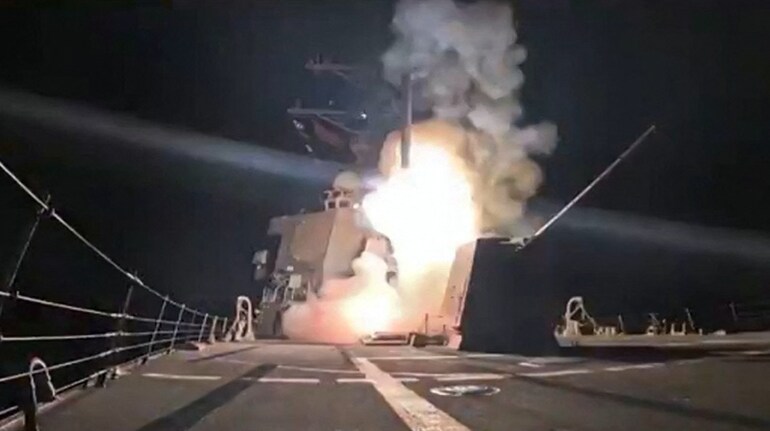
After the United States launched Christmas Day strikes targeting ISIS bases in northwest Nigeria, questions remain concerning the strategy and details of the operation.
Here is what we know:
Who was involved?
US President Donald Trump was the first to announce the strikes, initially raising concern among Nigerians that their sovereignty may have come under attack.
Later both countries said that they were involved, and that the strikes had the approval of Nigerian President Bola Tinubu.
It is not clear whether the Nigerian military's involvement went beyond intelligence sharing. Official communications by Washington and Abuja vary on this question.
Which group was targeted?
Neither Abuja nor Washington have identified their precise targets among the multiple armed groups operating in Nigeria.
The United States said it targeted militants linked to the Islamic State group and US African command said there were multiple casualties, without providing details.
Analysts questioned the choice of striking northwestern Sokoto state, where non-ideological armed gangs known as "bandits" are a bigger concern than jihadists -- who may not even have been hit by the strikes.
The main theatre of the country's years-long jihadist insurgency is in fact the northeast of Nigeria.
"If you're going to strike then it shouldn't be the least" affected areas, said Victoria Ekhomu, an analyst and head of the Association of Industrial Security & Safety Operators of Nigeria.
She said a more obvious target would have been northeastern Borno state, the epicentre of Nigeria's jihadist conflict.
However, US and Nigerian officials have said that there will be more strikes to come.
What is known about Islamic State group in northwest Nigeria
Nigeria has been battling a jihadist insurgency in its northeast since 2009, waged by Boko Haram and rival offshoot Islamic State West Africa Province.
Several other groups, some of them associated with the northeastern jihadists, have established themselves in the northwest.
Some researchers have recently linked an armed group known as Lakurawa -- the main jihadist group located in Sokoto State -- to Islamic State Sahel Province (ISSP), which is mostly active in neighbouring Niger and Mali, although others are doubtful.
Research on Lakurawa is complicated as the term has been used to describe various armed fighters in the northwest.
Fears are also growing that another powerful Sahel jihadist group, Al-Qaeda affiliated Group for the Support of Islam and Muslims (JNIM), might establish itself in Nigeria following an attack claimed by its fighters on the Nigeria-Benin border in October.
What about the timing?
Trump unexpectedly turned on Nigeria in October in November, accusing its government of allowing a "genocide" of Christians -- a framing that has long been used to describe the country’s myriad conflicts by the US and European religious right.
The Nigerian government and independent analysts reject the accusations, pointing out that Nigeria’s multiple, sometimes overlapping conflicts have killed Muslim and Christian civilians alike.
Following weeks of intelligence gathering, including US recon flights tracked by open source analysts, the timing of the strikes on Christmas Day may be significant.
"The fact that it was Christmas when we were trying to celebrate the birth of Jesus Christ" suggests Trump "has his own agenda, and ... he's focused on Christians," said Ekhomu.
Security analyst Brant Philip, writing on X, suggested the timing was "a symbolic start to official US operations in Nigeria", adding: "The operational results of the strikes are not significant, but much is expected soon."
Discover the latest Business News, Sensex, and Nifty updates. Obtain Personal Finance insights, tax queries, and expert opinions on Moneycontrol or download the Moneycontrol App to stay updated!
Find the best of Al News in one place, specially curated for you every weekend.
Stay on top of the latest tech trends and biggest startup news.