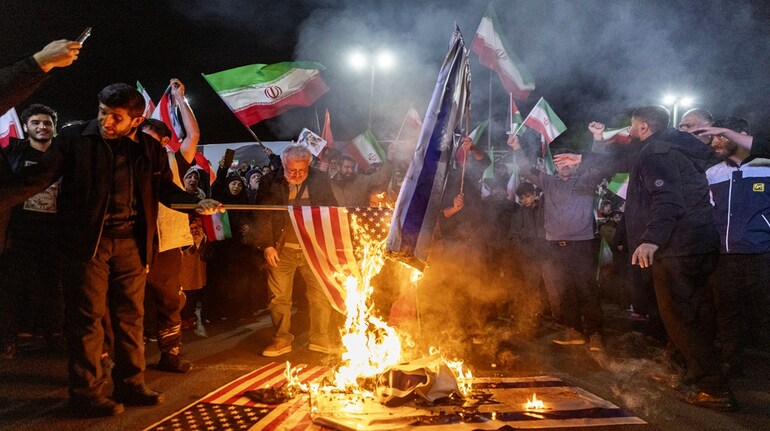

The US took fresh steps to curb the turmoil in energy markets as Iran vowed to escalate its attacks on oil and gas infrastructure in the Middle East with the conflict stretching toward three weeks.
President Donald Trump temporarily waived a century-old shipping mandate to lower the cost of transporting energy goods around the US. Vice President JD Vance and other key Trump administration officials also plan to huddle with oil executives Thursday, according to people familiar with the matter.
Still, Trump expressed renewed irritation with countries who have rejected pleas to help secure the Strait of Hormuz, a critical energy waterway which remains all but impassable.
“US allies need to get a grip – step up and help open the Strait of Hormuz,” he said in a social media post Wednesday.
As military operations showed little signs of abating, Brent crude prices neared $110 a barrel.
Tehran warned Gulf countries that a number of energy assets are now “legitimate targets” after Israel attacked a key gas field in Iran. Facilities in Qatar, Saudi Arabia and the United Arab Emirates are on a list of sites at risk of Iranian airstrikes, the semi-official Tasnim news agency reported on Wednesday.
Israel carried out the strike on South Pars, a senior official from the country said, asking not to be named discussing sensitive matters. Iraq reported a loss of power generation after Iran halted gas supplies as a result — the latest example of how other Middle East countries are becoming embroiled in the 19-day conflict.
Anwar Gargash, a top adviser to UAE President Sheikh Mohamed bin Zayed, signaled that the UAE may be willing to help secure the Hormuz strait.
Oil prices rose again on Wednesday with US crude rising toward $100 a barrel and Brent crude almost touching $110 during the session. Supplies from US emergency reserves are poised to hit the market soon, helping keep US oil price increases relatively tame compared to international benchmark Brent.
Still, both oil contracts have skyrocketed by more than 40% since the US and Israel began their war on Feb. 28. So far, the US administration’s measures have done little to curb retail gasoline and diesel prices from surging to multi-year highs.
Countries continue to vie for access and control in the Strait of Hormuz. The US said it dropped 5,000-pound bunker-buster munitions on Iranian missile sites near the waterway late on Tuesday.
Russia said it plans to provide naval convoys to protect merchant ships.
Iran, meanwhile, has been moving its own oil through the strait at close to pre-war levels. Crude loadings at Kharg Island also appear to continue undisturbed, despite US strikes on the export hub.
Iran’s Foreign Minister Abbas Araghchi told Al Jazeera that “we need to design new arrangements for the Strait of Hormuz and the way ships pass through it in the future.”
The South Pars attack also renewed focus on the wartime vulnerability of energy infrastructure in the Middle East, even as Trump has suggested that the US is reluctant to carry out direct attacks on energy sites that would hurt global supply.
Earlier this week, Iran set a massive natural gas field in the UAE ablaze as it stepped up its retaliation.
Israel’s targeting of the South Pars field “is a dangerous and irresponsible step,” Foreign Ministry spokesperson Majed Al Ansari of Qatar, which shares ownership of South Pars with Iran, said in a post on X.
The South Pars attack signals a shift in the conduct of the war toward degrading Iran’s economic infrastructure and curbing its ability to continue fighting, according to Hamidreza Azizi, a visiting fellow at the German Institute for International and Security Affairs in Berlin.
“South Pars is central to Iran’s gas supply and, by extension, to electricity generation and industrial activity,” Azizi said by email. “Even limited or temporary disruptions can translate into power shortages, industrial slowdowns, and broader economic strain.”
There were other signs on Wednesday that the war was picking up on multiple fronts. Iran launched fresh waves of missiles and drones at the UAE, Saudi Arabia and Kuwait after confirming the assassination of its security chief, Ali Larijani. It also struck Tel Aviv, killing two people. Israel and the US maintained their bombardment of Iran.
Tehran’s military vowed to avenge the death of Larijani as well as that of Gholamreza Soleimani, the head of the Basij paramilitary unit, which maintains internal security in Iran. Iranian Intelligence Minister Esmaeil Khatib was also killed.
In parallel with the war in Iran, Israel has stepped up an offensive in Lebanon, where it’s fighting the Tehran-backed Hezbollah militant group. Israeli strikes in the country have killed more than 900 people, according to the Lebanese government.
That brings the war’s death toll to more than 4,000, with more than three quarters of the fatalities in Iran. Dozens of others were killed in the rest of the Middle East, while the US has lost 13 military personnel.
Trump reiterated on Tuesday that he started the war to disarm a potent nuclear threat, claiming Tehran was just two weeks away from acquiring a weapon. Iran has denied pursuing atomic weapons and nuclear experts mostly disagree it could have built weapons that quickly.
Iran “is considered, by everyone, to be the NUMBER ONE STATE SPONSOR OF TERROR,” Trump posted on Truth Social on Wednesday. “We are rapidly putting them out of business!”
US gasoline prices have soared in recent weeks, rising to around $3.84 a gallon on Wednesday, according to the American Automobile Association. That’s the highest level in more than two years and is piling pressure on the administration ahead of the November midterm elections.
“Gas prices are up and we know they’re up, and we know that people are hurting because of it and we’re doing everything that we can to ensure that they stay lower,” Vance said on Wednesday, calling the spike “a temporary blip.”
In one sign of growing domestic opposition to the conflict, Joe Kent, a top counterterrorism official, resigned in protest against the war, arguing that Israel had dragged the US into the conflict.
Director of National Intelligence Tulsi Gabbard on Wednesday scrapped a mention in congressional testimony that Iran hasn’t re-started uranium enrichment since US strikes destroyed its facilities last year. That conclusion would have undercut claims that Tehran posed an imminent threat to the US.
Discover the latest Business News, Sensex, and Nifty updates. Obtain Personal Finance insights, tax queries, and expert opinions on Moneycontrol or download the Moneycontrol App to stay updated!
Find the best of Al News in one place, specially curated for you every weekend.
Stay on top of the latest tech trends and biggest startup news.