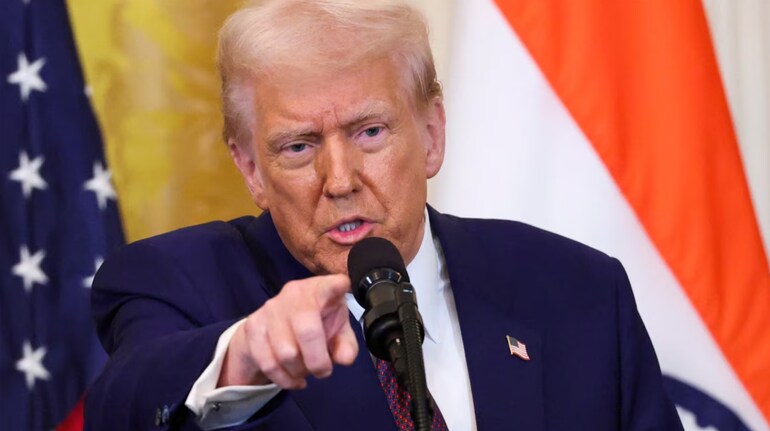
US President Donald Trump is once again confronting one of the most difficult challenges in US foreign policy: how to handle Iran without triggering a wider war — or appearing weak.
As negotiations open in Oman between US and Iranian officials, Trump finds himself boxed in by his own rhetoric and past actions. He has repeatedly threatened consequences if Iran resumes nuclear activities or intensifies its domestic crackdowns. He has also demonstrated a willingness to use force, including prior strikes on Iranian targets and the assassination of top commander Qasem Soleimani during his first term.
Now the question is whether pressure leads to a breakthrough — or a new conflict.
A moment of vulnerability for Tehran
Iran appears weaker than it has in decades.
The country is facing deep economic strain, recurring protests, and uncertainty over the eventual succession of Supreme Leader Ayatollah Ali Khamenei. Regional allies such as Hamas and Hezbollah have suffered major setbacks in recent conflicts, reducing Iran’s deterrent power across the Middle East.
For some in Washington and Jerusalem, this looks like a rare opportunity. If Iran’s leadership is politically fragile and militarily stretched, decisive action now could permanently alter the balance of power in the region.
Such a move would carry enormous historical implications. US presidents from Jimmy Carter through Joe Biden have struggled to contain or transform Iran’s behaviour. A breakthrough — whether through force or diplomacy — would define Trump’s legacy.
But what looks like opportunity can quickly become peril.
The risks of escalation
Any serious attempt to cripple Iran’s military capacity or destabilise the ruling establishment would likely require sustained air operations, not a limited strike. Iran’s security infrastructure is embedded in civilian areas, raising the risk of civilian casualties and international backlash.
There is also no clear roadmap for what follows a collapse of central authority. Unlike Iraq in 2003, Iran has strong national cohesion, but the consequences of sudden regime change remain unpredictable. A power vacuum could produce chaos, internal conflict or a new hardline government.
Iran also retains the ability to retaliate. Missile strikes against US bases or regional allies, disruptions to oil infrastructure and attacks through proxy groups are all plausible scenarios. Even limited retaliation could spike global energy prices and destabilize financial markets.
At home, Trump faces a more complicated political environment than in past confrontations. His approval ratings have dipped below 40% in some surveys, and economic concerns dominate voter priorities. A prolonged conflict — especially one involving US casualties — could reshape the political landscape ahead of midterm elections.
Diplomacy offers its own constraints
The alternative — a negotiated agreement — is hardly straightforward.
Secretary of State Marco Rubio has indicated that Washington seeks restrictions not only on Iran’s nuclear program but also on ballistic missiles and regional activities. Tehran has signalled it is willing to discuss nuclear issues but not broader security matters.
That mismatch complicates the possibility of a comprehensive deal.
Trump withdrew from the 2015 nuclear agreement during his first term, arguing it was too narrow and allowed Iran to expand its regional influence. Any new deal that resembles the earlier framework could invite criticism from his own political base.
Yet without concessions from both sides, negotiations may stall. And after weeks of heightened rhetoric and military positioning, stepping back without tangible results could weaken US credibility.
A presidency defined by instinct
Trump has often framed unpredictability as a strategic asset. Supporters argue it keeps adversaries off balance. Critics warn it increases the risk of miscalculation.
Iran presents a case where instinct, domestic politics and geopolitics intersect sharply. Military escalation could reshape the region but carries heavy uncertainty. Diplomacy could avert conflict but may deliver incremental, rather than sweeping, gains.
In either case, there are no clean victories.
For now, the administration appears to be keeping both options open. The coming weeks — and the outcome of talks in Oman — may determine whether this chapter ends in negotiation, confrontation or a prolonged standoff.
What is clear is that decisions made in Washington will reverberate far beyond the Gulf — affecting global markets, regional stability and the trajectory of US foreign policy for years to come.
Discover the latest Business News, Sensex, and Nifty updates. Obtain Personal Finance insights, tax queries, and expert opinions on Moneycontrol or download the Moneycontrol App to stay updated!
Find the best of Al News in one place, specially curated for you every weekend.
Stay on top of the latest tech trends and biggest startup news.