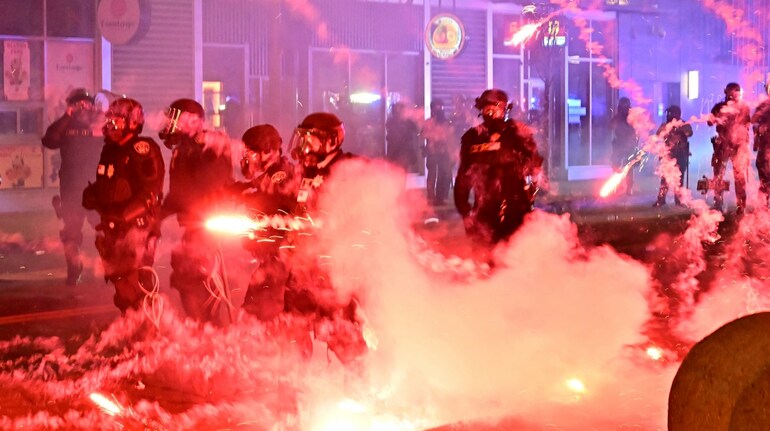
For the first time since 1992's Los Angeles riots, National Guard soldiers have been sent to the city on presidential orders—but this time without the approval of California's governor. President Donald Trump on Saturday deployed 2,000 California National Guard soldiers to quell protests against his administration's immigration raids, initiating a political and legal struggle with state officials, the Washington Post.
California Gov. Gavin Newsom sharply opposed the move and announced plans to sue the Trump administration, calling the deployment "immoral" and "unconstitutional." "We didn't have a problem until Trump got involved," Newsom wrote on social media, arguing that state and local authorities had the situation under control.
Trump's move is reminiscent of the 1992 riots, when President George H.W. Bush deployed National Guard troops to Los Angeles at the behest of California leaders after riots broke out over the acquittal of police officers who had beaten Rodney King. Yet whereas Bush's action was in coordination with state authorities, Trump's directive is issued in opposition to the state's elected officials.
A protracted and contentious history of federal force in U.S. protests
Presidents have on rare occasions employed the National Guard as a reaction to civil disturbances, with recent precedents in the civil rights period. President Lyndon B. Johnson federalized the Alabama National Guard in 1965 to safeguard civil rights marchers in Selma over the objection of Gov. George Wallace. Presidents Dwight D. Eisenhower and John F. Kennedy also employed the Guard to provide school desegregation.
But such federal moves have been a rarity in recent times, particularly when mobilized over state opposition. The Insurrection Act—a statute authorizing presidents to deploy troops to suppress disorder—had not been used since the 1992 Los Angeles riots. While Trump has not yet moved to use the Insurrection Act, he did leave open the possibility of doing so when he addressed reporters Sunday. "Depends on whether or not there's an insurrection," he replied.
Without a declaration of an Insurrection Act, National Guard soldiers have only a support role and may not undertake the law enforcement activities of making arrests or conducting raids, legal experts quoted by The Washington Post said.
Tensions rise between federal and state power
Federal force deployed in Los Angeles has revived arguments about the division of state and federal authority. Gov. Newsom, following rhetoric voiced by then-Louisiana Gov. Kathleen Blanco during Hurricane Katrina, maintained that control of the National Guard belonged under state commanders.
"There is not a governor in this country who would relinquish control of the National Guard," Blanco testified at a 2006 Senate hearing, highlighting the delicacy of such federal intrusions.
State officials generally use local law enforcement and seek Guard help only in extraordinary circumstances. The Trump administration's unilateral move is a stark departure from that precedent, adding to tensions between the federal government and California.
A politically charged deployment with historical echoes
The current protests in Los AnTrump, LA protest geles were sparked by opposition to Trump’s immigration policies, not racial injustice as in 1992. But the visual of National Guard troops patrolling American streets once again evokes the turbulent history of federal force in civil unrest.
As lawsuits play out and the protests persist, the political and constitutional reverberations of Trump's order will be felt well beyond California.
Discover the latest Business News, Sensex, and Nifty updates. Obtain Personal Finance insights, tax queries, and expert opinions on Moneycontrol or download the Moneycontrol App to stay updated!





Find the best of Al News in one place, specially curated for you every weekend.
Stay on top of the latest tech trends and biggest startup news.