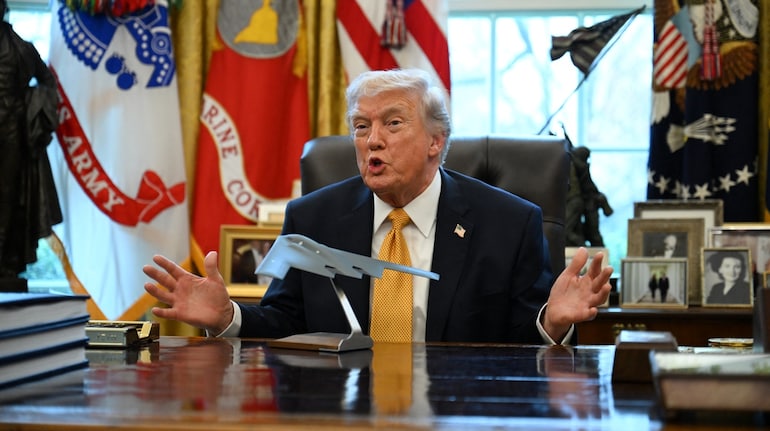

US President Donald Trump’s messaging on the ongoing war in Iran has become increasingly contradictory, raising questions about both the clarity of Washington’s strategy and the coherence of its objectives.
On Monday, Trump dismissed the importance of allies in the conflict, only to immediately call on them for help.
“We don’t need anybody,” he said. But in the same breath, he urged other nations to take responsibility for securing the Strait of Hormuz, a critical global oil route that Iran has threatened and partially disrupted.
According to reporting by The New York Post, such conflicting statements have become a defining feature of Trump’s approach to the war, with the president oscillating between declarations of victory and warnings that the job is far from finished.
A pattern of mixed signals
Trump’s remarks on the Iran conflict have often shifted rapidly, sometimes within the same statement.
He has described the war as merely an “excursion,” while also framing it as a necessary response to an existential threat. He has claimed that the United States has already “won,” but simultaneously argued that forces must remain engaged to complete the mission.
This pattern is not new. Trump has long used ambiguity as a political tool, allowing him to appeal to different audiences and retain flexibility in his positions.
However, as The New York Post notes, the stakes are far higher in an active military conflict. The lack of a clear and consistent narrative is now intersecting with a war that has already produced significant casualties and global economic disruption.
Experts flag lack of clarity
Analysts say the inconsistency points to a deeper issue. The administration itself may not have a clearly defined end goal.
“The lack of discipline and the lack of clarity strongly suggest that the administration was simply unprepared for the messaging aspects of this conflict,” said James J. Kimble, a historian of rhetoric and propaganda at Seton Hall University.
“The likelihood is that the demands are ambiguous because the administration does not know what its goals are beyond winning.”
Trump’s aides have rejected the criticism. They argue that his messaging style is deliberate, part of a negotiating strategy that keeps adversaries off balance.
Karoline Leavitt, the White House press secretary, dismissed concerns about inconsistency as a “fake narrative.”
“The United States has won -- the regime is significantly weakened and the evil ayatollah is dead,” she said in a statement. “But the president will not rest until the objectives of Operation Epic Fury are fully realized -- destroy their ballistic missiles and their ability to make them, permanently end their ability to build a nuclear bomb, annihilate their Navy and weaken their evil proxies in the region.”
Contradictions within the strategy itself
Even as the White House outlined these objectives, Trump’s earlier statements appeared to undermine them.
After US airstrikes on Iranian nuclear facilities last year, Trump had claimed those sites were “obliterated.” The current emphasis on dismantling Iran’s nuclear capabilities raises questions about whether those earlier claims were overstated.
According to The New York Post, this inconsistency reflects a broader pattern in Trump’s approach, where rhetorical claims of success often outpace on ground realities.
The absence of a clear pre-war justification has also added to the confusion. Unlike previous US presidents, Trump did not undertake a sustained public campaign to explain the rationale for military action against Iran.
Weak domestic support and growing criticism
Public backing for the war has been significantly lower than in previous US conflicts.
Polls indicate that less than half of Americans support the military campaign. This stands in sharp contrast to the aftermath of the September 11 attacks, when 92 percent of Americans backed the war in Afghanistan, according to Gallup.
Criticism has also emerged from within Trump’s own support base.
Podcast host Joe Rogan, who endorsed Trump in 2024, described the war as “crazy” and “insane.”
“He ran on no more wars; end these stupid, senseless wars,” Rogan said. “And then we have one that we can’t even really clearly define why we did it.”
Experts suggest Trump is attempting to balance competing constituencies.
“He can speak to an audience that might support a moral or ethical argument for regime change in Iran,” said Allison Prasch, a professor at the University of Wisconsin Madison.
At the same time, she added, he can reassure “America First” supporters by portraying the conflict as limited. He can “write off this bombing campaign as a temporary blip, as nothing permanent or consequential.”
Real-world consequences mount
Beyond rhetoric, the war is already producing tangible consequences.
More than 2,100 people have been killed since the conflict began on February 28, including at least 13 American service members.
A US military investigation has also raised serious concerns. Preliminary findings indicate that a Tomahawk missile strike by US forces hit an Iranian elementary school, killing at least 175 people, most of them children. This contradicts Trump’s earlier suggestion that Iran was responsible for the attack.
The economic fallout has also been significant. Oil prices have surged to over $90 a barrel, marking a roughly 40 percent increase since before the war.
Confusion extends to diplomacy
Trump’s messaging has also complicated diplomatic efforts.
On Monday, he said he was open to negotiations with Iran but quickly added that the United States did not know who to engage with.
“We have people wanting to negotiate,” Trump said. “We have no idea who they are.”
The statement reflected another contradiction. While expressing willingness to talk, Trump also suggested that Iran’s leadership had been so heavily targeted that no clear interlocutors remained.
Nicholas J. Cull, a professor of public diplomacy at the University of Southern California, said the messaging may be aimed more at domestic audiences than international ones.
“It is too soon to judge the impact of this on world opinion,” Cull said. “But it seems as if the role of measured superpower statesmanship on the world stage is, for the time being, vacant.”
A war without a clear narrative
As the conflict enters its third week, Trump has shown little inclination to clarify his position.
Instead, his statements continue to shift between confidence and uncertainty, victory and unfinished business, isolation and reliance on allies.
According to The New York Post, this evolving narrative is now shaping not just perceptions of the war, but also its broader geopolitical impact.
With rising casualties, economic strain, and growing scrutiny at home and abroad, the question remains whether the administration can align its messaging with a coherent strategy or whether the contradictions will continue to define America’s role in the conflict.
Discover the latest Business News, Sensex, and Nifty updates. Obtain Personal Finance insights, tax queries, and expert opinions on Moneycontrol or download the Moneycontrol App to stay updated!





Find the best of Al News in one place, specially curated for you every weekend.
Stay on top of the latest tech trends and biggest startup news.