






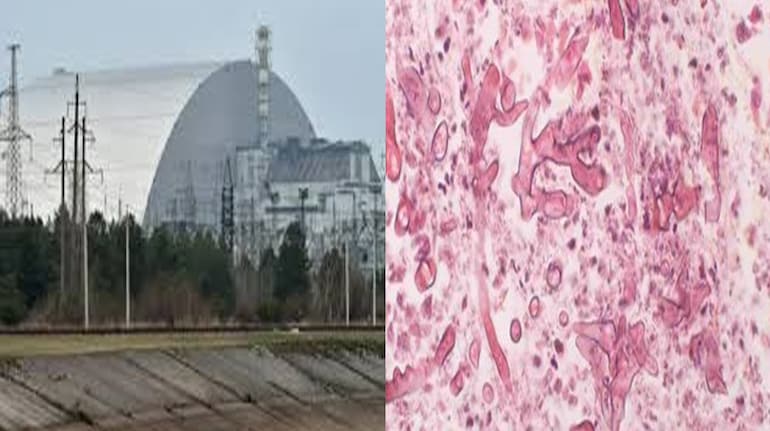
Inside the shattered remains of Chernobyl's Unit Four reactor, where ionizing radiation still lingers at levels lethal to humans, scientists have made a remarkable discovery: a fungus that seems inordinately comfortable with danger. The organism, called Cladosporium sphaerospermum, grows in thick black clusters along the interior walls of the structure. Its colour comes from melanin, a pigment that some researchers believe may be doing far more than protecting the fungus, it might be helping it harvest energy from radiation in a process loosely compared to photosynthesis.
Dubbed "radiosynthesis," the concept first attracted scientific interest in the late 1990s, when microbiologist Nelli Zhdanova and her team conducted a survey of the Chernobyl Exclusion Zone. Researchers were astonished to find that 37 types of fungi were growing in the greatly irradiated shelter, many of them dark-pigmented. Of those, C. sphaerospermum was the dominant one in the samples, with the highest levels of radioactive contamination. Yet it appeared untroubled, even healthy.
To investigate further, radiopharmacologist Ekaterina Dadachova and immunologist Arturo Casadevall conducted follow-up experiments in the early 2000s. They found that exposing this fungus to ionizing radiation-the kind strong enough to knock electrons off atoms and shred DNA-didn't harm it. In fact, it grew better.
Further experiments demonstrated that radiation changed both the structure and behaviour of the melanin inside the fungus, suggesting an energy-harvesting mechanism. This resulted in a 2008 paper proposing that melanin in these fungi works in a manner similar to chlorophyll in plants.
While intriguing, the theory remains to be confirmed by scientists due to the need to verify whether the fungus actually transforms radiation into usable metabolic energy. No person has managed to demonstrate carbon fixation or any defined biochemical pathway that would prove radiosynthesis. Even so, this fungus still continues to amaze researchers. An experiment funded in 2022 by NASA strapped C. sphaerospermum to the outside of the International Space Station. Sensors revealed that the fungus blocked some cosmic radiation, raising the possibility of using it as a natural radiation shield during deep-space missions.
One thing is for sure: C. sphaerospermum is pulling off a remarkable trick in surviving in this lethal environment for humans. Other melanised fungi have unusual responses to radiation, as well, none quite exactly like this. Whether it is adapting to "feed" on radiation or simply using melanin as an extreme protective tool is not known.
For the moment, it serves as a reminder that life can adapt in ways more inventive and mysterious than we might have anticipated.
Discover the latest Business News, Sensex, and Nifty updates. Obtain Personal Finance insights, tax queries, and expert opinions on Moneycontrol or download the Moneycontrol App to stay updated!
Find the best of Al News in one place, specially curated for you every weekend.
Stay on top of the latest tech trends and biggest startup news.









