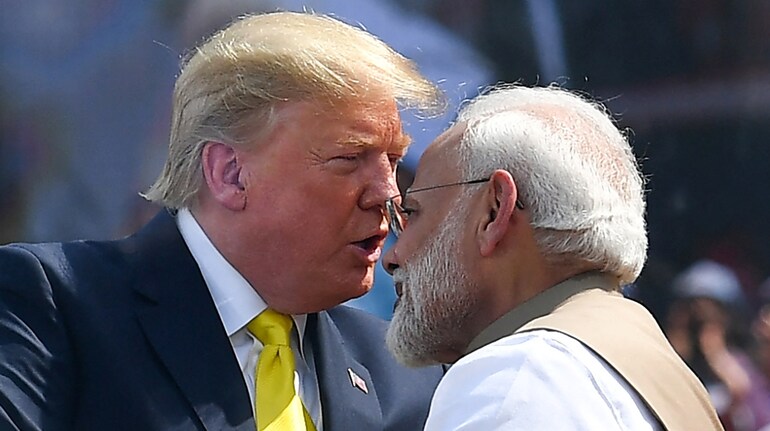
Amid the rising trade tensions between New Delhi and Washington, the spotlight remains on US President Donald Trump’s plan to impose steep 50 per cent tariffs on Indian goods. The move threatens industries that rely on exports of electronics, gems, seafood and carpets. But beyond the turbulence in goods, there is another story quietly holding the economic relationship together: the trade in services.
The New York Times reports that while the United States ran a $46 billion deficit in goods trade with India in 2024, services tell a different story. The two countries exchanged $84 billion worth of services last year, and the balance has remained nearly equal for years. That services trade, covering everything from finance and education to consulting and IT, has become the binding glue of the relationship.
The scale of services ties
Two-thirds of Fortune 500 firms now rely on offshore operations in India, the New York Times report noted. American multinationals including Meta, Microsoft, Walmart and Lowe’s have built permanent corporate offices across Indian cities. Their annual payroll in India exceeds the value of the US goods deficit that has drawn Trump’s ire -- money that sustains Indian families while strengthening American companies’ bottom lines.
“In India, we have this unique model,” Amitendu Palit, a former Indian trade official and now a senior research fellow at the National University of Singapore, told the New York Times.
In services, he said, India’s workforce can handle functions “from entry level to executive, like nowhere else in the world.” That, he added, is what pushes the bilateral services trade.
Goldman Sachs, for instance, employs more staff in Bengaluru and Hyderabad than in Mumbai, India’s financial capital. On Monday, the bank announced a major new office in Mumbai that will be 50 percent larger than its current one. These teams are not just answering phones but managing global stock operations, engineering projects and even designing legal strategies.
Why it matters
For both economies, services are more than a side note. The US remains a global powerhouse in services exports, from finance to education. Indian students, who form the largest group of foreign students in America, contribute significantly to US education revenue. Their tuition payments, airfare and medical expenses in the United States all count as services trade, the NYT pointed out.
Unlike goods trade, services between the two countries are expanding rapidly, with double-digit growth in recent years. Economists expect India’s offshore service hubs to employ at least 2.5 million people by 2030, creating a new upper-middle-class base in the country.
While India has promoted “Make in India” as a way to expand manufacturing, services have quietly outpaced factories in contributing to economic growth. And as the NYT noted, the outcome of the Trump-Modi standoff over tariffs will have wide consequences. For now, it is the services sector, built on American investment and Indian talent, that continues to anchor the partnership.
Discover the latest Business News, Sensex, and Nifty updates. Obtain Personal Finance insights, tax queries, and expert opinions on Moneycontrol or download the Moneycontrol App to stay updated!
Find the best of Al News in one place, specially curated for you every weekend.
Stay on top of the latest tech trends and biggest startup news.