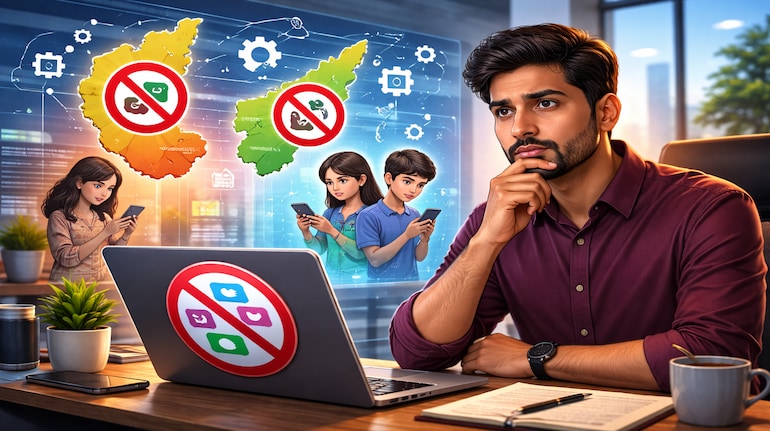

Austria has joined a growing list of countries tightening rules around children’s access to social media, announcing plans to prohibit use for those under 14. The move reflects mounting concern worldwide over how digital platforms affect young users, from mental health to misinformation exposure.
What Austria is proposing
The announcement came from Vice-Chancellor Andreas Babler, who outlined the government’s intention to introduce legislation in the coming months.
"It is almost impossible for parents to control their children's consumption" on these platforms, he said, arguing that many are designed to make users "deliberately dependent."
Austria aims to present the law as early as summer, with the goal of enforcing it quickly. The country’s leadership has framed the move as a response to the growing influence of algorithm-driven platforms that shape behaviour and attention.
Babler said authorities would specifically target systems using "algorithms that create addiction, generate profits and have harmful effects". He also warned that young users are increasingly exposed to harmful content ecosystems.
Children today, he said, are "left to their own devices in a world where they are confronted, for example, with unrealistic beauty ideals, the glorification of violence, disinformation, and where they are also manipulated."
Why governments are concerned
Austria’s proposal is rooted in broader anxieties about how social media affects young people’s development and well-being.
Policymakers across countries have pointed to patterns such as compulsive usage, exposure to misleading or harmful content, and pressure created by unrealistic standards online. The Austrian leadership has also emphasised how platform design itself encourages prolonged engagement.
At the same time, the debate is not purely about restriction. Austria plans to introduce a compulsory school subject titled "Media and Democracy", aimed at helping students identify misinformation and understand attempts at influence.
The initiative suggests that governments are increasingly pairing restrictions with education, rather than relying solely on bans.
Challenges around enforcement
Despite political agreement on the need for action, practical questions remain unresolved. In Austria, the ruling coalition has yet to agree on how age verification will work.
This is a recurring issue globally. Many countries struggle with balancing effective enforcement and user privacy. Systems that require identity verification can raise concerns about data collection, while self-declaration methods are often seen as inadequate.
Austria’s experience reflects this dilemma, with Babler acknowledging that consensus on verification mechanisms has not yet been reached.
Early signals from Austria’s school experiment
The policy debate has been influenced by a recent nationwide trial in Austria. A three-week "no mobile phone" experiment involved around 72,000 pupils and their families.
Education Minister Christoph Wiederkehr said the results offered insight into children’s relationship with devices.
"The feedback we have is that this has been a kind of withdrawal experience for the pupils and that they are aware of the harmful effects of their excessive consumption," he said.
The findings are being used to support the argument that reduced screen exposure can have noticeable behavioural and psychological effects.
Political opposition and free speech concerns
Not everyone supports the proposed ban. Critics argue that such measures could restrict freedoms and limit access to information.
The far-right FPÖ party described the plan as a "frontal assault on freedom of expression". Party representative Katayun Pracher-Hilander suggested the timing of the move was politically motivated.
"Now that critical voices, alternative media and patriotic forces are gaining reach on social networks, they suddenly want to impose bans and censorship measures," she said.
This tension between regulation and freedom is a recurring theme in debates over digital policy, not just in Austria but globally.
A wider global trend
Austria’s proposal is part of a broader international shift toward stricter digital rules for minors.
Several European countries are moving in the same direction. France has approved a ban for children under 15, while Spain and Denmark are working on similar limits. The United Kingdom is also exploring tighter controls, including possible restrictions for younger teens.
Outside Europe, Australia has taken one of the most stringent steps by banning social media access for children under 16. The law places responsibility on platforms themselves, with heavy financial penalties for non-compliance.
In Brazil, a different model has emerged. Instead of a complete ban, authorities require minors under 16 to link accounts to a guardian and have prohibited features such as infinite scrolling and autoplay, which are seen as addictive.
Indonesia is also moving toward a ban for under-16 users on what it calls "high-risk" platforms, with implementation beginning in phases.
Malaysia, meanwhile, has focused on regulatory oversight, requiring major platforms to obtain licences and comply with safety and transparency rules, while also planning age-based restrictions.
Situation in India
India is also beginning to engage with the issue, though at a more fragmented level.
Karnataka recently became the first state to ban social media use for children under 16, while Goa and Andhra Pradesh are considering similar steps. At the national level, concerns have been raised about how platforms retain user attention.
India’s chief economic adviser earlier described social media platforms as "predatory" in their engagement strategies, signalling growing concern within policymaking circles.
However, unlike countries such as Australia, India does not yet have a unified nationwide framework regulating children’s access to social media.
Legal pressure in the US
Developments in the United States have added momentum to global debates, even though federal regulation remains limited.
Recent jury decisions have found major tech companies responsible for harms linked to youth usage. In one case, a Los Angeles court held companies liable for contributing to a teenager’s depression and failing to warn users about risks.
Another jury found that a company knowingly harmed children’s mental health and did not adequately address issues such as exploitation.
These rulings have reinforced concerns among parents and advocacy groups, though comprehensive federal legislation is still pending.
(With inputs from AFP and Reuters)
Discover the latest Business News, Sensex, and Nifty updates. Obtain Personal Finance insights, tax queries, and expert opinions on Moneycontrol or download the Moneycontrol App to stay updated!
Find the best of Al News in one place, specially curated for you every weekend.
Stay on top of the latest tech trends and biggest startup news.