




Scientists have uncovered what may be the oldest proof that ancient humans could ignite their own fires. The discovery comes from a reddish patch of sediment buried in an old clay pit in Barnham, a quiet spot in southern England, where researchers now believe a hearth once burned at least 400,000 years ago. The finding, published in the journal Nature, pushes back the timeline of controlled fire-making by roughly 350,000 years, the Washington Post reported.
Why early fire-making matters for human evolution
The potential to create fire on demand sits at the heart of several long-standing mysteries in human evolution. Fire could soften and cook food, making calories easier to absorb. That change may have supported the growth of larger brains that demanded more energy. Firelight might also have shaped early social life as small groups gathered around its warmth. Yet evidence of ancient fire-making is often fragile, scattered or lost, leaving researchers to rely on tiny geochemical signatures and tools shaped by heat.
At Barnham, no human bones have been found. Even so, the team believes the hearth was most likely made by Neanderthals, who lived in Europe during the same period and who are thought to have interbred with early Homo sapiens later in prehistory.
A fragile footprint of an ancient campfire
The challenge for archaeologists is that fire rarely leaves behind lasting physical clues. Ash, charcoal and soft sediments can wash away. Only unusual conditions preserve traces long enough to be studied. Nicholas Ashton, a curator at the British Museum and one of the study’s lead authors, said the team was fortunate that this one stretch of clay still held its secrets. Excavations had already yielded flint hand axes that showed signs of heating, prompting researchers to investigate further.
One of the key questions was whether the reddish layer of soil was the product of a single wildfire or something more deliberate. Over four years, specialists examined its magnetic properties, which shift when sediment is heated. They experimented with modern materials to estimate how often a fire would need to be lit for the soil to retain the signatures they observed. They concluded that at least a dozen separate burning events, each lasting hours, would have been required. That pattern suggested a place where fires were lit repeatedly rather than a solitary blaze.
Chemistry, magnets and stones that spark
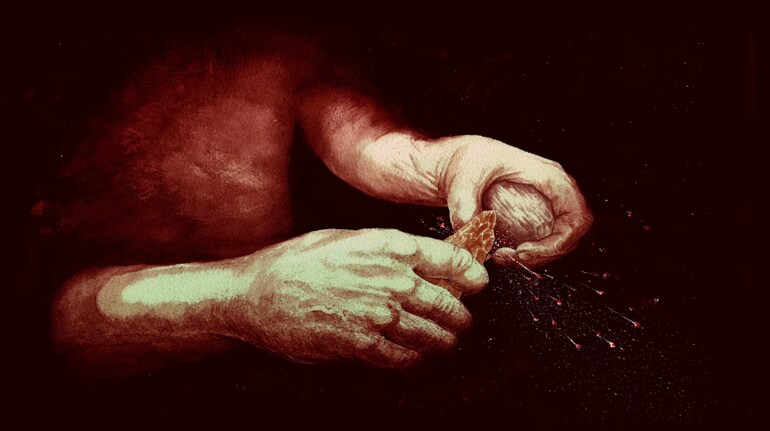
Chemical analyses provided additional clues, pointing to compounds consistent with controlled burning. The final piece of the puzzle came from small fragments of shattered flint and two pieces of pyrite found at the site. When struck together, pyrite and flint can create sparks. Geological surveys indicated that pyrite was not common in the local environment, raising the likelihood that early humans had carried it to the site to start fires.
Even so, debate continues. Some archaeologists argue that the evidence remains circumstantial because the stones do not show the clear microwear marks seen at later Neanderthal fire-making sites. Others believe the data forms a convincing case when considered alongside the magnetic and chemical evidence.
Scavenging embers or making fire on demand
The broader archaeological record documents fire use among hominins stretching back more than a million years in Africa. But the distinction between harvesting embers from natural fires and producing sparks intentionally is crucial. Mastering the latter would have allowed ancient humans to live in colder climates, protect themselves from predators and extend their active hours after dark.
Barnham was likely a woodland landscape with a seasonal pond and an array of wildlife such as lions, elephants, deer and fish. The hearth found there does not reveal where humanity first learned to make fire. Instead, it offers a rare and unusually well-preserved window into a moment when knowledge, cooperation and technology intersected.
A small hearth with big social implications
As paleoanthropologist John Hawks notes, maintaining fire required social rules, shared labour and a deeper understanding of wood types. All of that hints at a complex culture developing long before modern humans appeared. For researchers, the Barnham hearth is less a single breakthrough and more a snapshot of an ongoing story. It suggests that by 400,000 years ago, some of our relatives were not just borrowing flame from nature but learning how to create and tend it for themselves.
Discover the latest Business News, Sensex, and Nifty updates. Obtain Personal Finance insights, tax queries, and expert opinions on Moneycontrol or download the Moneycontrol App to stay updated!
Find the best of Al News in one place, specially curated for you every weekend.
Stay on top of the latest tech trends and biggest startup news.