Months after India’s Operation Sindoor dismantled key terror-linked infrastructure in Pakistan and Pakistan-occupied Kashmir, Islamabad is still struggling to recover from the military and strategic damage inflicted.
The operation, conducted in May 2025 in response to the Pahalgam terror attack that killed 26 people, most of them Indian tourists, targeted critical Pakistani military assets. These included the Nur Khan Chaklala, Rafiqui and Rahim Yar Khan airbases, all known for housing equipment and logistics used by groups like Jaish-e-Mohammed (JeM) and Lashkar-e-Taiba (LeT).
Even Pakistan Prime Minister Shehbaz Sharif was forced to admit the scale of destruction. His government’s silence since then has only underlined Islamabad’s inability to defend or conceal the damage.
India’s Operation Sindoor: A decisive strike
Operation Sindoor was India’s most assertive cross-border military action since the Balakot airstrikes of 2019. It dismantled key Pakistani military installations used for coordinating terrorist training and movement.
After the strikes, Prime Minister Narendra Modi declared that India would make “no distinction between terrorists and those who shelter them.” He also said the country would no longer give in to “nuclear blackmail” -- a pointed message to Pakistan’s establishment.
New evidence of reconstruction at Nur Khan
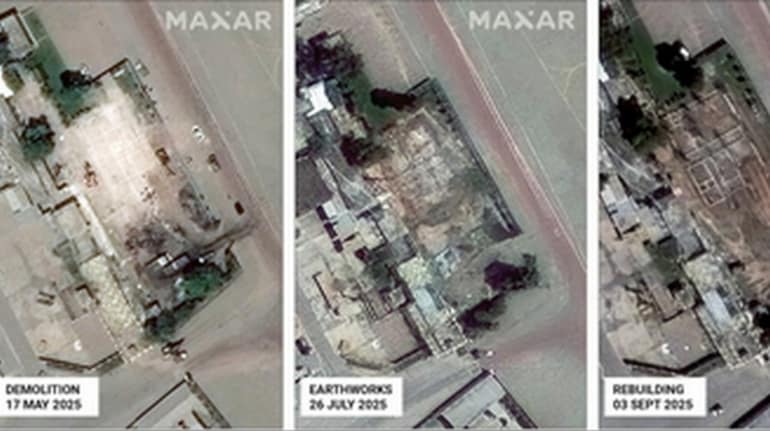
Recent satellite images have revealed that Pakistan is now attempting to rebuild parts of the heavily damaged Nur Khan airbase in Rawalpindi. The images, analysed by geo-intelligence researcher Damien Symon of Intel Lab, show fresh construction on the very site India struck in May.
Symon, an Open Source Intelligence (OSINT) expert who had earlier exposed India’s strike on Pakistan’s nuclear weapons storage at Kirana Hills, noted that the reconstruction work matches the footprint of the facilities India destroyed.
He wrote on X, “A review of Nur Khan Airbase reveals the entire complex near India’s strike location has now been demolished.”
Symon also confirmed to India Today that “India’s strike in May targeted specialised military trucks and caused secondary damage to nearby structures, which were later demolished. The layout of the new walls suggests Pakistan intends to restore operational capacity at this site, which is likely integral to airfield operations.”
Satellite images taken in the days after the strike showed extensive destruction -- burning fuel trucks, collapsed warehouses, and debris strewn across the runway. What appeared to be “specialised military trucks” at the site were reduced to twisted wreckage.
Veteran defence journalist Vishnu Som also shared imagery showing “two long trailer trucks with awnings,” believed to be part of Pakistan’s command and control system. Air Marshal A.K. Bharti later released further photos illustrating the extensive structural damage.
Why Nur Khan matters to Pakistan’s military
The Nur Khan airbase is no ordinary site. Situated near the old Benazir Bhutto International Airport, it houses Pakistan’s Air Mobility Command and supports the PAF College Chaklala. Its proximity to the Pakistan Army General Headquarters and the Strategic Plans Division, which oversees the country’s nuclear arsenal, makes it one of the most sensitive military zones in the country.
The base also hosts key PAF squadrons equipped with Saab Erieye early-warning aircraft, C-130 Hercules transports, Saab 2000s and IL-78 refuellers -- all central to Pakistan’s logistics, aerial surveillance and mid-air refuelling capability.
The New York Times once described Nur Khan as “home to the air refuelling capability that would keep Pakistani fighters aloft.” That capability has now been severely compromised.
On the night of 9–10 May, Pakistan Army Chief Asim Munir reportedly called Prime Minister Shehbaz Sharif at 2.30 am to inform him that India had struck the base with ballistic missiles. IAF officials later said Nur Khan was being used as a coordination hub for Pakistan’s drone and missile operations.
It also served as the departure point for senior Pakistani military and political officials, including Munir himself, who flew from Nur Khan to China soon after his promotion to Field Marshal.
Pakistan’s weak response
Islamabad’s response to the strike has been muted, reflecting both its military vulnerability and internal political instability. While Indian officials have remained tight-lipped about the exact weapon systems used, analysts believe the operation deployed BrahMos or SCALP missiles, capable of precision deep strikes.
Pakistan, meanwhile, has tried to quietly rebuild rather than retaliate. The reconstruction at Nur Khan, visible from satellite imagery, suggests desperation to restore capability, but experts believe it will take years before the base returns to full operational status.
For India, the strike was a message: no target is untouchable. For Pakistan, it was a painful reminder of its eroding deterrence and deepening isolation.
Discover the latest Business News, Sensex, and Nifty updates. Obtain Personal Finance insights, tax queries, and expert opinions on Moneycontrol or download the Moneycontrol App to stay updated!
Find the best of Al News in one place, specially curated for you every weekend.
Stay on top of the latest tech trends and biggest startup news.