




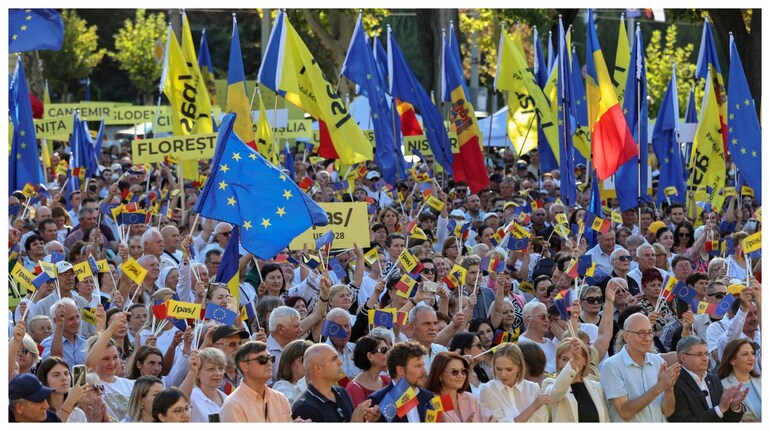
Russia increased its propaganda activities in Moldova as it capitalized on the Trump administration's pullout of US programs that earlier countered foreign interference. Nearly 500 Russia-linked accounts have been discovered posting propaganda on TikTok, Telegram, Facebook and YouTube, and Moldova's September 28 parliamentary election became a test ground for the potency of unregulated propaganda in reshaping views in fragile democracies. The campaign has been assisted by artificial intelligence software that makes it harder for computer-generated posts and videos to be detected, the New York Times reported.
Trump sabotages US disinformation counter-campaign
President Trump since January has reduced spending and scrapped programs to combat disinformation, including cuts to Radio Free Europe, Voice of America, and US funding of independent media. The $22 million initiative to promote Moldova's political process was cancelled, leaving the 2.4-million country more vulnerable than ever. Officials and experts caution that the pullout is equivalent to abandoning the information sphere to Moscow, which moved in and filled the void to steer the democratic course of Moldova.
Russia's Moldovan strategy
The Russian campaign has been characterized as Europe's most brazen by European diplomats and analysts. A clandestine network known as "Matryoshka" has upped at least 39 false narratives in recent months, defaming Moldovan President Maia Sandu with misogynist and homophobic remarks. One of the fake videos employed OK! celebrity news magazine credibility to generate a sperm donors' narrative. Experts call this mix of personal affront and cultural wedge questions a classic instance of Russia's general policy of fostering conflict within democratic societies.
Moldova as a testing ground
Moldova, bordering Ukraine, has long been torn between Moscow's pull and a hope to belong to Europe. The Kremlin sees the election as a chance to keep the nation in its orbit. The Stimson Center has termed Moldova a "test ground for hybrid war," where methods refined there are to be transposed across Europe. The campaign has picked up steam in the hands of Sergei Kiriyenko, a Putin loyalist, and underscores Kremlin interest in discrediting pro-EU Moldova's leadership.
Women leaders in the crosshairs
Moldova's initial female President, Maia Sandu, has been one of the principal subjects for Russian disinformation. Researchers note the misogynistic tone of the majority of the attacks, recalling previous campaigns against women leaders like Germany's Annalena Baerbock and New Zealand's Jacinda Ardern. Reset Tech's Kristina Wilfore described it as "part of the Kremlin's war on women," assuming that embarrassing women in power is a deliberate attempt to undermine democratic legitimacy. Sandu herself warned that Russian-aligned forces, such as fugitive businessman Ilan Shor, pose an immediate threat to the sovereignty of Moldova.
The challenges ahead
The stakes are higher than for Moldova. Experts say the Kremlin is building AI-driven propaganda methods to be unleashed in bigger European democracies in the not-too-distant future. Simultaneously, Trump's resistance to EU efforts at the regulation of firms like Meta and X unravelled defences further, with American diplomats being charged with trying to prevent the EU's Digital Services Act. For Moldova, danger is in the short term: a shift in public perception by a fraction of a percentage point can bring into question the parliamentary election and the nation's position within Europe.
Discover the latest Business News, Sensex, and Nifty updates. Obtain Personal Finance insights, tax queries, and expert opinions on Moneycontrol or download the Moneycontrol App to stay updated!
Find the best of Al News in one place, specially curated for you every weekend.
Stay on top of the latest tech trends and biggest startup news.