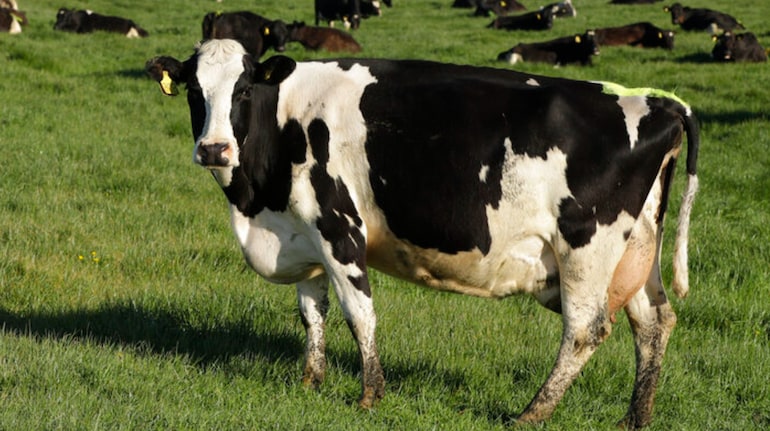
The concept of “non-vegetarian milk” has sparked debate, challenging traditional views on dairy consumption. Trade negotiations between India and the US have hit a roadblock over issues related to dairy and agriculture.
In addition to protecting farmers' interests, cultural concerns around ‘non-veg milk’ have become a key sticking point.
India has labeled certain American dairy products as non-vegetarian, citing cultural sensitivities. This classification is based on the belief that feeding cows animal-derived products contradicts their natural vegetarian diet. As a result, New Delhi has blocked American dairy imports over concerns surrounding the concept of “non-veg milk.”
What is Non-veg cow milk?
The term “non-veg milk” refers to milk from cows fed animal byproducts like bone meal and meat powder, though it is not an official scientific term. This concept has recently sparked international debate, particularly between the United States and India.
In the US, cattle feed reportedly contains animal parts from pigs, fish, and dogs. Conversely, Indian cows are usually fed a strictly vegetarian diet.
“Cows are still allowed to eat feed that can include parts of pigs, fish, chicken, horses, even cats or dogs… And cattle can continue to consume pig and horse blood for protein, as well as tallow, a hard fat from rendered cattle parts, as a fattening source,” noted a 2004 report by Seattle Post-Intelligencer.
Why India and US are at crossroads?
The controversy stems from deep-rooted religious and cultural beliefs. In India, many find the idea of cows being fed meat-based or non-vegetarian fodder unacceptable. Milk from such cows is neither considered holy nor suitable for consumption.
Several religious communities, especially Hindu and Jain groups, hold that for milk to be pure and sacred, the cow must be fed a strictly vegetarian diet.
India has firmly labeled this issue as a "non-negotiable red line" to protect its citizens and is demanding strict certification that imported milk comes only from cows not fed animal-based products like meat or blood.
India has strongly refused to compromise on dairy. The sector supports over 1.4 billion people and employs more than 80 million, mainly small-scale farmers. "There is no question of conceding on dairy. That's a red line," a senior government official told India Today TV in July.
America's stance
Many US dairy producers that export items such as milk powder, ghee, and butter to India raise their cows on feed that includes animal-based ingredients. This has sparked religious and ethical concerns among Indian consumers.
Washington, DC, has referred to India’s refusal to allow dairy and agricultural imports as an “unnecessary trade barrier,” according to India Today.
The issue has been raised at the World Trade Organisation (WTO). As per the Times of India, the U.S. has indicated that India’s revised dairy certification, introduced in November 2024, does not mention such objections.
Discover the latest Business News, Sensex, and Nifty updates. Obtain Personal Finance insights, tax queries, and expert opinions on Moneycontrol or download the Moneycontrol App to stay updated!
Find the best of Al News in one place, specially curated for you every weekend.
Stay on top of the latest tech trends and biggest startup news.