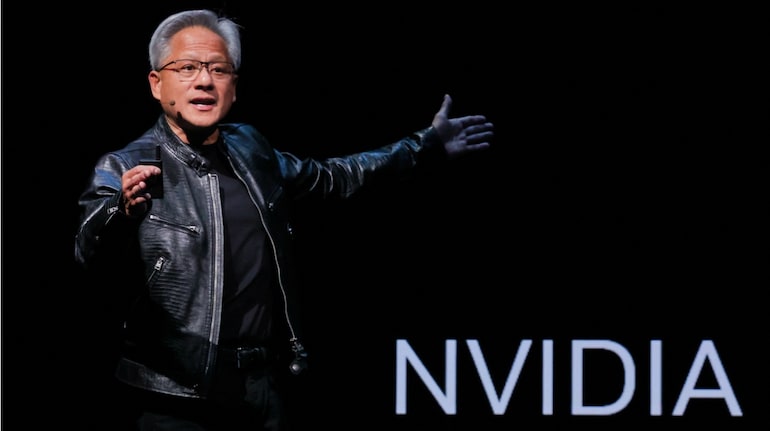
Is the next big technological revolution lurking at the end of this decade? Nvidia CEO Jensen Huang certainly believes so.
At the company's annual developer conference in California, Huang—who heads one of the most valuable companies in the world—said that humanoid robots will be widely used in manufacturing facilities within the next five years.
He also unveiled a platform called "Isaac GR00T N1", which he said will “supercharge humanoid robot development”.
According to a report in Reuters, Huang expressed optimism that the manufacturing industry would likely be the first to adopt humanoid robots, given that the sector has well-defined tasks that robots can perform in a controlled environment.
What are humanoid robots and how can they go mainstream?
Humanoid robots are designed to resemble humans in both form and function. They are advancing with the help of AI mimicking human appearance and actions, making them ideal for tasks like caregiving or assisting in workplaces. Think an advanced AI model that can also perform physical tasks.
According to a 2024 Mckinsey’s report titled “The robot renaissance: How human-like machines are reshaping business”, the convergence of Generative AI and robotics creates exciting possibilities for roboteers and AI developers.
The report said that rapid technological progress across the globe is taking robots back to their science fiction roots (Think Terminator), with human-like appearance that can perform tasks typically carried out by a human—walking, sensing, communicating and manipulating objects in their environment.
The latest humanoid robots are designed with advanced arms and hands capable of handling intricate tasks, such as picking up delicate objects or assembling components.
According to the US Bureau of Labor Statistics, cited by the report, these fine manipulation skills are essential in most modern jobs.
In fact, high-performance robotic arms can achieve precision down to 0.001 millimeters and feature adaptive control systems to operate effectively in unpredictable environments.
Companies leading the AI revolution are also now looking to integrate their systems into machines that can mimic human tasks.
A report in the Nature said that rapid advances in artificial intelligence (AI) could help address labor shortages, with major tech firms like OpenAI and Google DeepMind now working to integrate foundation model, AI algorithms powering chatbot into robotics.
This integration will not only enhance robots' capabilities but also holds potential for improving AI itself, creating a symbiotic relationship between the two. However, challenges like data limitations, complex movements, and safety issues still need to be addressed before widespread use, the report said.
Moreover, sophisticated AI has also helped the robots to increasingly appear to “think” like humans. AI-based robots are increasingly controlling systems that use large language and behaviour models to understand verbal instructions and emulate human actions.
Tale of Apollo Robot
A recent report by UK-based Sky News highlighted a major breakthrough in humanoid robotics. Apollo, a 5'8" humanoid robot developed by Apptronik, successfully completed a real-world task—autonomously assembling an engine part. The robot achieved this using its servo-controlled wrists, marking a significant milestone in human-like robotic capabilities.
The robot is although smaller and less powerful compared to traditional industrial machines, but it offers flexibility in tasks, as it can adapt to different roles on an assembly line, the report said. Mercedes-Benz has invested in Apollo and is trialing the robot at its Berlin and Hungary factories, it added.
The goal is to evaluate how humanoid robots can collaborate with human workers in production and logistics, especially for tasks deemed repetitive, dangerous, or dull, while improving their learning and dexterity.
Future of Humanoid Robots
By 2050, it is projected that 22 percent of the global population will be over the age of 60, the Mckinsey report said. This demographic change would increase the relevance of the humanoid robots in filing up the growing labour gap in all the major sectors.
The report said that humanoid robots, with motor skills, have remarkable use cases across multiple sectors, from manufacturing and supply chain logistics to healthcare and customer service.
In factories, they can connect automation processes by handling loading, assembly and maintenance tasks. In warehouses, they assist with sorting, stocking and last-meter deliveries.
They also offer support in construction, field services and hazardous environments. In retail and hospitality, humanoid robots can stock shelves, take orders and assist customers.
Discover the latest Business News, Sensex, and Nifty updates. Obtain Personal Finance insights, tax queries, and expert opinions on Moneycontrol or download the Moneycontrol App to stay updated!
Find the best of Al News in one place, specially curated for you every weekend.
Stay on top of the latest tech trends and biggest startup news.