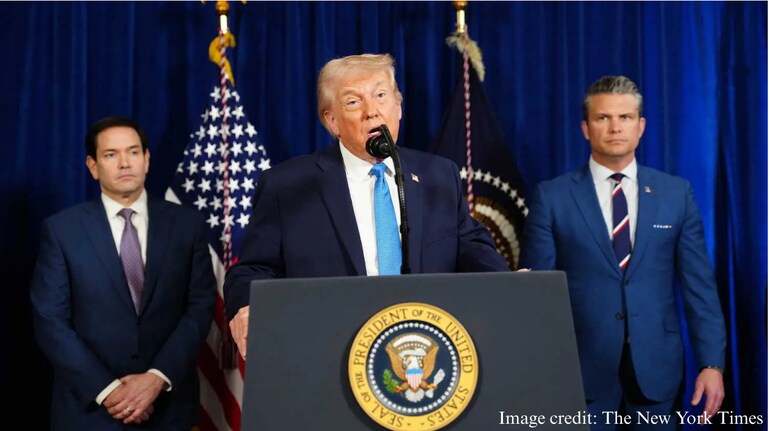
Marco Rubio has held more titles than any recent American diplomat. After Saturday’s operation that removed Venezuelan President Nicolás Maduro, he may have acquired his most daunting role yet: chief US overseer of Venezuela’s uncertain future.
US officials say Rubio was central to planning the operation that led to Maduro’s capture and transfer to US custody. Now, with no clear successor in Caracas and President Donald Trump openly suggesting Washington will help “run” the country, Rubio has emerged as the administration’s point man for stabilizing Venezuela, allocating oil assets and guiding a political transition, the Washington Post reported.
A long-held goal, realised at a cost
For Rubio, the moment fulfils a campaign he has waged for more than a decade. The son of Cuban parents, he has consistently argued that Maduro’s rule was illegitimate and that US pressure, including military force, could be justified to remove him. Allies say Latin America policy is deeply personal for Rubio, shaped by his family history and years of engagement with Venezuelan opposition figures.
That history made him a natural choice for Trump, officials say, given his Spanish fluency and relationships across the region. But they also acknowledge the scale of the challenge. Decisions on energy policy, sanctions, elections and security now loom simultaneously, even as Rubio continues to juggle multiple senior roles in the administration.
Trump’s ambiguity complicates the task
Trump has offered few details on how Venezuela will actually be governed in the interim. Asked whether his administration was capable of running the country, he pointed vaguely to advisers around him and said the arrangement would last for a “period of time.”
The president praised Rubio’s early contacts with Maduro’s vice president, Delcy Rodríguez, suggesting she was willing to cooperate. Rodríguez quickly contradicted that account, declaring that Venezuela would never become a “colony of another empire,” highlighting the fragile and contested nature of any US-backed transition.
A bureaucratic win and a political risk
Maduro’s removal also marked a bureaucratic victory for Rubio within an administration that includes sceptics of regime change, notably Vice President JD Vance. Analysts say Rubio is likely to view the operation as validation of his long-held strategy.
But critics warn that the harder phase begins now. Avoiding an Iraq- or Afghanistan-style quagmire will depend on keeping U.S. troop levels low and objectives narrowly defined. Some experts argue that the intervention remains politically manageable only as long as American casualties and costs stay limited.
US Congress, credibility and the law enforcement argument
Rubio’s role is further complicated by accusations from lawmakers that he misled US Congress. Several senators say he and US Defence Secretary Pete Hegseth had promised lawmakers that Venezuela was not about regime change. Rubio disputes that claim, arguing that congressional approval would have been required only for traditional military strikes.
He has described the operation as a law enforcement action tied to Maduro’s US indictment on drug charges. Defence and legal experts have pushed back, noting that bombing targets, seizing a head of state and asserting control over a country strains the definition of law enforcement and sidesteps Congress’s war powers.
How many troops, and for how long?
Perhaps the most unresolved question is security. Some analysts estimate that stabilizing Venezuela could require tens of thousands of troops, far more than the US forces currently deployed in the region. Others believe the administration hopes to rule indirectly, pressuring Venezuelan elites through threats of renewed strikes rather than a formal occupation.
By leaving Rodríguez in place, the Trump administration may be trying to avoid dismantling the state entirely, as the US did in Iraq. Whether she can command loyalty from Venezuela’s military and security services remains uncertain.
Precision without a plan
Even critics acknowledge the professionalism and speed of the operation that removed Maduro. What worries them is what followed. The clarity of the military action has been matched by ambiguity about governance, authority and end goals.
For Marco Rubio, the challenge now is not proving that regime change was possible. It is demonstrating that the United States can shape Venezuela’s future without becoming trapped in another open-ended intervention that reshapes American foreign policy far beyond Caracas.
Discover the latest Business News, Sensex, and Nifty updates. Obtain Personal Finance insights, tax queries, and expert opinions on Moneycontrol or download the Moneycontrol App to stay updated!
Find the best of Al News in one place, specially curated for you every weekend.
Stay on top of the latest tech trends and biggest startup news.