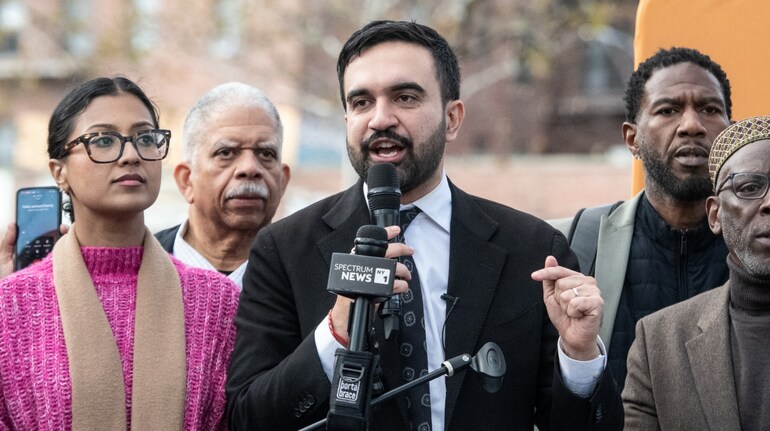
New York City’s mayoral election, once a routine contest about housing, crime, and public services, has transformed into a defining moment in America’s national political landscape. The city appears poised to elect Zohran Mamdani, a 34-year-old Democratic socialist and state assemblyman from Queens, as its next mayor, according to the latest polls. His expected victory has drawn fierce attention from Washington, particularly from President Donald Trump, who has openly warned that he could withhold federal funds if Mamdani wins.
Mamdani leads the race with around 41 to 43 percent of support among likely voters, ahead of former New York governor Andrew Cuomo, who is running as an independent with about 33 to 34 percent, and Republican candidate Curtis Sliwa, polling between 14 and 24 percent. A recent AtlasIntel survey showed Mamdani’s lead narrowing to seven points, but prediction markets such as Polymarket still give him a 94 percent chance of victory.
If elected, Mamdani would become New York City’s first Muslim mayor, a historic milestone in a metropolis celebrated for its diversity. Yet, his rise has triggered alarm within centrist Democratic circles and the conservative establishment alike. For many, this election has become a referendum on the ideological future of the United States, whether progressivism, centrism, or right-wing populism will define the coming political era.
A socialist on the verge of power
Mamdani’s ascent has been one of the most surprising developments in American politics this year. The son of Ugandan immigrants, he first entered public life as a state assemblyman, advocating for tenant rights, expanded public housing, and higher taxes on the wealthy. His campaign message, centered on reducing living costs and empowering working-class households, resonated deeply with younger voters and grassroots activists across the five boroughs.
“I sure hope it improves the city,” said Denise Gibbs, a 46-year-old physiotherapist who voted in Brooklyn. “I want to see it decrease divisiveness and increase livelihoods of working-class households and services for children.”
Mamdani’s appeal lies in his framing of New York as a city for “the many, not the few.” However, critics argue that his redistributive agenda could burden the city’s economy and drive away businesses. A J.L. Partners survey suggested that about 9 percent of New Yorkers -- around 765,000 people -- said they would “definitely” leave the city if Mamdani were elected, with another 25 percent “considering” it. Pollster James Johnson told the New York Post, “If anywhere near that number actually left, the economic impact would be seismic.”
Among high-income earners, 7 percent of those making over $250,000 a year said they would depart, while older residents and Staten Islanders were most likely to flee. Respondents described Mamdani’s New York as a “disaster,” “hell,” and a “sh–hole,” reflecting how sharply the city has become polarised.
Trump’s intervention: From threat to political theatre
While Mamdani’s campaign was already reshaping the Democratic Party, the contest became a national flashpoint after Donald Trump intervened. In a Truth Social post, Trump endorsed Andrew Cuomo, calling on voters to block Mamdani’s path to City Hall.
“If Communist Candidate Zohran Mamdani wins the Election for Mayor of New York City, it is highly unlikely that I will be contributing Federal Funds, other than the very minimum as required, to my beloved first home,” Trump wrote.
He expanded on that message in an interview with CBS’s 60 Minutes, saying, “I’m not a fan of Cuomo one way or another, but if it’s going to be between a bad Democrat and a communist, I’m going to pick the bad Democrat all the time, to be honest with you.”
Trump’s statements have fueled accusations of political blackmail and deepened the ideological rift surrounding the election. While the US president cannot unilaterally cut off funding to a city, the warning carried symbolic weight. For Trump, New York remains deeply personal—it is the city where he built his business empire but also where he has faced repeated rejection at the ballot box.
Mamdani wasted no time in responding. At a campaign event in Queens, he said, “What was rumoured, what was feared has become naked and unabashed -- the ‘MAGA’ movement’s embrace of Andrew Cuomo.” He added, “This funding is not something that Donald Trump is giving us here in New York City. This is something that we are, in fact, owed in New York.”
Syracuse University political science professor Grant Reeher told AFP that a Mamdani victory would likely provoke a “showdown” between the White House and City Hall. “Trump will treat New York City more aggressively,” he said. “There will be some kind of political showdown.”
A divided democratic party
Mamdani’s rise has also intensified the internal struggle within the Democratic Party. His win in the primary against Cuomo, once seen as the establishment favorite, emboldened progressives to push for more ideological purity. This has alarmed moderates who fear the leftward drift could alienate swing voters in future national contests.
Former President Barack Obama reportedly spoke with Mamdani ahead of the election but stopped short of endorsing him, reflecting the party’s unease with fully embracing the socialist wing. Cuomo, meanwhile, has attempted to rally centrist Democrats and independents, warning that Mamdani’s economic policies could destabilize the city’s finances.
What happens after election day
Polls close at 9 p.m. local time (6:30 a.m. Wednesday IST), and turnout is projected to reach about 1.9 million, potentially the highest for any mayoral race in more than five decades.
If Mamdani wins, the result will be interpreted far beyond New York’s borders. It would signal a resurgence of the progressive movement that has struggled to gain traction nationally since Bernie Sanders’ 2020 campaign. It could also set the stage for heightened conflict between New York City’s leadership and a Trump White House, should the president seek to make good on his threats.
“What India does matters to the world,” Finland’s President Alexander Stubb recently said in another context. A similar sentiment could apply to Mamdani’s victory: what New York does often matters to America. For now, the city stands at the crossroads of change, and its next mayor may determine not just the city’s future, but the direction of national politics itself.
Discover the latest Business News, Sensex, and Nifty updates. Obtain Personal Finance insights, tax queries, and expert opinions on Moneycontrol or download the Moneycontrol App to stay updated!
Find the best of Al News in one place, specially curated for you every weekend.
Stay on top of the latest tech trends and biggest startup news.