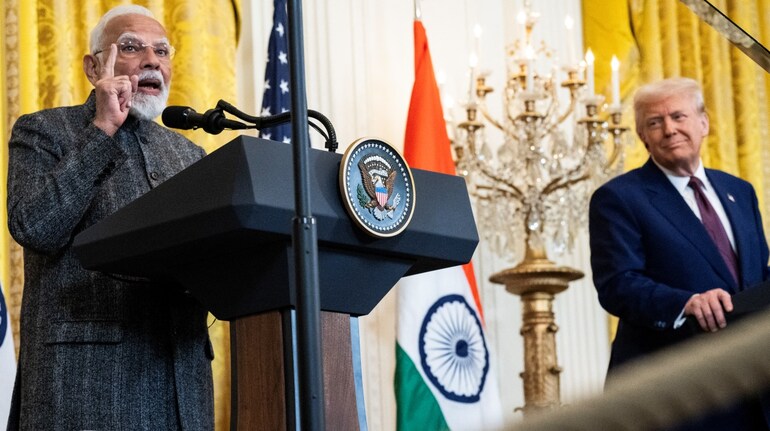
The India-US trade deal announced this week has quietly but decisively altered the balance of economic advantage in Asia. By cutting US tariffs on Indian goods to 18 percent, Washington has placed India in a far more competitive position than key regional rivals such as China and Pakistan. The shift not only improves India’s access to the world’s largest consumer market but also reinforces its status as a preferred economic partner for the United States at a time of global trade realignment.
The agreement was announced by Donald Trump after a phone call with Narendra Modi, marking a sharp turnaround from last year, when Indian exports were facing an effective tariff burden of up to 50 percent.
From penalty to preference
Until recently, Indian goods entering the US were hit by a 25 percent reciprocal tariff and an additional 25 percent punitive duty linked to India’s purchases of Russian crude oil. Together, these measures placed India among the most heavily taxed US trading partners.
That structure has now been dismantled. Under the new arrangement, the US will apply a single 18 percent tariff on Indian goods, removing the oil-related penalty and lowering the base rate.
Announcing the decision, Trump wrote on Truth Social, “Out of friendship and respect for Prime Minister Modi and, as per his request, effective immediately, we agreed to a trade deal between the United States and India, whereby the United States will charge a reduced reciprocal tariff, lowering it from 25 per cent to 18 per cent.”
Prime Minister Modi welcomed the announcement, calling it a boost for Indian manufacturing and exporters. “Wonderful to speak with my dear friend President Trump today. Delighted that Made in India products will now have a reduced tariff of 18 per cent,” Modi said, adding, “I look forward to working closely with him to take our partnership to unprecedented heights.”
Why India now outpaces China
The tariff gap between India and China remains wide and strategically significant. Chinese goods continue to face US tariffs ranging between 34 percent and 37 percent, reflecting a mix of baseline duties, fentanyl-related penalties and legacy trade measures.
For multinational companies pursuing China Plus One strategies, this differential matters. In price-sensitive sectors such as electronics, machinery, textiles and consumer goods, a tariff gap of nearly 20 percentage points can decisively influence sourcing decisions.
India’s lower tariff rate, combined with exemptions that still apply to pharmaceuticals, semiconductors and critical minerals, strengthens its appeal as a diversified manufacturing base rather than a narrow alternative to China.
At a time when US-China trade tensions remain unresolved, the India-US agreement sends a clear signal to global investors that New Delhi enjoys a more stable and predictable trade relationship with Washington.
How India pulls ahead of Pakistan
The contrast with Pakistan is equally stark. Pakistani exports to the US continue to face tariffs of around 19 percent, with no indication of relief or preferential treatment. Unlike India, Pakistan has not secured tariff reductions tied to broader strategic or economic commitments.
More importantly, the India-US deal embeds trade within a wider framework of energy cooperation, market access and long-term engagement. Pakistan, by contrast, remains largely outside Washington’s preferred trade architecture and continues to face concerns over economic instability and policy continuity.
In sectors where India and Pakistan compete directly, such as textiles and apparel, India’s lower tariff rate and larger production scale give it a decisive advantage in attracting buyers and shifting supply chains.
A boost for India’s export sectors
For Indian exporters, the impact is immediate and tangible. Industries operating on thin margins stand to benefit the most.
Textiles, garments and footwear are among the biggest gainers, where margins often range between 3 percent and 5 percent and tariff differences directly affect sourcing decisions. Engineering goods, which account for roughly a quarter of India’s exports to the US, also gain from improved price competitiveness.
Gems and jewellery, another high value export category, benefit from lower inventory and retail pricing pressures in the US market. Pharmaceuticals continue to enjoy tariff exemptions, reinforcing India’s position as a key supplier of affordable medicines.
Strategic signal beyond tariffs
Beyond numbers, the deal carries strategic weight. It places India closer to US allies such as Japan, South Korea and the European Union, all of which face tariffs of around 15 percent, while clearly separating India from higher tariff emerging economies.
Trump framed the agreement in geopolitical terms as well, writing that India’s shift away from Russian oil “will help END THE WAR in Ukraine, which is taking place right now, with thousands of people dying each and every week!”
While details of implementation are still awaited, the direction is clear. India has moved from being a pressure point in US trade policy to a partner with preferential access.
India’s advantage going forward
The trade deal also reinforces India’s broader global strategy. Coming days after the conclusion of a long awaited free trade agreement with the European Union, the US pact strengthens India’s position as a central player in reshaped global supply chains.
With US tariffs now lower than those applied to China, Pakistan, Bangladesh and Vietnam, India enjoys a rare alignment of cost competitiveness, market access and strategic trust.
As global companies reassess risk and reliability, the India-US trade deal has given New Delhi a clear upper hand in Asia’s trade hierarchy.
Discover the latest Business News, Sensex, and Nifty updates. Obtain Personal Finance insights, tax queries, and expert opinions on Moneycontrol or download the Moneycontrol App to stay updated!
Find the best of Al News in one place, specially curated for you every weekend.
Stay on top of the latest tech trends and biggest startup news.