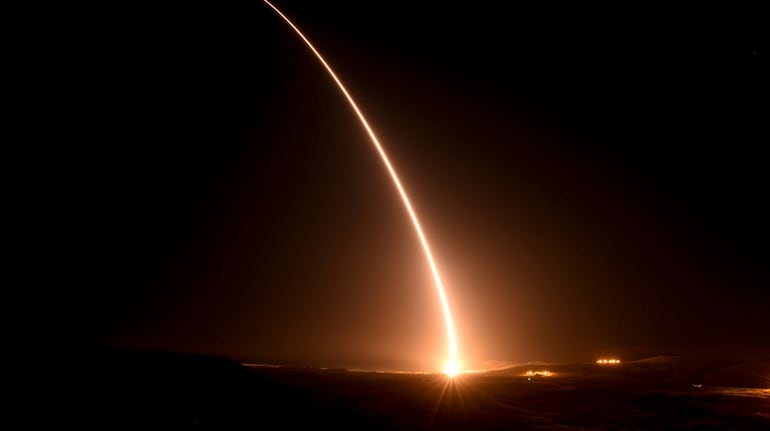

Fifteen days into the military confrontation between the United States, supported by Israel, and Iran, bombing has continued across Iranian territory and parts of West Asia.
In response to the strikes, Tehran has launched waves of low cost Shahed drones towards Israel and several Gulf states, targeting military bases and energy infrastructure across the region. The use of these drones has complicated the defensive response from the United States and its allies.
Washington has maintained that its operations are steadily weakening Iran’s ability to conduct attacks. However, the drone barrages have forced American and allied forces to rely heavily on defence systems that were originally designed to counter more sophisticated weapons.
The scale of the retaliation has raised questions over whether the United States had anticipated the extent of Iran’s response to the strikes that have killed more than 1,400 people in the country, including former supreme leader Ali Khamenei.
While US President Donald Trump has pressed Tehran for “unconditional surrender”, Iran has refused to comply. Instead, the conflict has widened into the Gulf, slowing the movement of oil and gas through the Strait of Hormuz and pushing global energy prices higher.
Former American officials and military analysts told the Financial Times that Iran has managed its campaign by combining intelligence inputs, satellite imagery, lessons learned from Russia’s wartime experience and its geographical proximity to US bases in the region.
According to analysts, low cost drones have played a central role in Tehran’s strategy. Iranian forces have launched more than 3,000 missiles and drones at US allies in the Gulf, in addition to hundreds directed at Israel.
Recent strikes have targeted tankers and merchant ships, an Omani port, areas near Dubai’s airport, an oil refinery in Abu Dhabi and Kuwait’s airport.
Many of these attacks have involved Iran’s one-way attack drones, such as the Shaheds. These drones are significantly cheaper than the missiles that advanced US defence systems are designed to intercept.
Powered by motorcycle engines, the drones carry warheads weighing between 25 and 50 kilograms. Some are reportedly built using lightweight materials such as styrofoam.
Their relatively simple construction allows them to be launched quickly, often from mobile rails mounted on pickup trucks, making them difficult to destroy before deployment. Experts told the Financial Times that the drones can strike precise targets using satellite navigation or even computer vision technology.
Unlike ballistic missiles, the drones fly at low altitudes and do not follow fixed trajectories. They can travel just above the surface of the Gulf, which reduces their visibility to radar systems.
Yuri Lyamin, from the Centre for Analysis of Strategies and Technologies, told the publication that Iran’s early attacks appeared to be aimed “primarily at blinding US forces and their allies in the region by destroying various radars”.
The lower cost and targeting accuracy of Iranian suicide drones allows them to be deployed in large numbers. To counter these threats, the United States and its regional partners rely on systems such as THAAD and Patriot to intercept missiles, rockets and drones launched by Iran and allied militias.
These defence systems depend heavily on radar networks to detect incoming threats. The equipment used in such systems is expensive and limited in supply. The conflict has also consumed a significant number of US interceptor missiles used to shoot down incoming attacks, the Wall Street Journal reported.
Military analysts say Iran has also drawn lessons from Russia’s deployment of versions of the Shahed drones during the war in Ukraine.
Lyamin told the Financial Times that Iran learned to launch drones toward the same target along different paths rather than sending them in tight groups, making them harder to intercept.
Some Iranian drones may also incorporate Russian technology designed to resist electronic jamming. Fabian Hoffman told the publication that such technology appears to have been integrated into certain models.
Experts also note that some of Iran’s most advanced weapons have not yet been deployed in the conflict. Iranian officials have repeatedly warned that more sophisticated missiles and drones remain unused.
Among them is the Qassem Basir, a hypersonic missile that uses optical guidance. However, analysts believe Iran possesses only a limited number of these systems.
Discover the latest Business News, Sensex, and Nifty updates. Obtain Personal Finance insights, tax queries, and expert opinions on Moneycontrol or download the Moneycontrol App to stay updated!
Find the best of Al News in one place, specially curated for you every weekend.
Stay on top of the latest tech trends and biggest startup news.