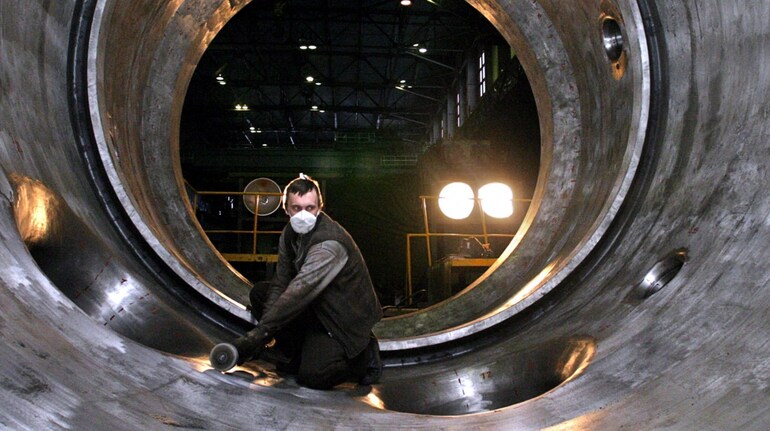
Russia’s President Vladimir Putin arrived in New Delhi for the 23rd India–Russia Annual Summit, and his first stop on the agenda was energy cooperation. The biggest highlight of that cooperation is the Kudankulam Nuclear Power Plant (KKNPP) in Tamil Nadu, India’s largest nuclear installation. As Putin stood beside Prime Minister Narendra Modi on Friday, he underlined how central the project has become to the partnership between the two countries.
Speaking at a joint press briefing, Putin called Kudankulam a “flagship project” and emphasised its importance in shaping India’s clean energy future. He said, “We are conducting a flagship project to build the largest Indian nuclear power plant, Kudankulam. Two out of six reactor units have already been connected to the energy network, and four are still under construction.” The Russian leader added that once fully operational, Kudankulam will make “an impressive contribution to the energy requirements of India.”
Kudankulam gets a boost as Unit 3 receives fuel
Putin’s arrival in India happened on the same day that the Russian state-owned atomic corporation Rosatom delivered the first batch of nuclear fuel for Unit 3 of Kudankulam. The shipment arrived on Thursday through a special cargo flight from Russia, which Rosatom described as part of an “uninterrupted” supply chain.
During delegation-level talks, Putin assured India that Russia remains committed to energy cooperation. He told Modi, “Russia is a reliable supplier of oil, gas, coal, and everything that is required for the development of India.” The delivery of fuel for Unit 3 is key because it allows engineers to start the initial loading of nuclear assemblies into the reactor core. This step leads toward “first criticality,” where a self-sustaining nuclear reaction begins, eventually allowing the unit to send power to the grid.
Rosatom has said the supplied fuel is more advanced than earlier generations. The new VVER-1000 units at Kudankulam will operate on 18-month fuel cycles, which means refuelling will be less frequent and outages will be shorter. Older reactors needed refuelling every 12 months. Longer fuel cycles translate into more consistent power generation and reduced operational costs.
What Kudankulam means to India
Kudankulam is located in Tirunelveli district in southern Tamil Nadu, and its scale makes it unique in India’s power landscape. When all six units are running, the plant will have a combined capacity of 6,000 MW. No other power project in the country, nuclear or non-nuclear, generates this much electricity from a single location.
Two units of 1,000 MW each are already operational. They have been supplying electricity to Tamil Nadu, Kerala, Karnataka, and Puducherry for years. Unit 3 is now entering the pre-commissioning phase, Unit 4 is progressing through construction, and Units 5 and 6 are at the civil works stage.
The project itself dates back more than three decades. Kudankulam was first agreed upon in 1988 during discussions between then Prime Minister Rajiv Gandhi and Soviet leader Mikhail Gorbachev. It survived the collapse of the Soviet Union, economic turmoil in Russia, and international efforts to limit civil nuclear cooperation with Moscow in the 1990s. Today, it is the only foreign-built nuclear plant in India that has reached full-scale electricity production. By comparison, nuclear projects involving the United States and France have been delayed due to pricing debates and unresolved liability concerns.
India’s nuclear expansion has become central to its “Net Zero by 2070” agenda. Nuclear power is seen as a reliable baseload source that supports the growth of renewable energy. Wind and solar power fluctuate depending on weather and daylight, but reactors maintain constant output. Officials at India’s power ministry view Kudankulam as critical to protecting the stability of the southern grid, which already has a high share of renewables.
Talks shift to future reactors: Russia pitches SMRs
Along with large reactors, Russia is also pushing cooperation in Small Modular Reactors (SMRs). SMRs are compact nuclear units, each producing up to 300 MW of power. They can be manufactured in factories and transported to installation sites, reducing construction timelines and cost overruns.
Rosatom promoted SMRs during the summit, arguing that they suit India’s industrial hubs and remote regions. The reactors can deliver round-the-clock electricity to energy-intensive industries such as steel or aluminium factories, and they can power regions where grid connectivity is limited. Rosatom chief Alexey Likhachev pointed to the Akademik Lomonosov, Russia’s floating nuclear power station, saying it is proof that SMRs already operate successfully in harsh environments.
The joint statement from the summit noted that both countries will “actively explore” localisation of SMR technology in India. This could mirror the successful BrahMos missile partnership, where Russian designs were produced in Indian facilities.
A partnership resistant to sanctions pressure
Western countries have imposed sanctions on Russia following the conflict in Ukraine, and they have urged India to scale back ties with Moscow. Yet the arrival of nuclear fuel for KKNPP’s Unit 3 shows that strategic cooperation remains unaffected. Russia and India have shifted to trading in rupees and roubles and are using alternative payment systems to bypass restrictions on dollar-based transactions. Putin highlighted that both nations value sovereignty in their foreign policy and described independent positions as “a source of stability in the world.”
As Unit 3 prepares for criticality in the coming months, the focus will turn to speeding up completion of the remaining reactors and preparing India for the next phase of nuclear cooperation. Whether through large reactors at Kudankulam or future SMRs built in India, Moscow remains deeply embedded in India’s energy journey.
Discover the latest Business News, Sensex, and Nifty updates. Obtain Personal Finance insights, tax queries, and expert opinions on Moneycontrol or download the Moneycontrol App to stay updated!
Find the best of Al News in one place, specially curated for you every weekend.
Stay on top of the latest tech trends and biggest startup news.