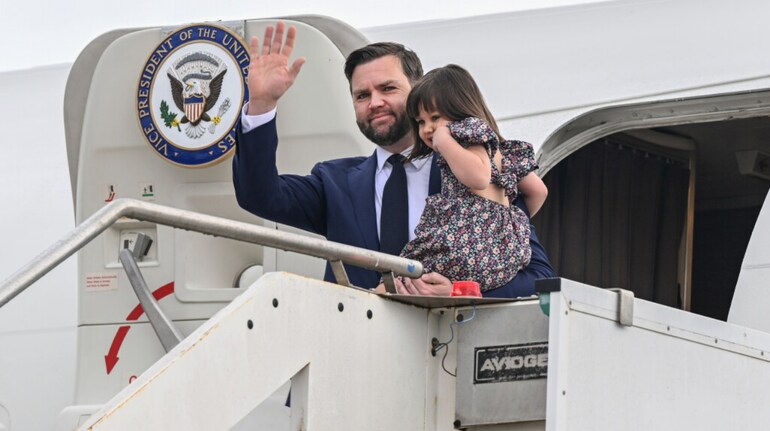
US Vice President JD Vance will be on a four-day visit to India beginning April 21, during which he will hold talks with Prime Minister Narendra Modi. Vance – on his first official visit to India – will be accompanied by his wife Usha Vance and their children.
The visit, coming at a critical juncture, is being closely watched by diplomatic and business circles alike. With the US locked in an intensifying tariff war with China and global supply chains being reshuffled, India is seen as a key alternative partner. Simultaneously, the Russia-Ukraine war continues to cast a long geopolitical shadow, and Washington is eager to align support among its allies—particularly from a balancing power like India.
Against this backdrop, Vance's discussions with Prime Minister Narendra Modi are expected to focus on finalising a bilateral trade pact, enhancing cooperation on migration and visa issues, and charting a joint strategy on emerging global conflicts.
What to expect from the visit?
Bilateral trade agreement: Discussions for finalisation of a comprehensive bilateral trade pact between the two countries is expected to top the agenda during Vance’s meeting with PM Modi. The agreement aims to bolster economic ties, enhance market access, and strengthen supply chain resilience. Given the current global trade environment, both countries are keen to establish a framework that mitigates tariff-related risks and promotes mutual growth.
India and the US agreed in February to work on the first phase of a trade deal to be concluded late this year, with a view to reaching bilateral trade worth $500 billion by 2030.
India is reportedly open to slashing tariffs on over half of the $23 billion worth of US imports in this first phase — potentially the biggest tariff cut in years.
Addressing immigration and visa policies: Immigration and visa policies, particularly those related to H-1B visas, F-1 visas and green cards, are likely to be a sensitive topic of discussion amid the Trump administration’s recent crackdown on foreign nationals, including Indians. India has long advocated for more favourable visa policies for its skilled professionals, who contribute significantly to the US economy.
Vance's recent remarks regarding green cards, where he stated that they do not confer an indefinite right to stay in the US, have raised concerns in India. This statement suggests a potential hardening of the US stance on immigration, which could complicate negotiations.
Navigating geopolitical challenges: Amid the US-China trade war, which has seen tariffs on Chinese goods rise to unprecedented levels, India emerges as a potential alternative for U.S. trade and investment. The bilateral discussions may explore opportunities for India to fill gaps left by reduced U.S.-China trade, particularly in sectors like agriculture and manufacturing.
Regarding the Russia-Ukraine conflict, India's position of neutrality has been a point of contention. While the US seeks broader international support against Russia, India maintains strategic ties with Moscow. The visit may involve dialogues on aligning positions and exploring avenues for collaborative peace efforts.
Indo-Pacific Strategy: The US views India as a vital partner in its Indo-Pacific strategy, aimed at maintaining a free and open Indo-Pacific region. Discussions on maritime security, regional stability, and counterterrorism are expected.
Vance's visit to India is poised to reinforce the strategic partnership between the United States and India. By addressing critical economic, immigration, and geopolitical issues, the visit seeks to chart a collaborative path forward amid global uncertainties.
Discover the latest Business News, Sensex, and Nifty updates. Obtain Personal Finance insights, tax queries, and expert opinions on Moneycontrol or download the Moneycontrol App to stay updated!
Find the best of Al News in one place, specially curated for you every weekend.
Stay on top of the latest tech trends and biggest startup news.