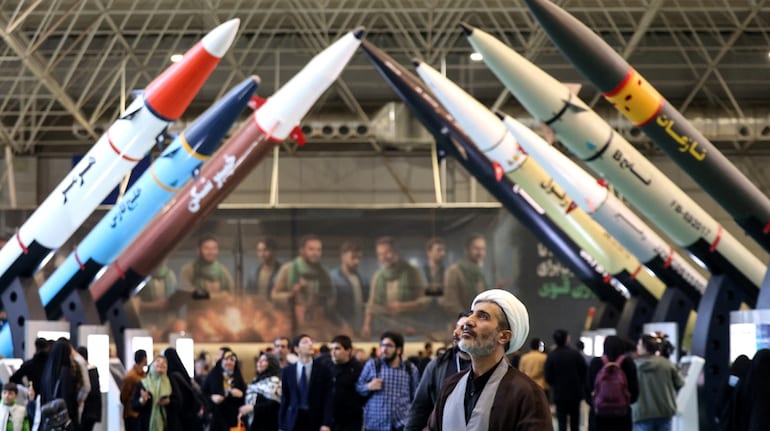

The Iran-Israel conflict entered a more dangerous phase on Saturday, with Iranian missiles striking areas near Israel’s main nuclear research hub, even as US President Donald Trump issued a 48-hour ultimatum to Tehran over the Strait of Hormuz.
Iranian missiles struck the southern Israeli cities of Dimona and Arad late Saturday, damaging buildings and injuring at least 64 people, according to rescue officials.
The strikes are significant for their proximity to Israel’s main nuclear research centre in the Negev desert.
Israel’s military said it failed to intercept the missiles, marking the first known breach of air defences in this sensitive zone.
Prime Minister Benjamin Netanyahu described it as a 'very difficult evening' as emergency crews were rushed to the sites.
Iran’s Parliament Speaker Mohammad Bagher Ghalibaf called the breach a sign the war is 'entering a new phase.'
The UN’s nuclear watchdog said it had received no reports of damage or radiation leaks at the facility.
Trump issues 48-hour ultimatum on Hormuz
Even as missiles hit Israel, Trump escalated pressure on Tehran from Washington.
In a social media post, he warned Iran to fully reopen the Strait of Hormuz within 48 hours, or face US strikes on its power infrastructure.
He said the US would begin destroying “various power plants, starting with the biggest one first.”
The Strait of Hormuz is one of the world’s most critical energy arteries:
Ongoing attacks and threats have already disrupted shipping, with tankers avoiding the route and producers cutting output due to blocked exports.
Conflict expands beyond the Middle East
In a sign of expanding reach, Iran also targeted the UK-US Diego Garcia military base in the Indian Ocean, about 4,000 km away.
The attack was unsuccessful, but its implications are significant.
Military experts say the strike suggests:
Israel’s army chief said Iran used a two-stage intercontinental ballistic missile, though Tehran has not confirmed this.
Natanz strike triggers retaliation cycle
The missile strikes followed an earlier attack on Iran’s Natanz nuclear enrichment facility, one of Tehran’s key atomic sites.
The back-and-forth underscores a rapid escalation cycle, with nuclear infrastructure now directly or indirectly in play.
Global pressure builds to secure oil flows
With Hormuz effectively disrupted, global pressure is mounting to restore shipping.
The UAE joined over 20 countries, including the UK, France, Germany and Japan, in signalling readiness to ensure safe passage.
The US has also:
Iran’s oil ministry said it has little crude left in floating storage, limiting immediate export increases.
Attacks spread across the region
The conflict is now spilling across multiple geographies:
Casualties continue to mount:
The US and Israel have offered shifting justifications for the war:
So far, there are no signs of internal uprising in Iran, and information flows remain restricted.
Iran’s leadership structure also remains opaque, with Supreme Leader Ayatollah Mojtaba Khamenei not seen publicly since assuming the role.
Discover the latest Business News, Sensex, and Nifty updates. Obtain Personal Finance insights, tax queries, and expert opinions on Moneycontrol or download the Moneycontrol App to stay updated!
Find the best of Al News in one place, specially curated for you every weekend.
Stay on top of the latest tech trends and biggest startup news.