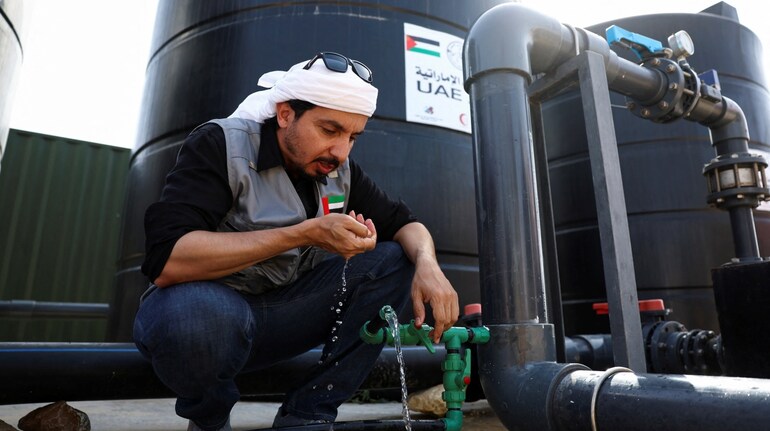

When one thinks of conflict in West Asia, oil often dominates the conversation. Tankers, pipelines and refineries are widely seen as the region’s most valuable assets. But there is another resource that is even more critical to daily survival. Water.
Decades ago, the Central Intelligence Agency identified potable water as the most crucial commodity in the Gulf. Today, that assessment appears more relevant than ever. As tensions escalate in the region, desalination plants, which convert seawater into drinking water, have emerged as both indispensable infrastructure and highly vulnerable targets.
What is desalination and why does it matter
Desalination is the process of removing salt and other impurities from seawater to make it safe for human consumption and agriculture. While the concept dates back to ancient civilisations, modern technologies such as reverse osmosis and thermal distillation have made it viable on a large scale.
In the Gulf, reverse osmosis is the dominant method because of its relatively higher energy efficiency.
This technology is not just a supplement. It is the backbone of water supply.
The Gulf countries, including Bahrain, Kuwait, Oman, Qatar, Saudi Arabia and the United Arab Emirates, are among the most water scarce regions in the world. With limited natural freshwater sources, they rely heavily on desalination to sustain their populations.
According to an Al Jazeera report, these countries produce roughly 40 per cent of the world’s desalinated water, operating more than 400 plants along their coastlines.
A 2023 report from the GCC Statistical Center estimates that the six Gulf states generate 7.2 billion cubic metres of freshwater annually through desalination. This translates to around 334 litres per person per day.
Dependence levels are striking. Around 70 per cent of Saudi Arabia’s drinking water comes from desalination. In Oman, Qatar and Kuwait, the figure rises to nearly 90 per cent. Major cities such as Dubai, Doha and Kuwait City are almost entirely reliant on desalinated water.
Michael Christopher Low, director of the Middle East Centre at the University of Utah, told AP that these nations should be viewed differently.
“Everyone thinks of Saudi Arabia and its neighbours as petrostates. But I call them saltwater kingdoms. They’re manmade fossil-fuelled water superpowers,” he said.
Why desalination plants are vulnerable in conflict
This heavy dependence makes desalination plants highly strategic assets.
Unlike oil infrastructure, which can sometimes be rerouted or substituted, water systems offer very limited flexibility. Most Gulf cities depend on a small number of large coastal desalination facilities.
This concentration creates a critical vulnerability.
Recent developments have already raised concerns. Bahrain has accused Iran of damaging a desalination plant, while Iran has claimed that a US strike hit a freshwater facility on Qeshm Island. Both sides have denied responsibility for attacks attributed to them.
Regardless of the claims and counterclaims, the incidents highlight a dangerous possibility. Desalination plants are now part of the conflict landscape.
What happens if a desalination plant is hit
Experts warn that the consequences of targeting desalination infrastructure would be immediate and severe.
Nima Shokri, director of the Institute of Geo-Hydroinformatics at the Hamburg University of Technology, told The Guardian that even a single successful strike could have far reaching effects.
“Targeting desalination plants could quickly create water shortages in several Persian Gulf states,” he said.
“Many cities depend on a small number of large coastal plants, meaning a successful strike could disrupt drinking water supplies within days. Unlike oil facilities, these plants cannot easily be replaced or repaired quickly. In extreme cases, governments could be forced to ration water for entire urban populations.”
The impact would not be limited to drinking water alone.
Water shortages would immediately affect hospitals, sanitation systems, firefighting capabilities, food production and schools. Within hours, governments could face immense pressure to manage a cascading crisis.
There is also a direct link between water and power.
A report cited by Asia Times explains that several Gulf countries rely on systems where desalination is integrated with electricity generation. An attack on intake systems, pumping stations or grid connections could disrupt both water and power supply simultaneously.
Psychological and political fallout
Beyond the physical damage, experts highlight the psychological impact of such attacks.
Naser Alsayed, an environmental researcher specialising in the Gulf, told Al Jazeera that the perception of risk itself can trigger instability.
“Water is essential to human life, and the perception of risk can cause fear and panic, which is particularly challenging in the current environment in the region, where authorities are working to maintain calm,” he said.
In highly urbanised Gulf societies, where populations depend almost entirely on desalinated water, even the threat of disruption can lead to panic buying, unrest and loss of confidence in authorities.
Legal questions around targeting water infrastructure
The targeting of desalination plants also raises serious legal concerns.
Under international humanitarian law, civilian infrastructure essential for survival is protected. Zinaida Miller, a professor of law and international affairs at Northeastern University, pointed to Article 54 of the Geneva Conventions.
“That you can’t attack objects indispensable to the survival of human life,” she said. “It’s pretty clear that that includes water installations.”
This means that deliberate attacks on desalination plants could be considered violations of international law.
A fragile lifeline under threat
As the conflict in West Asia continues, desalination plants have emerged as a critical but vulnerable lifeline.
While oil may drive the global economy, water sustains life on the ground. The Gulf’s transformation into modern urban hubs has been made possible by desalination.
As Auroop Ganguly, a Northeastern professor of engineering, warned, the stakes could not be higher.
“Oil built the Persian Gulf. Desalinated water keeps it alive. War threatens both.”
In a region already defined by scarcity, the targeting of water infrastructure risks turning a geopolitical conflict into a humanitarian crisis.
Discover the latest Business News, Sensex, and Nifty updates. Obtain Personal Finance insights, tax queries, and expert opinions on Moneycontrol or download the Moneycontrol App to stay updated!





Find the best of Al News in one place, specially curated for you every weekend.
Stay on top of the latest tech trends and biggest startup news.