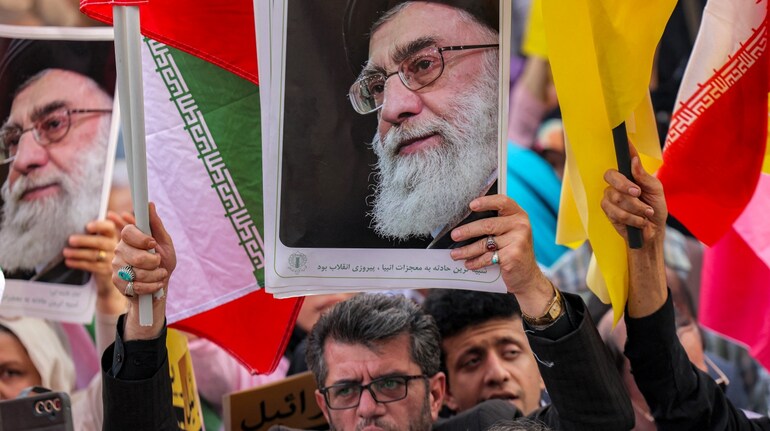
In a dangerous escalation following four days of hostilities with Israel, Iran has signalled it may withdraw from the Nuclear Non-Proliferation Treaty (NPT). The country said its parliament was preparing a bill to leave the nuclear Non-Proliferation Treaty (NPT), adding that Tehran remained opposed to developing weapons of mass destruction, reported Reuters.
Passing the bill could take several weeks but the move risks stoking deeper concerns about Iran's nuclear programme in Western countries which have long suspected Tehran wants to build nuclear weapons, a charge Iran denies.
"Government has to enforce parliament bills but such a proposal is just being prepared and we will coordinate in the later stages with parliament," said foreign ministry spokesperson Esmaeil Baghaei, when asked at a press conference about Tehran potentially leaving the NPT.
Earlier, Iranian President Masoud Pezeshkian reaffirmed that Iran has no intention of developing nuclear weapons, emphasizing the country's commitment to its right to nuclear energy and scientific research. He also reiterated Supreme Leader Ayatollah Ali Khamenei’s religious decree prohibiting weapons of mass destruction.
Passing the bill could take several weeks but the move risks stoking deeper concerns about Iran's nuclear programme in Western countries which have long suspected Tehran wants to build nuclear weapons, a charge Iran denies.
Iran’s potential departure from the NPT would be a seismic shift in global nuclear stability. It would mark a departure from decades of international agreements that have sought to contain the spread of nuclear weapons and prevent nuclear conflict.
What is NPT and why it is important
The Nuclear Non-Proliferation Treaty, signed in 1968 and enforced from 1970, is one of the world’s most critical arms control agreements.
The objective of the treaty is to halt the spread of nuclear weapons-making capability, guarantee the right of all members to develop nuclear energy for peaceful ends and - for the original five nuclear weapons powers - to phase out their arsenals.
The treaty defines nuclear-armed states as those that “manufactured and exploded a nuclear weapon or other nuclear device prior to January 1, 1967.” They are the United States, Britain, France, China and Russia, which assumed rights and obligations from the former Soviet Union. Those five nations are the permanent members of the UN Security Council.
A total of 191 countries are party to the NPT. Nuclear weapons states agree not to transfer those weapons or to help non-nuclear states obtain them.
Two non-signatories, India and Pakistan, developed nuclear weapons. Another, Israel, is widely assumed to have a nuclear arsenal but has not confirmed or denied it publicly.
North Korea signed the treaty in 1985 but announced its withdrawal in 2003 after U.S. officials confronted it with evidence they said pointed to a covert enrichment program. After a rapprochement, North Korea expelled IAEA inspectors again in 2009, and they have not returned since.
Escape Clause
The treaty is divided into 11 articles, including one that enables a state to withdraw "if it decides that extraordinary events ... have jeopardized the supreme interests of its country". A state must give three months' notice to other treaty members and the UN Security Council.
Why Iran leaving NPT is a serious threat
Iran has been a non-nuclear-weapon signatory to the NPT since 1970. It has a uranium enrichment program that it says is for peaceful purposes, not developing weapons, but Western powers and Israel suspect it intends to develop the means to make atomic bombs.
The declaration by the International Atomic Energy Agency's 35-nation Board of Governors on June 13 that Iran is in breach of its non-proliferation obligations was the first such decision in almost 20 years and followed a damning report that the IAEA sent to member states on May 31.
The resolution adopted by the board cited Tehran's "many failures to uphold its obligations since 2019 to provide the Agency with full and timely cooperation regarding undeclared nuclear material and activities at multiple undeclared locations in Iran".
A central issue of concern for the IAEA is Iran's failure to provide credible explanations of how uranium traces detected at undeclared sites in Iran came to be there despite the agency having investigated the issue for years. The IAEA believes they mostly point to activities carried out more than 20 years ago.
Iran's foreign ministry and atomic energy organisation said in response that the Islamic Republic had always adhered to its safeguards obligations. They said the IAEA's findings were politically motivated and lacked technical or legal foundation.
Asked at a press conference about Tehran potentially leaving the NPT, a foreign ministry spokesperson reiterated Tehran's official stance against developing nuclear weapons but said: "In light of recent developments, we will take an appropriate decision. Government has to enforce parliament bills but such a proposal is just being prepared and we will coordinate in the later stages with parliament."
If Iran withdraws from the NPT, the IAEA would lose access to Iranian nuclear facilities, halting inspections that have so far at least partially kept Iran’s program in check. Without international monitoring, Tehran would be free to enrich uranium and develop nuclear capabilities without accountability or transparency.
Although Iranian officials continue to insist they have no intention to build nuclear weapons, walking away from the world’s primary non-proliferation framework says otherwise. Exiting the NPT is widely seen as the first major step toward building a nuclear bomb. North Korea did the same in 2003, and tested its first nuclear weapon just three years later.
A nuclear-armed Iran would not only threaten Israel (which it frequently vows to destroy), but would likely push Saudi Arabia, Turkey, Egypt, and other regional powers to reconsider their own nuclear postures. This would destroy what little remains of nuclear restraint in the Middle East, a region already wracked by sectarian conflicts and proxy wars.
Israel, which sees Iran as an existential threat, is unlikely to sit idle if Tehran appears to be preparing for a nuclear breakout. Iran’s withdrawal from the NPT could trigger direct military action, with far-reaching consequences for the region. The risk of all-out war would spike.
Discover the latest Business News, Sensex, and Nifty updates. Obtain Personal Finance insights, tax queries, and expert opinions on Moneycontrol or download the Moneycontrol App to stay updated!
Find the best of Al News in one place, specially curated for you every weekend.
Stay on top of the latest tech trends and biggest startup news.