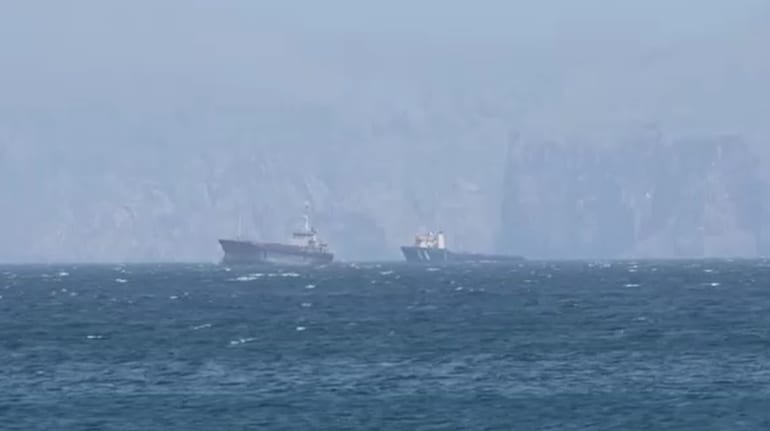
As the United States moves to clear suspected mines from the Strait of Hormuz, it is expected to rely on a mix of drones, explosive-laden robots and helicopters in an effort to reduce risks to personnel. However, defence specialists warn that mine-clearance crews could still remain vulnerable to potential Iranian attacks during operations.
The mission forms part of Washington’s broader attempt to secure the strategic waterway and restore shipping flows disrupted by Iran’s actions, which have sharply constrained global energy supplies since US and Israeli strikes on Iran at the end of February.
While modern technology allows for remote detection and disposal of mines, former naval officers say clearing a chokepoint such as the Strait of Hormuz remains a slow, methodical and multi-stage process.
The US military said over the weekend that mine-clearing operations had already begun, with two warships transiting the strait. It confirmed that additional assets, including underwater drones, would be deployed in the coming days, though it provided limited operational detail.
Reuters previously reported that Iran had deployed around a dozen mines in the strait, citing sources familiar with the matter, although the exact locations remain unknown.
US President Donald Trump said at the weekend that all Iranian minelaying ships had been sunk. However, experts caution that Tehran could still deploy further devices.
Mine warfare is particularly effective because it is inexpensive yet costly and complex to counter. “Even the threat of a minefield is enough to stop ships, especially commercial ships,” said Jon Pentreath, a retired British Rear Admiral and consultant.
From traditional sweepers to unmanned systems
Traditionally, the US Navy relied on manned minesweeping vessels entering suspected minefields, using sonar and mechanical gear to detect and remove explosives, often with diver support. Much of this older fleet has now been retired.
They have been gradually replaced by littoral combat ships equipped with semi-autonomous surface and underwater drones, alongside remote-controlled systems that allow crews to operate at safer distances. The US Navy currently has three such vessels deployed.
Two of these ships were undergoing maintenance in Singapore, a senior US official told Reuters in March. At that time, US mine-clearing assets in the Middle East included unmanned underwater vehicles, four Avenger-class ships, helicopters and divers.
The Navy and US Central Command declined to provide updated details on current capabilities in the region.
Detecting and neutralising hidden threats
Experts say Iran is believed to possess a range of naval mines, including bottom mines resting on the seabed, tethered mines anchored below the surface, drifting mines, and limpet mines attached directly to hulls.
The US operation is expected to rely heavily on unmanned surface and underwater vehicles equipped with sonar systems to detect suspicious objects. Once identified, data is relayed to crews operating outside the danger zone for verification and response.
Helicopters may also be deployed to spot mines closer to the surface, alongside autonomous sensors scanning key shipping routes.
To destroy mines, the US can use systems such as the Archerfish — a torpedo-shaped, remotely operated device carrying an explosive charge and transmitting video back to operators. It is designed to be expendable and costs tens of thousands of dollars.
Unmanned vessels towing sweeping equipment that triggers or collects mines could also be deployed, according to Bryan Clark, a retired US Navy officer and Hudson Institute fellow. Human divers may still be used in limited roles, including intelligence gathering.
Slow, dangerous and evolving mission
Clearing the Strait of Hormuz could take two to three weeks, Clark estimated, warning that Iranian interference could further delay operations and increase risks. He added that US forces would likely deploy protective measures, including ships and airborne drones, to shield clearance teams.
“Finding and destroying mines is very time consuming,” said US Admiral Daryl Caudle, chief of naval operations, in March, adding that such operations remain “vulnerable”.
New technologies are being developed to accelerate the process, particularly through improved sensor systems. French defence firm Thales says its latest sonar can scan suspected mines from multiple angles in a single pass, reducing the need for repeated sweeps.
Artificial intelligence is also increasingly being used to process data on board unmanned vessels.
Longer term, militaries hope to deploy coordinated fleets of autonomous systems capable of detecting, identifying and destroying mines in a single integrated process — though experts say that capability is still not operational.
“That doesn’t exist today,” said Mark Bock, a retired US Navy captain and vice president of business development at Thales’ US Navy division. “But it is what all nations are trying to achieve now.”
(With inputs from Reuters)
Discover the latest Business News, Sensex, and Nifty updates. Obtain Personal Finance insights, tax queries, and expert opinions on Moneycontrol or download the Moneycontrol App to stay updated!
Find the best of Al News in one place, specially curated for you every weekend.
Stay on top of the latest tech trends and biggest startup news.