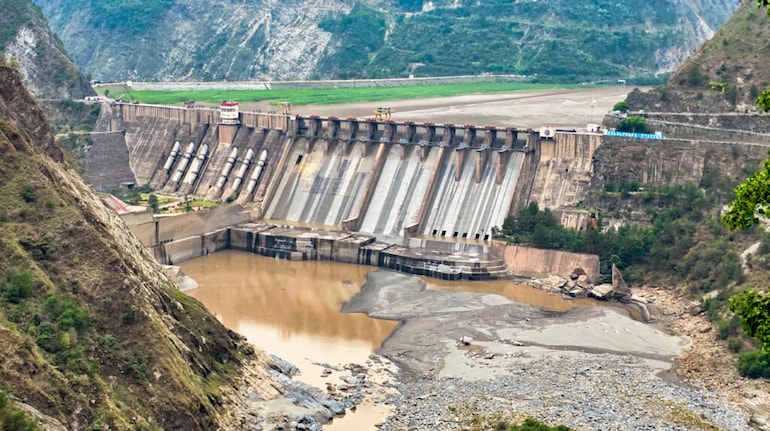
The Indian government has made its position crystal clear—the Indus Waters Treaty (IWT) will remain in abeyance. This announcement follows Pakistan’s recent signal that it is willing to hold talks on India’s long-standing concerns regarding the 1960 water-sharing agreement brokered by the World Bank. But for New Delhi, it appears to be too little, too late.
External Affairs Minister Dr S Jaishankar on Thursday emphasised India’s stance on IWT, saying it will be held in abeyance until Pakistan finds a solution to cross-border terrorism. “...The Indus Waters Treaty is held in abeyance and will continue to be held in abeyance until the cross-border terrorism by Pakistan is credibly and irrevocably stopped,” he said.
This diplomatic shift comes at a time when bilateral relations are at an all-time low following the Pahalgam terror attack, with India tightening both diplomatic and economic screws on Pakistan. At a time when Pakistan is reeling under domestic chaos and economic distress, the IWT suspension add salt to its wounds, posing a massive threat to its agriculture backbone, particularly in regions like Punjab and Sindh, which are heavily dependent on the Indus River System.
Experts, speaking to Moneycontrol, also maintained that India’s decision to continue suspending the Indus Waters Treaty was a strategically sound move. They argued that in the wake of repeated provocations, leveraging water as a tool of pressure sends a strong message without crossing into direct military escalation.
India’s strategic control over the upstream waters of the Indus river system has now emerged as a formidable pressure point in its diplomatic arsenal. Before we delve into how the prolonged suspension of the treaty could affect Pakistan, it’s important to revisit the origins and framework of the IWT—and why it has long been considered a cornerstone of India-Pakistan water-sharing diplomacy.
What is Indus Waters Treaty?
The IWT was signed in 1960 to settle a long-standing dispute between India and Pakistan regarding the use of waters from the Indus River system, a crucial lifeline for both countries, particularly Pakistan. Mediated by the World Bank, the treaty aimed at establishing an equitable way to share the river’s resources.
The agreement gave India control over the eastern rivers – Ravi, Beas and Sutlej – and Pakistan control over the western rivers – Indus, Jhelum and Chenab. While it allowed India to use western rivers for agriculture, hydropower and domestic use in a limited manner, New Delhi could not alter the flow of fivers or build storage systems that reduced Pakistan’s access.
Despite several wars and periods of hostility, the IWT survived as one of the few enduring pillars of India-Pakistan diplomacy. But over the years, India has raised repeated objections about Pakistan’s misuse of the mechanism, such as delaying approvals for Indian hydropower projects, politicizing technical issues, and failing to acknowledge acts of terror emanating from its soil.
The current freeze is not sudden, it’s the culmination of repeated Pakistani provocations, and India's growing resolve to weaponize water as a strategic lever.
Why India froze the treaty: A bigger picture
India’s decision to suspend the IWT must be seen in the context of an increasingly belligerent Pakistan, which continues to export terrorism across the border while playing the victim card internationally. From the 2016 Uri attacks to the 2025 Pahalgam carnage, Pakistan's state complicity in terror has drawn widespread condemnation, but little change in behaviour.
The suspension of the treaty signals a broader strategic doctrine – India is no longer willing to separate water diplomacy from national security concerns. The move is not just a message to Islamabad, it tells the international community that treaties cannot survive in a vacuum of trust.
Meanwhile, the IWT suspension also offers India the opportunity to fast-track long-pending projects on its side of the Indus basin, including dams and irrigation networks, which have been held up due to procedural constraints linked to the treaty.
Why Pakistan should be worried
Pakistan is one of the most water-stressed countries in the world. It relies on the Indus river system for more than 80 per cent of its agricultural needs, which in turn feeds over 60 per cent of its population and contributes over 20 per cent to its GDP. Well over 130 million Pakistanis are directly or indirectly dependent on the Indus River System for drinking water, irrigation, sanitation, and livelihood.
The suspension of the IWT, therefore, is not merely symbolic – it’s a dagger aimed at the country’s food security, economic stability, and internal cohesion.
Speaking to Moneycontrol, international conservative political and foreign policy expert Dr Suvrokamal Dutta said, “It will have a huge impact and it will be on a long-term basis. The economy of Pakistan will be devastated by stopping of water. Pakistan is an agricultural country and around 24-26 per cent of its GDP is contributed by agriculture. The major impact of this will be seen in Punjab province, Bahawalpur and Sindh. The way there is a huge food crisis going on in Pakistan, and food inflation there is almost around 26-27 per cent and GDP growth rate is 2.25 per cent. In such scenario, the stopping of water will have a cascading and devastating impact.”
According to US Department of Agriculture data (2015–2018 averages), the Punjab province – home to over 110 million people – alone accounts for 77% of Pakistan’s wheat production. Sindh contributes another 15%, while Khyber Pakhtunkhwa accounts for about 5%, and Balochistan just 3.5%. The heartland of Pakistan’s wheat belt is crisscrossed by rivers like the Chenab, Jhelum, Ravi, and Sutlej, all of which originate in India. This means any reduction or disruption in water flow would severely impact over three-fourths of Pakistan’s wheat output.
Districts along the Indus and its tributaries, including areas around Rawalpindi, Sialkot, Multan, and Bahawalpur, report the highest wheat production levels (ranging between 450 to 1,200 thousand metric tons). Central and Southern Punjab regions, shown in deep green on the map, would be particularly vulnerable if water shortages persist during critical sowing and harvesting windows.
Punjab – Pakistan’s food basked under threat
Punjab province, ironically sharing its name with its Indian counterpart, is the most fertile and agriculturally productive region of Pakistan. The province grows major staples like wheat, rice, and sugarcane and relies heavily on water from the Chenab and Jhelum rivers, both of which originate in India. Even a slight reduction in water flow during critical growing seasons could devastate crop yields, trigger price inflation, and foment unrest among farmers.
Sindh – Thirsty and Angry
The southern province of Sindh, home to Karachi and key industrial zones, is another victim in waiting. The Indus River is the lifeline of Sindh, especially its arid interior districts. The delta ecosystem, already endangered due to upstream diversions and poor water management, could collapse further, affecting fisheries, livelihoods, and biodiversity.
Domestic mismanagement adds fuel to the fire
Pakistan’s water crisis is not only India’s making. The country suffers from abysmal water governance, rampant canal losses, misallocation, and lack of storage. While India uses about 33 per cent of its annual water outflows from eastern rivers, Pakistan fails to store even a quarter of the western rivers’ bounty due to poor planning and corruption.
With no major dam constructed in decades, Pakistan’s water storage capacity has declined to just 30 days – far below the recommended 120 days for water-stressed nations. India, by contrast, stores enough water for over 200 days.
Can Pakistan turn to the World Bank or the UN?
Pakistan may try to raise the issue at international forums, accusing India of violating a binding treaty. However, it would be hard-pressed to win global sympathy when its own record on terror financing, cross-border infiltration, and failure to hold up diplomatic commitments is so stark.
Moreover, India has repeatedly cited Pakistan’s misuse of the treaty's dispute resolution mechanism, especially its push to involve neutral experts and courts on purely technical matters.
Speaking to Moneycontrol, analyst and Managing Partner at Ascendia Strategies, Amitabh Tiwary said Pakistan may attempt to rally global pressure on humanitarian grounds. “It will be interesting to see how India navigates this. New Delhi is strategically trying to corner Pakistan on three fronts — militarily, economically, and by restricting water flow. However, completely blocking the flow of water won’t be easy due to infrastructural limitations,” he noted.
“If India does consider softening its stance, it must negotiate a deal — securing something significant in return for releasing water,” he added.
Will India block all water?
India has not, and likely will not, violate international law by blocking or diverting all water flows. The focus instead is on using every permissible drop from the eastern rivers, building new hydropower projects on the western rivers, and asserting its right to manage water as per the IWT’s original terms.
Projects like the Pakal Dul dam, Kishanganga, and Ratle have been delayed by years due to Pakistani objections. With the IWT suspended, these may now proceed without diplomatic friction.
“Even with the existing dams, if India exercises strict control over water flow, it would significantly impact Pakistan,” he said. “Several major dam projects, previously stalled due to the constraints of the Indus Waters Treaty, have now resumed at full pace since Operation Sindoor. Within the next two years, construction is expected to be completed, giving India effective control over the Indus and its tributaries, essentially placing the keys to water distribution firmly in India’s hands,” Dutta told Moneycontrol.
The human cost
The implications of India’s suspension of the Indus Waters Treaty go beyond government offices, courtrooms, and dam blueprints.
More than half of Pakistan’s total population, potentially upwards of 150 million people, is exposed to the downstream effects of any significant disruption in the Indus system’s water availability. Even short-term interruptions during key agricultural seasons (Rabi and Kharif) could lead to: sharp drops in food production, surging inflation and food prices, rural unemployment, urban migration and water riots, and increased infant mortality due to waterborne diseases.
India’s suspension of the Indus Waters Treaty is a strategic and symbolic masterstroke, capitalizing on a broken bilateral relationship and Pakistan’s internal weaknesses. While New Delhi is within its rights to act, it is Pakistan that stands to lose the most - economically, socially, and politically.
Discover the latest Business News, Sensex, and Nifty updates. Obtain Personal Finance insights, tax queries, and expert opinions on Moneycontrol or download the Moneycontrol App to stay updated!
Find the best of Al News in one place, specially curated for you every weekend.
Stay on top of the latest tech trends and biggest startup news.