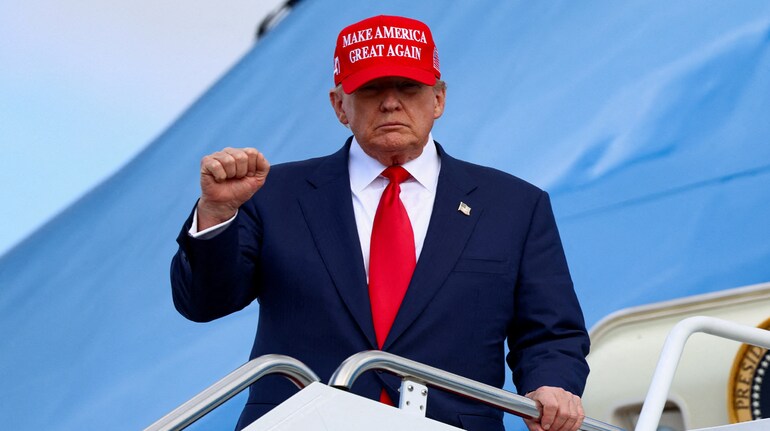
The Trump administration’s new National Security Strategy recasts how Washington sees the world, stripping away decades of rhetoric about defending democracy and replacing it with something far narrower: make money, curb migration and avoid judging authoritarian allies, the New York Times reported.
Released late Thursday, the 33-page document formalizes an approach President Trump has been signalling throughout his second term. Latin American governments are urged to steer big contracts to US companies. Gulf monarchies are treated less as human rights concerns and more as deep-pocketed partners. Taiwan and the Middle East are framed primarily in terms of shipping lanes, semiconductors and investment flows.
“We seek good relations and peaceful commercial relations with the nations of the world,” the document says, “without imposing on them democratic or other social change that differs widely from their traditions and histories.”
That is a sharp break from Trump’s own first-term strategy, which cast global politics as a struggle “between those who favour repressive systems and those who favour free societies.” The new version omits any call to defend democracy abroad and avoids describing Russia as an adversary.
A reality check or a retreat from values?
Supporters see the strategy as overdue realism. Critics see it as an abdication of US leadership.
Dan Caldwell, a former advisor to US Defence Secretary Pete Hegseth who advocates military restraint, praised the document as a “true break” from the bipartisan foreign policy consensus after the Cold War. For too long, he argued, Washington was guided by “delusion” about what US power could achieve through force. By contrast, he said, this is a “reality-based” framework focused on narrower interests.
Democrats and many traditional allies read it very differently. Representative Gregory Meeks of New York, the top Democrat on the House Foreign Affairs Committee, said the strategy “discards decades of values-based US leadership in favour of a craven, unprincipled worldview.”
European officials reacted with alarm, particularly to the section that portrays the continent as facing “civilizational erasure” from immigration and accuses mainstream governments of “trampling” democracy to suppress opposition. Former Swedish prime minister Carl Bildt wrote that the document “places itself to the right of the extreme right in Europe.”
From Monroe Doctrine to no-bid contracts
Nowhere is the profit-first approach more explicit than in the Western Hemisphere. The strategy calls for reasserting and enforcing the Monroe Doctrine “to restore American pre-eminence,” and it tells US diplomats to prioritize finding “major business opportunities,” especially government deals.
For countries that “depend on us most,” the document says, Washington should press for sole-source, no-bid contracts that go directly to American firms. In the Middle East, it urges an end to what it calls “misguided” US efforts to prod Gulf monarchies toward political reform. The region is described instead as “a source and destination of international investment.”
The paper also nods to Trump’s reluctance to confront powerful autocrats. It fits with his recent “things happen” remark about the killing of a Saudi journalist in 2018 and his broader willingness to downplay rights abuses by partners he sees as useful.
Restraint, Venezuela and a different map of priorities
The strategy stresses a “predisposition to non-interventionism” and calls for avoiding new military entanglements. Yet it also hints at possible action closer to home. Without spelling out a plan for Venezuela, it suggests shifting US military resources from other regions into Latin America “to address urgent threats in our hemisphere.”
Caldwell noted that many “America First” figures are wary of a regime-change war in Venezuela, but he argued that events there deserve more focus than control of the Donbas region in eastern Ukraine. That line underscores the document’s reordering of priorities, with the Western Hemisphere elevated and eastern Europe largely downgraded.
Russia, China and a softer tone on rivals
Compared with earlier strategies, especially Trump’s own 2017 version, the new paper takes a milder view of great-power competition. It drops language that said China and Russia “want to shape a world antithetical to US values and interests.” Instead, it calls for an “expeditious cessation of hostilities in Ukraine” as a US core interest and speaks of restoring “strategic stability with Russia” while preserving Ukraine as a “viable state.”
China appears mainly as a commercial rival. War over Taiwan is to be deterred because of its “major implications for the US economy,” particularly in semiconductors and trade routes. The document calls for a “genuinely mutually advantageous economic relationship” with Beijing, echoing the tone of the trade truce Trump and Xi Jinping announced in October.
Jonathan Czin, a former National Security Council official on China policy under President Biden, said the new strategy offers “a happier message for Beijing” than either Biden’s or Trump’s first-term blueprint. He noted that the emphasis on Latin America and the absence of ideological confrontation are likely to be seen in China as relatively good news.
A snapshot of Trump’s world view
The National Security Strategy is not legally binding and presidents do not always follow their own documents. But because it is typically issued once per term, it serves as a snapshot of how an administration wants to be understood.
In this case, the picture is clear: a United States that downplays democracy promotion, sidelines human rights concerns and defines its role abroad through the lenses of migration control, economic leverage and transactional deals, rather than the post-Cold War language of a global “force for freedom.”
Discover the latest Business News, Sensex, and Nifty updates. Obtain Personal Finance insights, tax queries, and expert opinions on Moneycontrol or download the Moneycontrol App to stay updated!
Find the best of Al News in one place, specially curated for you every weekend.
Stay on top of the latest tech trends and biggest startup news.