




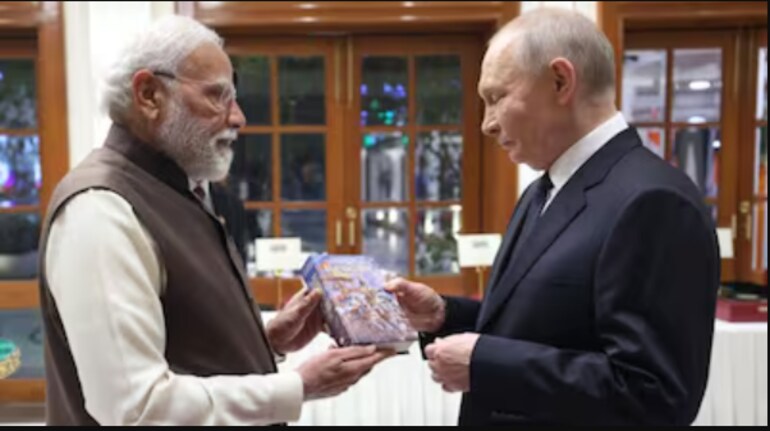
The relationship between India and Russia is steeped in history, extending back to modern historical times with deep cultural and intellectual links. During Russian President Vladimir Putin’s visit, Prime Minister Narendra Modi presented him with a copy of the Bhagavad Gita translated into Russian, symbolising the profound Sanskrit connection shared between the two nations.
St Petersburg emerged as Europe’s premier centre for Sanskrit studies in the 18th century. After a Russian traveller returned from India, the Emperor sanctioned the establishment of a Sanskrit printing press, laying the foundation for academic engagement with Indian languages and philosophy.
Scholar Gerasim Lebedev, who lived in Calcutta between 1785 and 1797, studied Indian society, culture, and language, promoting the study of India in Russia. Earlier, Russian merchant Afanasii Nikitin had visited India from 1469 to 1472, predating Portuguese and English arrivals.
By 1822, Lebedev became a Professor of Oriental Languages, marking the formal beginning of Sanskrit studies in Russia. Pioneers such as Robert Khristianovich Lenz (1808-1836), Otto Böhtlingk, and Pavel Yaknovlevich Petrov (1814-1875) advanced Sanskrit scholarship, particularly at Kazan University, setting the stage for Europe’s understanding of Indian languages.
Böhtlingk compiled a monumental seven-volume Sanskrit-German lexicon in St Petersburg, which remains a vital resource for scholars worldwide. Russian Indologists were also explorers: Ivan Minayev travelled extensively across India and Nepal, collecting rare Sanskrit and Pali manuscripts, enriching Russian academic collections. Later, Fyodor Stcherbatskoy became a global authority on Buddhist and Hindu philosophical texts, further cementing St Petersburg’s status as a hub for Indology.
Lenz taught Sanskrit at Kazan University and corresponded with German scholar Bopp on translating Sanskrit dramas. Böhtlingk studied Panini’s grammar, and Bolenzen published works on Sanskrit and Buddhism in Europe. Petrov translated parts of the Mahabharata and Kalhana’s Rajtaringini, eventually leading the Sanskrit Department at Moscow University, where he also published Sanskritskaya Grammatikа in 1865.
PM Modi’s gift of the translated Bhagavad Gita underscores this long-standing cultural and scholarly bond, reflecting not only a strategic partnership but also centuries of shared intellectual heritage between India and Russia.
Discover the latest Business News, Sensex, and Nifty updates. Obtain Personal Finance insights, tax queries, and expert opinions on Moneycontrol or download the Moneycontrol App to stay updated!
Find the best of Al News in one place, specially curated for you every weekend.
Stay on top of the latest tech trends and biggest startup news.