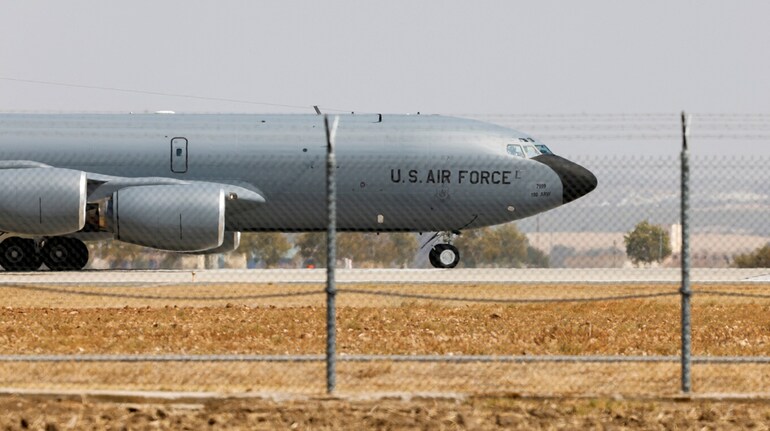

A US Air Force KC-135 Stratotanker crashed in Iraq while supporting operations connected to the Iran conflict, briefly pulling the spotlight onto a type of aircraft that rarely attracts public attention.
Reports by The Sunday Guardian and other international outlets confirm the tanker was flying as part of a refuelling mission tied to ongoing US military operations in the region. Tankers like the KC-135 are constantly in the air during such campaigns, quietly supporting fighters, bombers and surveillance aircraft.
They rarely appear in dramatic combat footage. Yet without them, many of those aircraft would not even reach their targets.
The aircraft that keeps fighters flying
The KC-135 Stratotanker, built by Boeing, first entered service with the US Air Force in the late 1950s. Its role was simple: refuel other aircraft while both are flying.
Its capability to do both things at once changed how air forces operate. Fighters no longer had to stay close to their bases. With tanker support, they could travel far greater distances and remain in the air much longer.
During conflicts in the Middle East, including the current US operations linked to Iran, tankers often orbit in designated areas while fighter jets cycle through to take fuel before continuing their missions.
According to the US Air Force, aerial refuelling allows American aircraft to operate across vast distances without constantly landing and taking off from forward bases.
What the aircraft costs
The KC-135 is no longer being built today. Most of the aircraft still flying were produced decades ago during the Cold War.
According to aviation data cited by Global Aircraft and US defence aviation databases, historically, the aircraft’s cost was around USD39 million when it was built. If the same aircraft were produced today with modern systems, analysts say the price would likely fall between USD70 million and USD80 million, though that depends mostly on upgrades and equipment.
That is still far below the cost of the tanker replacing it. The KC-46 Pegasus, the newer aircraft entering US Air Force service, costs more than USD150 million per aircraft, according to US defence procurement data.
How fast and how far it can fly
Despite its age, the KC-135 remains a capable aircraft. US Air Force official fact sheet shows the tanker has a top speed of around 530 miles per hour and can fly missions covering about 11,000 miles, depending on the amount of fuel it carries and transfers.
It typically operates with four crew members: a pilot, co-pilot, navigator and boom operator.
The aircraft itself is quite large at around 136 feet long with a wingspan of about 130 feet, and it can operate at altitudes close to 50,000 feet.
How mid-air refuelling actually happens
The most distinctive feature of the KC-135 is its refuelling boom, a long movable tube mounted under the rear of the aircraft.
During refuelling, the receiving aircraft flies behind the tanker while the boom is guided into a small receptacle on the aircraft that needs refuelling.
Once connected, fuel flows from the tanker into the receiving aircraft’s tanks.
It is a delicate operation. Both aircraft must maintain tight formation while travelling at high speed.
Later versions of the tanker, especially the KC-135R, were fitted with more efficient engines that improved fuel economy and increased the amount of fuel the aircraft could transfer during missions.
A Cold War aircraft still flying today
The aircraft entered US Air Force service in 1957, yet hundreds remain operational today.
The reason is simple: aerial refuelling remains essential, and the aircraft has proven reliable. Unlike fighters or bombers, tanker aircraft do not become obsolete as quickly because their basic mission does not change dramatically.
As long as aircraft need fuel in the air, tankers will remain indispensable.
The tanker fleet’s future
The US Air Force has begun gradually replacing the KC-135 with the KC-46 Pegasus, a more modern tanker based on the Boeing 767.
But replacing an entire tanker fleet takes time and money. For now, the KC-135 continues to fly missions across the world, including in regions like the Middle East.
The aircraft few people notice
In military aviation, military pilots swear by tankers, and say without them many missions simply would not be possible.
For more than 60 years, the KC-135 Stratotanker has quietly played that role, enabling operations thousands of kilometres from home while rarely being noticed by anyone outside the military.
Discover the latest Business News, Sensex, and Nifty updates. Obtain Personal Finance insights, tax queries, and expert opinions on Moneycontrol or download the Moneycontrol App to stay updated!
Find the best of Al News in one place, specially curated for you every weekend.
Stay on top of the latest tech trends and biggest startup news.