




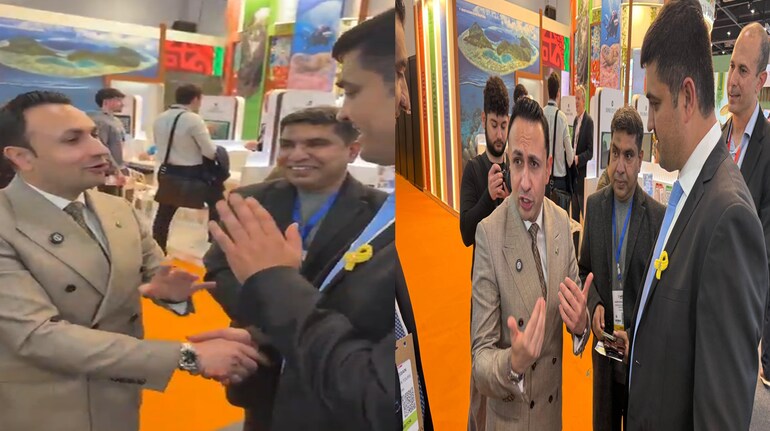
A brief encounter at a global travel fair in London has triggered political uproar in Pakistan and renewed questions about Islamabad’s evolving strategic posture — particularly as United States President Donald Trump promotes a new regional plan involving an International Stabilisation Force for Gaza.
The incident comes at a time when Pakistan is already being mentioned in diplomatic discussions surrounding Trump’s proposed ceasefire architecture, raising the stakes of any perceived engagement with Israel.
How the London incident unfolded
Earlier this month, delegations from more than 180 countries gathered at the World Travel Market (WTM) in London — one of the world’s largest tourism conferences. The 2025 edition was held from 4 to 6 November.
During the event, a video circulating on social media showed Michael Izhakov, Director General of Israel’s Ministry of Tourism, approaching the Pakistani pavilion and greeting Sardar Yasir Ilyas Khan, Adviser and National Coordinator to the Prime Minister of Pakistan on tourism.
The two briefly exchanged pleasantries, and the cordial nature of the interaction immediately triggered speculation. Because Islamabad and Tel Aviv have no formal diplomatic relations — and Pakistan legally bars its citizens from travelling to Israel — even an informal encounter quickly assumes political significance.
Though Israel’s attendance at WTM was routine, the friendly exchange stood out as Pakistan has never publicly acknowledged official-level contact with Israeli representatives. This comes on top of reports that several Pakistanis, including journalists and educators, had visited Israel this year despite the travel prohibition.
המפגש הישראלי – פקיסטני המפתיע ביריד התיירות בלונדון. במהלך יריד התיירות WTM בלונדון, מנכ"ל משרד התיירות הישראלי, מיכאל יצחקוב, תועד בביתן של פקיסטן המוסלמית שאין לה יחסים עם ישראל, כשהוא לוחץ את ידו של יועצו של ראש ממשלת פקיסטן לענייני תיירות, סארדאר יאסיר איליאס ח'אן. כזכור,… pic.twitter.com/LmzkEgj0tr— roi kais • روعي كايس • רועי קייס (@kaisos1987) November 12, 2025
What Pakistan’s tourism adviser said
As the footage gained traction, Yasir Ilyas Khan released a clarification denying prior awareness of whom he was meeting.
According to his statement, “During the event, a group of individuals from Israel visited the Pakistan Pavilion unannounced and met the Pakistani delegation without introducing themselves.” He stressed that the delegation’s visit to London was self-funded and focused strictly on tourism promotion.
Islamabad’s response: ‘Without authorisation’
At the Foreign Office’s weekly briefing, spokesperson Tahir Hussain Andrabi was repeatedly pressed on whether the interaction indicated a shift in Pakistan’s long-standing stance on Israel.
He stated, “I can assure you that if at all such a meeting or such an interaction took place, it was without authorisation, certainly without information to us and certainly without authorisation by the government.”
Andrabi emphasised that the Foreign Ministry had not approved nor been informed of any contact with Israeli officials. He also dismissed commentary linking the London exchange to broader strategic alignments such as the Abraham Accords, calling such conclusions “too far-fetched”.
He further clarified that Pakistani individuals reportedly travelling to Israel had done so without government permission and in violation of passport regulations.
Political reactions within Pakistan
The video prompted strong backlash, especially from political groups with firm positions on Palestine. Former Jamaat-i-Islami senator Mushtaq Ahmed Khan condemned the exchange on X, writing:
“Shaking hands with the killers of Palestinians is a betrayal of Al-Aqsa, Gaza, and the Palestinians. The handshake, meeting, and conversation during the international exhibition in London between Sardar Yasir Ilyas, Advisor to the Prime Minister of Pakistan on Tourism, and Michael Izhar-Kov, Director General of Israel’s Ministry of Tourism.”
Describing the moment as “shameful”, he warned that “the nation will not forgive the traitors of the Palestinian people.”
The sharp reaction underscores Pakistan’s deeply rooted public sentiment regarding Palestine, where any suggestion of softening toward Israel tends to provoke powerful criticism.
Pakistan’s possible role in the Gaza stabilisation plan
The controversy unfolded as reports circulated that Pakistan might be considered for the International Stabilisation Force (ISF), an initiative central to Trump’s Gaza ceasefire plan. The ISF would be tasked with securing territories, facilitating humanitarian efforts, and helping restore basic civil administration once hostilities end. Many proposed participants are Muslim-majority states.
Andrabi confirmed that Pakistan and Jordan “cooperate closely on multilateral issues, including Palestine,” and said Gaza would likely feature in discussions during King Abdullah II’s visit to Islamabad. However, he cautioned that “no decision has been taken on Pakistan’s participation.”
He added that the UN Security Council had yet to finalise the mandate for the force, describing it as “an ongoing process.”
Unverified reports have suggested Pakistan could contribute around 20,000 troops and that General Asim Munir recently held meetings in Egypt with Mossad and CIA officials — claims Islamabad has not confirmed.
Defence Minister Khawaja Asif previously said deliberations were still “in process”, and Andrabi stressed that any troop deployment would require approval from parliament and the highest state institutions.
Why Pakistan matters in Washington’s calculus
Trump’s administration has increasingly looked to Pakistan as a potential partner in reshaping regional geopolitics. Islamabad’s participation in Gaza stabilisation or regional infrastructure projects could influence dynamics involving Iran, China, and India.
Reports indicate Pakistan offered the US a port in Pasni, near the Iranian border, potentially serving American strategic interests. Washington has also moved toward designating the Baloch Liberation Army as a Foreign Terrorist Organisation, a step that could facilitate US commercial operations in mineral-rich Balochistan.
Yet analysts warn that any American presence in the region risks destabilising Pakistan’s already fragile security environment, particularly given BLA-linked insurgency and China’s massive investments under the China–Pakistan Economic Corridor.
Pakistan reaffirms its Palestine position
Despite speculation, Islamabad has restated its core stance:
Pakistan does not recognise Israel
It supports a sovereign Palestinian state along pre-1967 borders
It recognises East Jerusalem as the rightful Palestinian capital
It also signed a recent declaration with 14 nations criticising Israeli legislative moves in the West Bank, and publicly denied reports of altering its passport restrictions regarding Israel.
Discover the latest Business News, Sensex, and Nifty updates. Obtain Personal Finance insights, tax queries, and expert opinions on Moneycontrol or download the Moneycontrol App to stay updated!
Find the best of Al News in one place, specially curated for you every weekend.
Stay on top of the latest tech trends and biggest startup news.