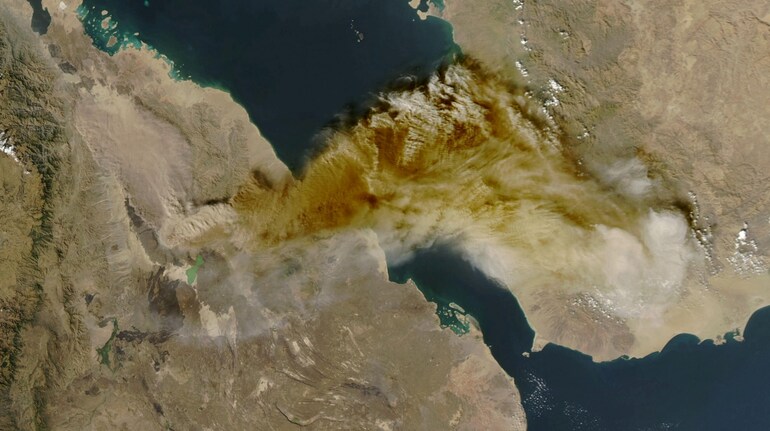
A volcano that had remained inactive for nearly 12,000 years has suddenly erupted in north-eastern Ethiopia, raising concerns among scientists and disaster monitoring agencies worldwide. The Hayli Gubbi volcano, located in the Afar region near the Eritrean border, burst into life on Sunday and sent towering ash clouds nearly 14 kilometres into the sky.
The ash plume spread across large parts of the Middle East and South Asia, reaching Yemen, Oman, India and northern Pakistan. The eruption lasted several hours and originated in the Rift Valley, a geologically fragile zone where tectonic plates slowly pull apart, making it prone to seismic and volcanic activity.
According to the Smithsonian Institution’s Global Volcanism Program, Hayli Gubbi has had no confirmed eruptions during the Holocene period, which began around 12,000 years ago after the last Ice Age. That makes this event rare and scientifically significant.
This dramatic eruption has renewed focus on a critical question. What exactly are dormant volcanoes and could other silent giants wake up in the future?
What is a dormant volcano
A dormant volcano is one that is not currently erupting but still has the potential to do so. Unlike extinct volcanoes, which are considered geologically dead, dormant ones are simply resting. They may remain inactive for hundreds or even thousands of years before suddenly reawakening.
These volcanoes often show subtle warning signs such as underground tremors, heat emissions, or gas releases. These signals indicate that magma still exists below the surface.
Well-known examples of dormant volcanoes include Mount Fuji in Japan, Mount Kilimanjaro in Tanzania, and the Yellowstone Caldera in the United States. Each has gone long periods without eruptions but is still considered capable of becoming active.
Why monitoring dormant volcanoes is crucial
Dormant volcanoes can erupt with little warning, making them extremely dangerous. A major example is Mount Pinatubo in the Philippines, which erupted in 1991 after more than 500 years of inactivity. The eruption caused massive loss of life and altered global climate patterns.
Apart from being scenic landmarks and tourist attractions, dormant volcanoes can pose serious risks to nearby populations. That is why scientists closely track them using seismic sensors, satellite imaging, temperature monitoring and gas detection tools. These methods help identify early signs of renewed activity and allow governments to issue timely warnings.
Dormant volcanoes that could pose major threats
While Hayli Gubbi has captured global attention, it is not the only dangerous dormant volcano. Several others around the world are closely watched due to their destructive potential.
Mauna Loa in Hawaii has erupted 33 times since 1843, with its last major activity in 1984. It is one of the most monitored volcanoes on the planet due to its massive size and frequent activity.
Mount Kilimanjaro, often called Africa’s Sleeping Giant, stands at 19,341 feet in Tanzania. It has been dormant for around 3.6 million years. Scientists are concerned that rapidly melting glaciers could indicate underlying geothermal changes that might lead to renewed activity.
Mount Fuji in Japan last erupted in 1707 but its proximity to Tokyo, one of the world’s largest cities, makes it especially dangerous if it becomes active again.
Mount St. Helens in the United States is known for its devastating 1980 eruption. It has been quiet since 2008 but remains under constant observation due to ongoing geological activity.
Italy’s Mount Vesuvius, which destroyed Pompeii and Herculaneum in 79 AD, has been dormant since 1944. Its location near Naples puts millions of people at potential risk.
Mount Etna in Sicily is considered Europe’s most active volcano. It erupted significantly in 2021 and continues to influence the regional climate and landscape.
Mount Rainier in the United States is known for its massive glaciers that could trigger deadly mudflows in the event of an eruption. Scientists have labelled it America’s “Time Bomb” due to the catastrophic damage it could cause.
Mount Taranaki in New Zealand has been dormant since 1850. Though admired for its perfect cone shape, experts warn it could unleash a powerful eruption affecting much of the North Island.
Mount Tambora in Indonesia caused one of the deadliest eruptions in history in 1815, leading to the “Year Without A Summer”. If it erupts again, its effects could be global, impacting climate and food supplies.
Mount Pelée in Martinique last erupted in 1902, killing over 30,000 people. Though currently silent, it is considered highly dangerous due to its explosive history.
Why this eruption is a warning for the world
The reactivation of Hayli Gubbi shows that even volcanoes silent for thousands of years can suddenly return to life. It highlights the need for continuous global monitoring and improved disaster preparedness, especially in regions situated near tectonic fault lines.
While volcanoes play an important role in shaping landscapes and enriching soil, their destructive power far outweighs their scenic appeal when they awaken without warning.
The Ethiopian eruption is not just a geological event. It is a reminder that the planet’s most silent giants can still disrupt air travel, climate patterns, human settlements and ecosystems in ways few disasters can match.
As scientists continue to study Hayli Gubbi, the global community is once again forced to confront a simple reality. Dormant does not mean safe. It only means waiting.
Discover the latest Business News, Sensex, and Nifty updates. Obtain Personal Finance insights, tax queries, and expert opinions on Moneycontrol or download the Moneycontrol App to stay updated!
Find the best of Al News in one place, specially curated for you every weekend.
Stay on top of the latest tech trends and biggest startup news.