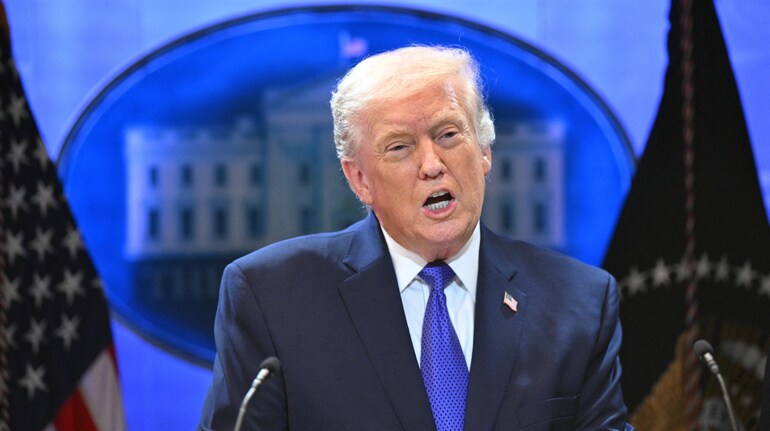

A debate has erupted in Washington over whether the United States’ military campaign against Iran is legally justified. The question is being examined both under US constitutional law and under international law, as lawmakers and legal experts argue over whether President Donald Trump exceeded his authority in ordering the strikes.
At the same time, members of Congress are attempting to assert their role in decisions about war.
Senate vote seeks to curb Iran campaign
US lawmakers moved toward a vote on a bipartisan war powers resolution that aims to halt the ongoing military operations against Iran unless Congress explicitly approves them.
The effort, led mainly by Democrats and supported by a few Republicans, is framed by its sponsors as an attempt to reclaim Congress’ constitutional authority over declarations of war.
"I do think it's really important to put every member of Congress on the record about this," Democratic Senator Tim Kaine of Virginia said during a press call ahead of the vote.
Kaine also challenged lawmakers who avoid taking a clear position on military action. "If you don't have the guts to vote 'Yes' or 'No' on a war vote, how dare you send our sons and daughters into war where they risk their lives?"
Despite the push, the measure faces significant obstacles. Republicans currently control narrow majorities in both chambers of Congress and have blocked similar attempts to limit Trump’s war powers before.
Republican leaders have also accused Democrats of politicising national security issues.
House Speaker Mike Johnson argued that restricting the president mid-operation could be dangerous. "Imagine a scenario where Congress would vote to tell the commander-in-chief that he was no longer allowed to complete this mission. That would be a very dangerous thing," he said after receiving a classified briefing on the conflict.
Even if the resolution clears the Senate, it would still need approval from the House and a two-thirds majority in both chambers to override a likely presidential veto.
Trump says the strikes were pre-emptive
The administration has defended the military action by saying it was necessary to stop a potential Iranian attack.
President Trump said he believed Iran was preparing to strike and that the US acted to eliminate what he described as an imminent threat. However, he has not publicly provided detailed evidence, and some of his claims have reportedly not been supported by US intelligence assessments.
Trump also argued that Iran was close to acquiring a nuclear weapon, suggesting the country could develop one within a month. That statement contradicted his earlier assertion in June that the US military had already "obliterated" Iran’s nuclear programme.
US Defence Secretary Pete Hegseth described the campaign in sweeping terms, calling it "the most lethal, most complex and most-precision aerial operation in history."
What the US Constitution says about war powers
Under the US Constitution, the president serves as commander-in-chief of the armed forces and directs foreign policy. However, the authority to declare war belongs exclusively to Congress.
Because of that division of power, legal experts say large-scale military action without congressional approval can raise constitutional concerns.
Historically, Congress has authorised major conflicts through formal legislation. For instance, lawmakers approved the military campaigns launched by President George W. Bush in Afghanistan in 2001 and Iraq in 2003.
Critics of the current Iran strikes say the absence of such authorisation means the operation could stretch the limits of presidential authority.
The War Powers Resolution and the 60-day limit
Another key law governing the use of US forces abroad is the War Powers Resolution of 1973.
The legislation was designed to restrain unilateral presidential military action. It allows the president to send troops into combat only under certain circumstances: if Congress has declared war, if lawmakers have provided specific authorisation, or if the United States or its forces are under attack.
The law also requires the administration to regularly inform Congress about military operations.
Crucially, the War Powers Resolution states that military action undertaken without congressional approval must stop within 60 days unless Congress votes to extend it.
It also gives lawmakers a mechanism to compel the withdrawal of US forces from a conflict.
How international law views the strikes
Beyond US domestic law, the legality of the attacks is also being debated under international law.
Legal experts say many countries may view the strikes as inconsistent with the United Nations Charter, which generally prohibits the use or threat of force against other states.
There are limited exceptions. Military force may be used if it is authorised by the UN Security Council or if a country acts in self-defence after being attacked.
Another concept sometimes cited is pre-emptive self-defence, which could justify a strike if there is clear evidence of an imminent and overwhelming threat.
However, critics argue that neither condition has clearly been demonstrated in the current conflict.
The legal question around Khamenei’s killing
The death of Iran’s Supreme Leader Ayatollah Ali Khamenei has added another layer to the legal debate.
Reports indicate that Israel conducted the strike that killed him while the United States provided intelligence and operational assistance.
US policy has long prohibited assassinations. In 1981, President Ronald Reagan signed Executive Order 12333, banning anyone working for the US government, or acting on its behalf, from carrying out such acts.
However, legal experts note that the issue becomes more complex during wartime.
While the targeted killing of a leader might be considered assassination in peacetime, it could be treated as a lawful military action if it occurs during an armed conflict and the individual is regarded as a military commander.
Because of these legal grey areas, the question of whether the strike was lawful depends largely on how the conflict itself is legally defined.
(With inputs from Reuters)
Discover the latest Business News, Sensex, and Nifty updates. Obtain Personal Finance insights, tax queries, and expert opinions on Moneycontrol or download the Moneycontrol App to stay updated!
Find the best of Al News in one place, specially curated for you every weekend.
Stay on top of the latest tech trends and biggest startup news.