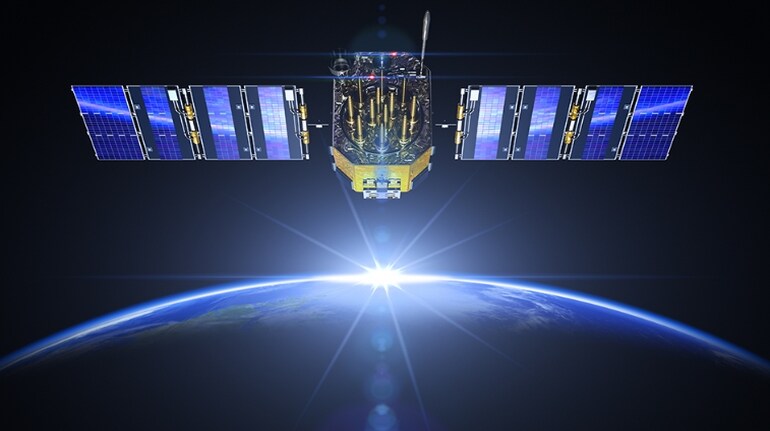

Reports in recent days say Chinese researchers have built a compact power system designed to drive a high-power microwave weapon, a type of directed energy technology that can disrupt electronics without physically blowing a target apart. Chinese media have framed it as a potential threat to low Earth orbit satellite constellations such as Starlink, which have become strategically important in modern conflicts.
The device most often mentioned is the TPG1000Cs, linked to the Northwest Institute of Nuclear Technology in Xi’an and its high-power microwave research lab. In simple terms, it is described as the “engine” that would feed intense microwave pulses into a weapon system. Multiple reports claim it can reach peak power levels of around 20 gigawatts for up to 60 seconds, and fire thousands of pulses in a session. Some accounts also say the system has been put through endurance testing totalling roughly 200,000 pulses.
A big part of the hype is the size. Earlier high-power microwave set ups tend to be bulky, which limits mobility. These reports describe a roughly 4-metre-long unit weighing about five tonnes, small enough in theory to be mounted on a truck or ship, and some coverage goes further and speculates about airborne or space-based deployment.
What would it actually do to a satellite. High power microwave attacks are generally aimed at frying, glitching, or temporarily disabling electronics by dumping electromagnetic energy into circuits. That is different from a missile based anti-satellite strike, which creates debris and is easy to attribute. Directed energy options are often discussed as “non kinetic” counterspace tools because they can be reversible in some scenarios, harder to prove quickly, and potentially scalable.
Still, it is worth keeping a cool head about capability claims. Peak power numbers do not automatically translate into real-world effectiveness against satellites moving fast in orbit. To have an impact, you need targeting precision, enough energy delivered at the right frequency, and you have to deal with atmospheric losses for ground-based systems and shielding on the satellite. Independent verification is limited, and most of what is circulating comes via secondary reporting on Chinese publications and a research paper said to have appeared in a Chinese journal.
The bigger story is the direction of travel. As mega constellations expand and become central to communications, navigation, and battlefield connectivity, governments are investing heavily in ways to jam, spoof, hack, dazzle, or disable space assets. This latest “Starlink killer” framing fits that broader counterspace race, whether or not the most dramatic claims hold up.
Discover the latest Business News, Sensex, and Nifty updates. Obtain Personal Finance insights, tax queries, and expert opinions on Moneycontrol or download the Moneycontrol App to stay updated!
Find the best of Al News in one place, specially curated for you every weekend.
Stay on top of the latest tech trends and biggest startup news.