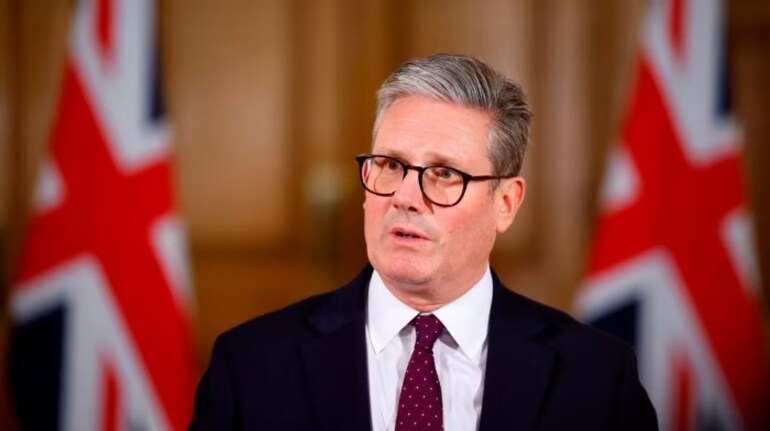
Prime Minister Keir Starmer heralded a “landmark deal” between the UK and the European Union on Monday that he billed as a reset moment for relations under his government. Still, with many details unresolved, Brexit never quite seems to be over.
Starmer said an agreement to ease border checks on agri-food products would drive down prices at supermarkets and add some £9 billion ($12 billion) to annual GDP by 2040. For its part, Brussels secured 12 years of ongoing access to British fishing waters on existing terms following a late concession from the UK.
Starmer sold the deal as a “win-win.”
The mood music in the gilded hall of Lancaster House was warm and positive, with European Commission President Ursula von der Leyen praising the “leadership” of her “dear Keir,” and both leaders sending a message to Moscow that they were united in the face of Russia’s ongoing invasion of Ukraine.
Yet beyond those limited tangible outcomes, the remainder of the “renewed agenda” unveiled at a summit in London amounted to an agreement to keep negotiating. Talks in the weeks leading up to the event were often fraught and ran down to the wire, with much ultimately left unfinished.
“Today’s announcement has created the momentum to advance our vital economic partnership,” BusinessEurope Director General Markus J. Beyrer said. “We now need to see real progress on making it easier to trade in goods and services,” he added. “We should also strive to facilitate the short-term mobility of professionals.”
Indeed, the two sides agreed only to “work towards” a youth visa program that could facilitate the travel of students and young workers between Britain and the continent. The EU had been disappointed that the UK wasn’t more ambitious at this meeting, while Starmer, determined not to be seen doing anything to increase immigration, insisted any such program would be capped and time-limited. Exactly how many young people from the EU will be allowed to come to the UK and for how long will be determined in future negotiations.
Airport Queues
While the UK publicly claimed it had scored a victory by securing the right of British citizens to use e-gates in EU countries — something that could end long passport queues which have become a frustration since Brexit — the text described only their “potential use where appropriate.”
Starmer was later forced to concede to reporters that he wasn’t sure if Britons would be allowed to use EU e-gates on their holidays this summer, with the details still to be thrashed out.
Similarly, a defense and security pact committed to “swiftly explore” UK access to the EU’s new €150 billion ($169 billion) defense fund, with no confirmation on when that might happen, what conditions would be attached, or how much Britain would have to pay for its companies to be involved. Von der Leyen suggested it could take “weeks” to answer those questions. Again, Starmer was unsure.
As such, there seemed to be a gulf between the grandiose rhetoric used by the UK government to sell the deal and its likely impact on the economy.
Downing Street has in recent days tried to forge a narrative of Starmer as a globe-trotting deal-maker, appearing to borrow from the high-tempo announcements of President Donald Trump to claim he had signed three “trade deals” in two weeks with India, the US and the EU. “Deals that will grow our economy, putting more money in the pockets of working people,” the premier argued on Monday.
Yet while it’s true that Starmer concluded a free trade agreement with New Delhi, it is likely to add no more than 0.1% to UK economic output in the long run, according to Bloomberg Economics calculations. The outline of an agreement with the US may have reduced some tariffs but it was well short of an FTA, and while the agri-food agreement with the EU should deliver a gain for the British economy, even by the government’s own numbers it is only likely to translate to around 0.2% of GDP.
The reality is that while the UK’s red lines on declining to join the EU’s single market or customs union remain, and the EU continues to refuse to allow any cherry-picking of the most attractive aspects of membership without the trade-offs on free movement of people, any reset of ties was always going to be limited.
The agreement contains little about services, which dominate the UK’s economy, and no agreement was reached to recognize professional qualifications. The deal paves the way for Britain to join the bloc’s electricity market, however, and to link up the UK and EU’s carbon markets.
Political Realities
Starmer has learned a lesson: it is not easy negotiating with the EU. The UK had originally been prepared to extend fishing arrangements with the EU by no more than four years, causing Brussels to insist on an equivalent time-limit on the sanitary and phytosanitary deal. Eventually the EU dropped that latter demand, but only after
Starmer had agreed to lengthen the fishing deal to 12 years.
“Everyone will either present it as a great deal that will boost economic growth, or a sell out. And it’s not really either of those things,” said Raoul Ruparel, former UK Brexit negotiator who is now a director at Boston Consulting Group. “A few helpful bits, but none of those really make a material economic difference — other than the SPS stuff in the agricultural sector, it doesn’t really affect many businesses.”
Looming behind Starmer is the specter of Brexit campaigner Nigel Farage, now leader of the Reform UK party which is currently leading opinion polls. Farage told Bloomberg Starmer’s deal on fisheries “will be the end of the industry,” a precursor to attacks he can be expected to make on the Labour government as he targets its working class heartlands in the years to come. That’ll be front and center of the prime minister’s mind in his future talks with the EU, especially on migration.
Discover the latest Business News, Sensex, and Nifty updates. Obtain Personal Finance insights, tax queries, and expert opinions on Moneycontrol or download the Moneycontrol App to stay updated!
Find the best of Al News in one place, specially curated for you every weekend.
Stay on top of the latest tech trends and biggest startup news.