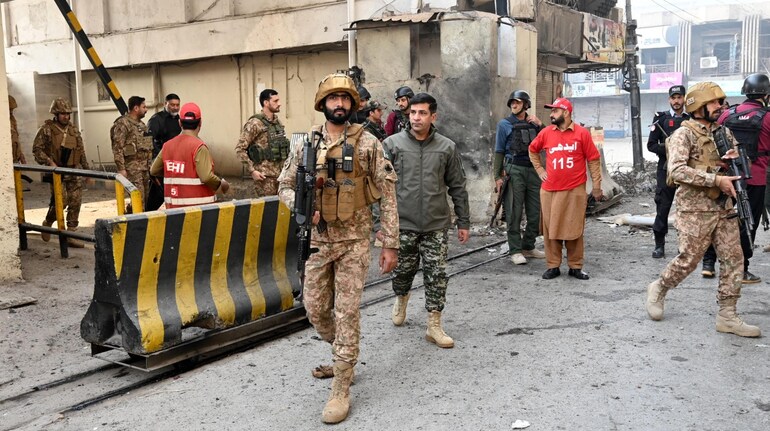

The 2026 Global Terrorism Index presents a paradox. Terrorism deaths worldwide have dropped sharply, yet Pakistan has emerged as the country most affected by terrorism, underlining a deepening crisis that stands in contrast to global trends.
According to the report by the Institute for Economics and Peace, global terrorism deaths fell 28 percent between 2024 and 2025, dropping to 5,582, the lowest level in years. Attacks also declined by nearly 22 percent. Eighty-one countries recorded improvements, suggesting what appears to be a rare moment of global respite.
But Pakistan is moving in the opposite direction.
“Pakistan was the country most impacted by terrorism this year, the first time it has been ranked at number one on the Index. It has been ranked among the ten countries most impacted by terrorism every year since the inception of the Index,” the report said.
Pakistan’s crisis deepens despite global decline
Pakistan recorded 1,139 terrorism-related deaths and 1,045 incidents in 2025, its worst toll in over a decade. Even as the world saw a decline in violence, Pakistan witnessed a 6 percent rise in deaths, making it a clear outlier.
The data points to a worsening internal security situation rather than a temporary spike. Incidents in Pakistan are now six times higher than in 2020, reflecting a sustained deterioration.
The Tehrik-i-Taliban Pakistan has emerged as the primary driver of this surge. The group carried out 595 attacks and caused 637 deaths in 2025, marking its deadliest year since 2011. The Global Terrorism Index ranks it as the third deadliest terror group globally after Islamic State and Jamaat Nusrat al-Islam wal-Muslimeen.
“The Taliban’s rise to power in Afghanistan profoundly impacted Pakistan’s security and stability. It provided the TTP with the means and motivation to significantly expand their geographic reach and operational efficiency, resulting in a considerable rise in violent extremism in the region,” the report noted.
Blowback from Pakistan’s own policies
The current crisis is deeply tied to Pakistan’s long-standing strategy of backing militant groups for strategic depth. The return of the Taliban in Afghanistan in 2021 has reversed that equation, with militant groups now using Afghan territory as a base to launch attacks inside Pakistan.
“Pakistan has experienced a significant increase in terrorist activity since the Taliban’s rise to power in Afghanistan in 2021. Militant groups operating from Afghanistan have continued to intensify their attacks, particularly along the Pakistan Afghanistan border,” the report said.
The TTP has also modernised its tactics, expanding the use of drones and improving coordination across regions. Violence has been concentrated in Khyber Pakhtunkhwa and Balochistan, which together account for over 74 percent of attacks and 67 percent of deaths.
The Balochistan Liberation Army has added another layer of instability, with high profile attacks such as the hijacking of the Jaffar Express near Quetta, where hundreds were taken hostage.
Asim Munir’s failure to contain the threat
The surge in terrorism raises serious questions about the effectiveness of Pakistan’s military leadership under Army Chief General Asim Munir. Despite repeated claims of restoring stability, the security situation has deteriorated significantly.
Under Munir’s tenure, Pakistan has not only failed to curb the TTP but has also seen the group expand its operational reach and lethality. The inability to secure borders with Afghanistan and prevent cross border infiltration highlights structural weaknesses in Pakistan’s counterterrorism approach.
More concerning is the escalation of tensions with Afghanistan itself. Pakistan has now entered open conflict with the Taliban regime, launching airstrikes on Kabul and Kandahar in February 2026. This has further destabilised the region and created conditions that militant groups are exploiting.
Instead of containing terrorism, Pakistan’s actions have contributed to a cycle of escalation that is strengthening extremist networks.
A region moving ahead without Pakistan
Pakistan’s trajectory stands in stark contrast to the broader South Asian region. India recorded a 43 percent drop in terrorist attacks and continued a decade-long improvement in its security profile. Bangladesh saw a complete elimination of attacks in 2025, while Nepal recorded zero incidents for the third consecutive year.
Even Afghanistan, despite remaining unstable, saw a decline in recorded attacks after the Taliban consolidated power.
This divergence underscores Pakistan’s unique position as the only major country outside Africa where terrorism is rising sharply.
Global gains may not last
Despite the global decline, experts warn that the improvement may be temporary. The report highlights emerging risks including renewed Islamic State activity, mass prison breaks, and escalating geopolitical conflicts.
“The convergence of a Pakistan Afghanistan conflict, an emboldened IS, the rapid radicalisation of younger recruits, and a fragmented political climate in the West suggests that 2025’s decline may prove a temporary reprieve for many countries, rather than the beginning of a sustained downward trend,” the report noted.
Sub-Saharan Africa remains the global epicentre of terrorism, accounting for over half of all deaths, but Pakistan’s rise to the top spot signals a worrying shift.
A dangerous outlier
Pakistan today represents a dangerous contradiction. At a time when much of the world is seeing a reduction in terrorism, it is experiencing a surge driven by internal failures, policy blowback, and regional instability.
The country’s inability to control groups it once nurtured, combined with weak governance and escalating conflicts, has turned it into the global epicentre of terrorism.
Unless there is a fundamental shift in strategy, Pakistan risks remaining trapped in a cycle of violence that not only threatens its own stability but also undermines security across the region.
Discover the latest Business News, Sensex, and Nifty updates. Obtain Personal Finance insights, tax queries, and expert opinions on Moneycontrol or download the Moneycontrol App to stay updated!
Find the best of Al News in one place, specially curated for you every weekend.
Stay on top of the latest tech trends and biggest startup news.