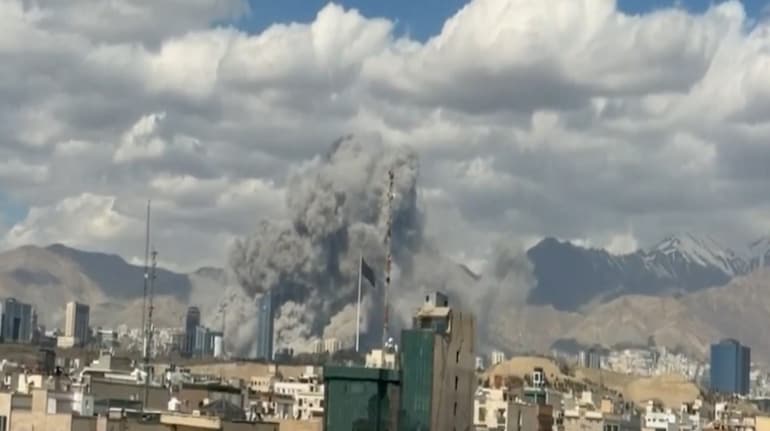

With tensions escalating between US-Israel and Iran and both sides refusing to take a step back and come to the negotiating table, questions have risen whether the war in West Asia has the potential to turn into World War 3.
Though the US, Israel and Iran were the key players in the conflict, a rapid escalation of missile and drone attacks over the last week has embroiled several countries into the war.
US President Donald Trump has already rejected claims that Israel maneuvered Washington into war with Iran and that US acted first as it feared Tehran was preparing to strike. He also said US would not stop till it has 'obliterated' Iran's military structure and it no longer has the capability to enrich its nuclear facilities.
Iranian diplomat Abdul Majeed Hakeem Ilahi said that it was US which started the war in the first place as it does not want developing countries such as India and China to emerge as global powers. The Iranian envoy also said that the onus to stop the war lay on Washington.
In an interview with The Atlantic magazine, Trump said Iran’s new leadership wanted to resume negotiations and that he has agreed to talk to them. However, Iran’s security chief Ali Larijani rejected the prospects of resuming negotiation, saying that Tehran has no plans to engage in talks with the Trump administration.
The Israel-Iran war, now in its sixth day, has not only rattled the global economy but has also deepened fears of a wider war in which many other countries may get involved. Here's a look at some of the countries which are supporting US or have expressed that they may get involved in the conflict.
UK
The UK government, led by Prime Minister Sir Keir Starmer, made it clear that it did not participate in the initial offensive military strikes, jointly launched by US and Israel, against Iran as it 'did want to see further escalation into a wider regional conflict.' The UK also agreed to let the US use some British bases for defensive purposes linked to counter-missile operations.
Australia
Prime Minister Anthony Albanese and Foreign Affairs Minister Penny Wong issued a joint statement shortly after the US–Israel strikes began saying Australia supports the US acting to prevent Iran from obtaining a nuclear weapon and threatening regional peace. It has not joined the war militarily, but supports defensive coordination with allies.
Alongside its support, Australia has called for a reduction in tensions and de-escalation of the conflict, emphasizing the need to involve Gulf states and find a diplomatic path forward.
Canada
Canadian Prime Minister Mark Carney criticised the US-Israeli strikes on Iranian territory as inconsistent with international law as they were carried out without engagement with the United Nations or consultation with key allies.
Carney said Canada welcomed steps aimed at preventing Iran from obtaining nuclear capabilities but would have preferred had those steps been taken within legal and diplomatic frameworks.
Calling for de-escalation and peace, Carney said though Canada has not participated in the offensive actions so far, it cannot categorically rule out future military participation in the conflict.
Gulf countries
Countries like Saudi Arabia, UAE, Qatar, Bahrain, Kuwait, and Oman are under Iranian attack and have bolstered their air defenses or warned they may take legitimate defensive action, but have not committed to offensive operations against Iran.
Turkey
According to Reuters, Turkey saw an Iranian ballistic missile enter its airspace (intercepted by NATO defenses). While Turkey has not declared it will enter the war, its air defenses were activated and NATO forces were involved, raising fears of regional escalation with a NATO member’s territory impacted.
Iraq
As per Associated Press, Kurdish Iran-dissident groups in northern Iraq have stated they are preparing for potential operations against Iran — reportedly with some US discussions — which would broaden the war beyond the core states.
Where India stands?
India has not joined the conflict militarily or taken sides outright. The Ministry of External Affairs (MEA) has urged all parties to exercise restraint, avoid escalation, cease hostilities quickly, and pursue dialogue rather than force.
Major powers that have condemned the attack but not joined the war
China
China has strongly criticised the US and Israel for their military strikes on Iran, calling them violations of international law and a breach of Iranian sovereignty. Chinese Foreign Minister Wang Yi said it was “unacceptable for the US and Israel to launch attacks against Iran ... still less to blatantly assassinate a leader of a sovereign country and instigate regime change.” Wang reiterated Beijing’s call for an “immediate ceasefire” and an “earliest possible return to dialogue and negotiation.”
Importantly, Beijing has not pledged to join the conflict militarily or directly support Iran, although it shares strategic and econominc ties with Tehran. China had warned 'all parties' that its ships passing throug the Strait of Hormuz should not be targeted. The warning came especially after Iran closed the narrow waterway and threatened to burn down any ship/vessel passing through the Strait.
Russia
President Vladimir Putin reportedly expressed condolences over the death of Khamenei, calling the act “a murder committed in cynical violation of all norms of human morality and international law.” Moscow accused the US of using a pretext to justify violent intervention and regime change.
Warning that further escalation may fuel instability or even trigger nuclear proliferation across the Middle East, Russia’s Foreign Ministry has called for “an immediate return to a political and diplomatic track.” Officials in Moscow have made it clear that they will diplomatically support Iran’s position and help where possible legally, but Russia is not entering the conflict as a combatant.
European Union
The European Union’s official reaction has centered on calling for maximum restraint from all parties. EU foreign ministers issued a joint statement urging restraint and de-escalation, respect for the UN Charter and international humanitarian law, protection of civilians and adherence to humanitarian norms.
Major EU members like France, Germany and others did not participate in the US–Israel offensive strikes against Iran. Instead, they have emphasised diplomatic solutions and defensive postures. Some EU countries (e.g., Belgium) have explicitly ruled out military support to the US or Israel in ongoing attacks on Iran, describing the campaign as inconsistent with international law.
Discover the latest Business News, Sensex, and Nifty updates. Obtain Personal Finance insights, tax queries, and expert opinions on Moneycontrol or download the Moneycontrol App to stay updated!
Find the best of Al News in one place, specially curated for you every weekend.
Stay on top of the latest tech trends and biggest startup news.