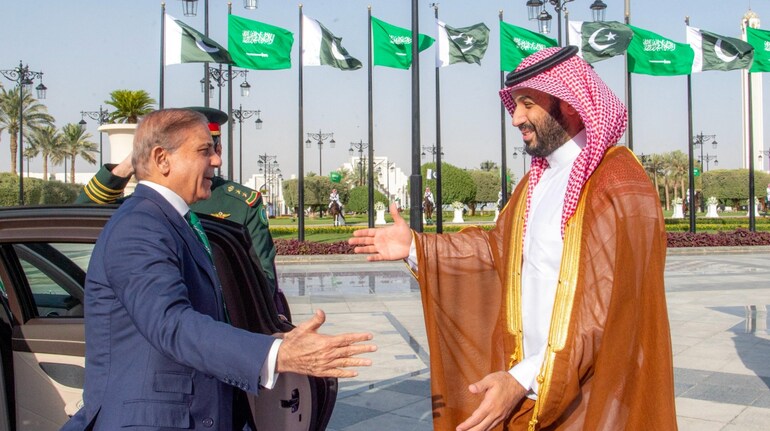

Pakistan’s much-touted defence partnership with Saudi Arabia is facing an uncomfortable test as the West Asia war intensifies. Despite repeated assurances of support for Riyadh’s security, Islamabad has stopped short of offering any military assistance, disappointing Saudi leadership that expected stronger backing from a long-standing ally.
Sources told CNN-News18 that the kingdom is privately upset over Pakistan’s absence during a critical moment in the conflict. Instead of joining the fight, Pakistan has chosen a cautious, carefully calibrated response, attempting to balance its ties with both Saudi Arabia and neighbouring Iran. The episode is now raising questions about how dependable Islamabad’s defence commitments to Riyadh really are.
Riyadh’s disappointment over Pakistan’s absence
According to sources cited by CNN-News18, Saudi officials are privately unhappy that Pakistan has refrained from offering any military assistance to counter the escalated attacks by Tehran, despite repeated references to a bilateral defence pact between the two countries.
Pakistan has publicly reiterated that it stands with Saudi Arabia and supports the kingdom’s security. However, the assistance has remained limited to diplomatic messaging rather than tangible military support. Saudi Arabia had expected that Islamabad, which has historically maintained close defence ties with Riyadh, would at least signal readiness to assist in protecting regional security.
ALSO READ | Will Pakistan be dragged into Iran war? Why Saudi defence pact puts Asim Munir in a bind
Instead, Pakistani officials have emphasised restraint and de-escalation, effectively keeping the country out of direct involvement in the war.
Islamabad walks a tightrope
Pakistan’s approach appears to be a calculated attempt to balance multiple regional pressures. While the country relies heavily on Saudi financial and diplomatic support, it also shares a long border with Iran and cannot afford to provoke Tehran.
Sources told CNN-News18 that Pakistan’s leadership fears being dragged into a wider regional conflict that could destabilise its own security environment. Islamabad has therefore chosen to avoid any military commitment while continuing to publicly affirm its defence ties with Riyadh.
However, analysts say this balancing act risks undermining Pakistan’s credibility as a strategic partner to Saudi Arabia.
Opening a new front in Afghanistan
Instead of entering the conflict directly, Pakistan has reportedly attempted to shift attention toward developments in Afghanistan.
Sources cited by CNN-News18 said Islamabad has intensified messaging around security concerns in Afghanistan and the activities of militant groups along the border. This move is widely seen as an attempt to reframe its security priorities while avoiding direct involvement in the Gulf conflict.
Pakistani officials have also characterised their response to the war as “calibrated,” suggesting that Islamabad intends to avoid escalation while monitoring developments in the region.
Defence pact faces reality check
The episode has also raised questions about the strength of the defence pact between Pakistan and Saudi Arabia.
For decades, Pakistan has been viewed as a key military partner for the kingdom. Thousands of Pakistani troops have historically been stationed in Saudi Arabia for training and advisory roles, and both countries have frequently highlighted their close security ties.
Yet the current conflict appears to have exposed the limits of that relationship. While Pakistan continues to reaffirm its commitment to Saudi security, its reluctance to provide military backing during a major regional crisis has led many observers to question how meaningful the defence pact really is.
Sources speaking to CNN-News18 said the situation has effectively become a reality check for the alliance, revealing that Islamabad may prioritise its own strategic calculations over longstanding pledges of support.
Balancing powers amid the Gulf war
Pakistan’s cautious posture reflects the difficult position it finds itself in amid rising tensions in West Asia.
The country maintains important economic and diplomatic ties with Saudi Arabia, which has provided financial assistance to Islamabad in times of economic crisis. At the same time, Pakistan cannot risk alienating Iran, a neighbouring country with which it shares security concerns along a volatile border.
This delicate balancing act has forced Islamabad to walk a narrow path, issuing statements of solidarity with Riyadh while carefully avoiding any commitment that could draw it directly into the conflict.
For Saudi Arabia, however, Pakistan’s absence on the battlefield during a critical moment has reportedly left a sense of disappointment. As the war continues, the episode is increasingly being seen as a test of whether the much-vaunted Pakistan-Saudi defence partnership is truly a strategic alliance or merely a political understanding that falls short when it matters most.
Discover the latest Business News, Sensex, and Nifty updates. Obtain Personal Finance insights, tax queries, and expert opinions on Moneycontrol or download the Moneycontrol App to stay updated!
Find the best of Al News in one place, specially curated for you every weekend.
Stay on top of the latest tech trends and biggest startup news.