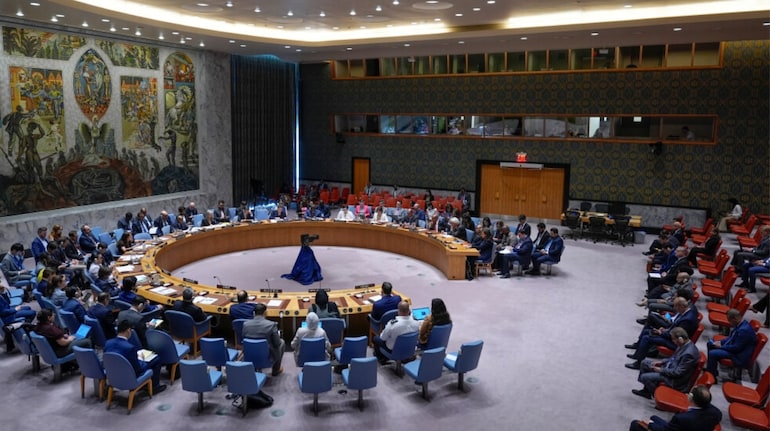
India, while criticizing Pakistan's "disinformation" on the Indus Waters Treaty at the United Nations, also highlighted that over 20,000 Indian lives have been lost to terror attacks over the past 40 years—the most recent being the targeted attack on tourists in Pahalgam.
Speaking at the Arria Formula Meeting on the Indus Waters Treaty, India’s Permanent Representative to the UN, Ambassador Parvathaneni Harish, addressed the matter after Pakistan accused India of using water as “weapon of war.” Harish responded strongly, stating that the treaty had been suspended due to Pakistan’s ongoing support for cross-border terrorism.
Pakistan violated sprit of treaty
While outlining India’s stance, Ambassador Parvathaneni Harish reminded the United Nations that the Indus Waters Treaty, signed in 1960, was established through mutual goodwill and cooperation.
"India has always acted in a responsible manner as an upper riparian state," Harish said, as he outlined four key points that, according to him, "exposed" Pakistan.
"India entered into the Indus Water Treaty 65 years ago in good faith. The preamble of that treaty describes how it was concluded with spirit and friendship. Throughout the six and a half decades, Pakistan has violated the spirit of that treaty by inflicting three wars and thousands of terror attacks on India," he stated.
Harish further emphasized how circumstances have evolved since the Indus Waters Treaty was signed in 1960, arguing that the agreement has failed to keep pace with emerging challenges such as terrorism, climate change, and the rising demand for clean energy.
“In these 65 years, far-reaching fundamental changes have taken place, not only in terms of escalating security concerns through cross-border terror attacks but also growing requirements for producing clean energy, climate change, and demographic change,” he explained.
Harish further noted the advancements in dam infrastructure technology, pointing out that while such improvements are essential for safety and efficiency, Pakistan has consistently hindered India’s efforts to implement necessary upgrades.
“Technology for dam infrastructure has transformed to ensure safety and efficiency of operations and water use. Some of the old dams are facing serious safety concerns. However, Pakistan has continued to block consistently any changes to this infrastructure and any modifications of the provisions which is permissible under the treaty,” he said.
He also highlighted India’s repeated attempts to engage with Pakistan on updating the treaty’s provisions, efforts that have been consistently rebuffed.
"India has formally asked Pakistan to discuss modifications on several occasions in the past two years. However, Pakistan continues to reject these, and Pakistan's obstructionist approach continues to prevent the exercise of full utilisation of the legitimate rights by India," he stated.
Harish concluded by stressing that the suspension of the treaty was a consequence of ongoing provocations and Pakistan’s refusal to cease its support for terrorism.
“It is against this backdrop that India has finally announced that the treaty will be in abeyance until Pakistan, which is a global epicentre of terror, credibly and irrevocably ends its support for cross-border terrorism," Harish added.
Tensions between India and Pakistan escalated following the terror attack in Pahalgam, Jammu and Kashmir, which claimed 26 lives. In response, and after uncovering cross-border links to the attack, India launched "Operation Sindoor" on May 7, targeting terror camps in Pakistan and Pakistan-occupied Kashmir (PoK).
Discover the latest Business News, Sensex, and Nifty updates. Obtain Personal Finance insights, tax queries, and expert opinions on Moneycontrol or download the Moneycontrol App to stay updated!
Find the best of Al News in one place, specially curated for you every weekend.
Stay on top of the latest tech trends and biggest startup news.