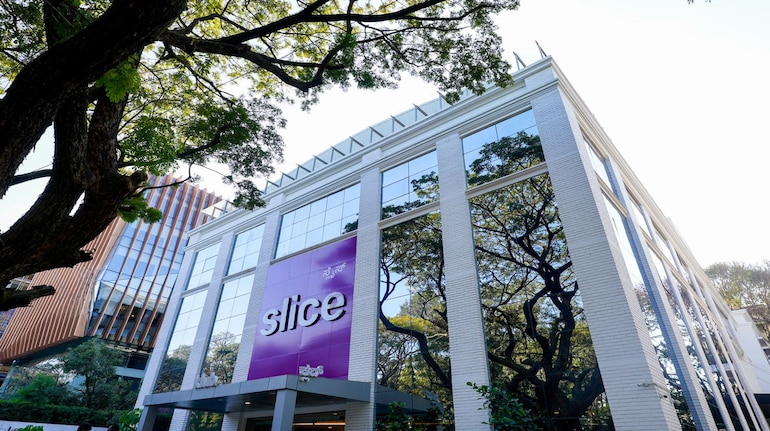
Bengaluru-based fintech firm Slice Small Finance Bank has turned profitable, reporting Rs 7 crore net profit during the first half of the current financial year.
Slice reported total income of Rs 632 crore during the first half of FY 26, compared with Rs 604 crore in the full financial year FY 25, indicating a 100 percent growth in income, according to data from credit rating agency Crisil.
Interestingly, the bank reported a pre-ESOP profit of Rs. 43 crore for H1 of FY 26.
"Better than anticipated results"
Slice had reported a loss of Rs 217 crore during the financial year ending March 31, 2025.
The new bank entity was formed after the merger of digital lending firm Slice, registered as Garagepreneurs Internet Pvt Ltd (GIPL), and North East Small Finance Bank. These are provisional figures and not the audited final figures, which can vary slightly.
“The bank’s provisional profit for H1FY26 was better than anticipated earlier. This was attributed to improved net interest margins, rationalisation in operating expenses, and credit costs remaining range-bound for the period,” Crisil noted in the credit report.
One of the key reasons behind the improving financials was the falling cost of funds, as Slice could now receive deposits from the public. Earlier, it was reliant on other banks and non-banking financial companies (NBFCs) for its lending requirements.
Deposit base grows, as Slice becomes a bank
The bank’s deposit base grew by 61 percent during the first half of FY 26 to Rs 3,900 crore. The bank pays around 8 percent interest to depositors, whereas its lending interest rate could range anywhere from 14 percent to 36 percent, depending on the credit risk.
This higher difference, called net interest margin, helped the company post considerable improvement in profitability.
“Through the amalgamation, the market presence of the bank has expanded with benefits emanating from erstwhile NESFB’s established presence in the north-eastern states of India and Slice’s expanding market presence in the unsecured personal loan segment on a pan-India level,” Crisil said in the credit report.
Rapid growth in lending
The financial institution’s assets under management (AUM) grew to Rs 3,800 crore by September 30, compared with Rs 3,000 crore reported at the end of March 31, 2025, a 27 percent growth in six months.
“The amalgamation offers cross-selling opportunities and business and operational synergies as the bank’s archaic business procedures are replaced by technology-driven practices,” Crisil noted.
Slice’s loan book comprised digital, unsecured personal loans (76%), secured portfolio comprising MSME loans (14%) and acquired direct assignment (DA), business correspondent book and other term loans extended (9%).
According to the Crisil report, Slice is looking to expand its presence in the secured asset classes to about one-third of the overall AUM and later increase the share to about 50% in the long run.
Improvement in net worth
Slice’s net worth also saw a dramatic improvement from Rs 61 crore as on March 31, 2024, to Rs 849 crore (comprising Rs 553 crore of shareholders’ equity and Rs 296 crore of compulsorily convertible debentures [CCD]) as on March 31, 2025.
This improved further to Rs 891 crore (Rs 595 crore shareholders’ equity and Rs 296 crore CCDs) as on September 30, 2025. As a result, the capital adequacy ratio improved from 11.3 percent as on March 31, 2024, to 20.3 percent as on March 31, 2025, before falling marginally to 18.1 percent as on September 30, 2025.


Discover the latest Business News, Sensex, and Nifty updates. Obtain Personal Finance insights, tax queries, and expert opinions on Moneycontrol or download the Moneycontrol App to stay updated!
Find the best of Al News in one place, specially curated for you every weekend.
Stay on top of the latest tech trends and biggest startup news.