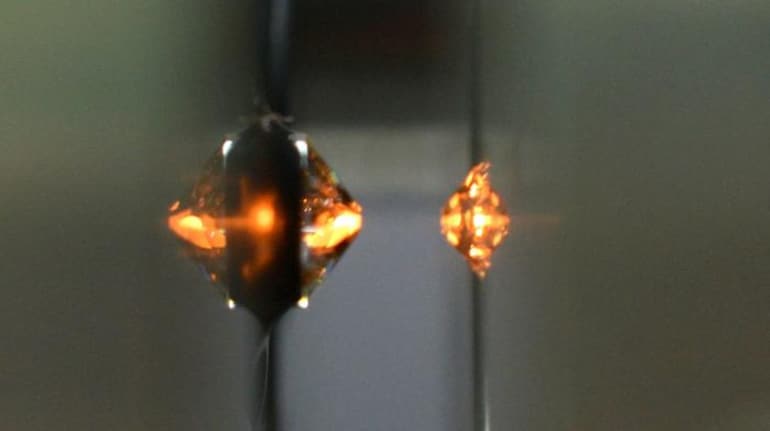
Water has once again proved it can still surprise scientists. Researchers in South Korea have discovered a new form of ice, one that forms at room temperature under pressures more than two million times that of Earth’s atmosphere. The finding, made by the Korea Research Institute of Standards and Science (KRISS), reveals an entirely new crystallisation pathway and marks the identification of the 21st known ice phase, named Ice XXI.
New Ice Phase Found at Room Temperature
The study, published in Nature Materials last October, describes how KRISS researchers observed the repeating freezing and melting of water under ultrahigh pressure over 2 GPa on a microsecond timescale. This marked the first direct observation of such a rapid and complex process.
The team, led by Dr. Lee Geun Woo, developed a supercompressed liquid state using a specially developed dynamic diamond anvil cell. The supercompressed state allowed water to exist in its liquid phase beyond its freezing point and pressure limits. Designed by KRISS, the dDAC can raise the pressure within 10 milliseconds and avoid mechanical shock, which often causes premature freezing in devices using more conventional methods.
By coupling the dDAC with the European XFEL, the most powerful X-ray free-electron laser in the world, researchers were able to document transient transformations in the structure of water under pressure. These high-speed snapshots revealed the existence of multiple crystallisation pathways, one of which ended in the previously undiscovered Ice XXI.
Ice XXI May Resemble Ice Found on Distant Moons
The newly identified Ice XXI has a distinct lattice structure of a flattened rectangular arrangement completely different from any previously known ice phase. Its density is similar to that of ice layers believed to exist deep within the icy moons of Jupiter and Saturn, suggesting new insights into how water behaves under planetary conditions.
“The density of Ice XXI is comparable to the high-pressure ice inside the icy moons of Jupiter and Saturn,” said Dr. Lee Yun-Hee, Principal Research Scientist at KRISS. “This discovery may help us understand how life could survive in extreme conditions in space.”
The research team included Dr. Kim Jin Kyun, Dr. Kim Yong-Jae, Dr. Kim Minju, and Dr. Cho Yong Chan, working alongside scientists from Germany, Japan, the USA, the UK, and the European XFEL. Together, 33 researchers contributed to the project, which was funded by the National Research Council of Science & Technology (NST) under South Korea’s ultra-high-temperature materials programme.
A Step Forward for High-Pressure Science
Over the last century, scientists have discovered 20 different crystalline ice phases by varying temperature and pressure. Yet, the region below 2 GPa has remained the most complex, where more than ten phases are clustered closely together. The KRISS team’s discovery fills a major gap in this area.
“By combining our dDAC technology with XFEL imaging, we captured transformations that were previously invisible,” said Dr. Lee Geun Woo. “Research in extreme conditions like this opens new frontiers in understanding materials and their role in planetary science.”
The study not only adds Ice XXI to the growing list of ice phases but also deepens understanding of how water behaves under conditions similar to those found inside distant worlds.
Discover the latest Business News, Sensex, and Nifty updates. Obtain Personal Finance insights, tax queries, and expert opinions on Moneycontrol or download the Moneycontrol App to stay updated!
Find the best of Al News in one place, specially curated for you every weekend.
Stay on top of the latest tech trends and biggest startup news.