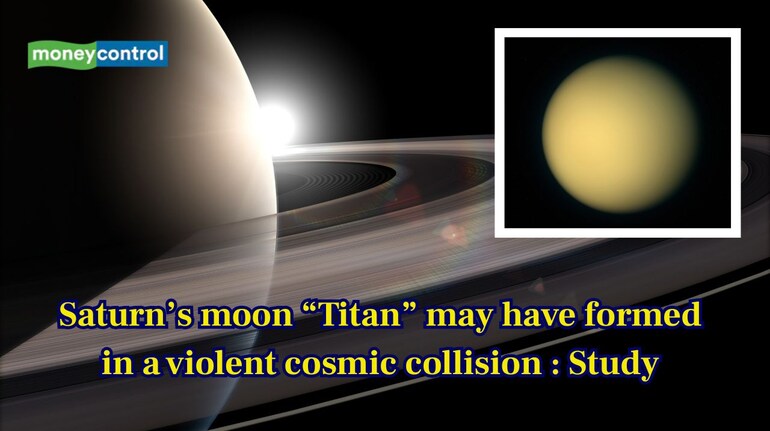

Studying Saturn is one of the Solar System’s enduring mysteries. Scientists now suggest that Titan, the largest moon of Saturn may not have formed quietly in orbit. Instead, it could be the result of a colossal collision between two ancient moons.
The new research, led by planetary scientist Matija Ćuk at the SETI Institute, paints a picture of chaos in Saturn’s early system. A violent merger that may have reshaped not only Titan, but the entire Saturnian family of moons.
Titan: A Moon Born from Impact?
A new model challenges that Saturn's moon Titan is born from collision. The scientists propose that two sizeable moons once orbited Saturn in unstable paths. Over time, gravitational interactions pushed them closer together until they collided.
Such an impact would have generated intense heat. This potentially explain the Titan’s surprisingly youthful surface and unusual internal structure.
Who Solved the Mystery of Titan?
The breakthrough comes from planetary scientist Matija Ćuk and colleagues at the SETI Institute. They used advanced computer simulations of orbital dynamics. The team also reconstructed how Saturn’s moons may have behaved billions of years ago.
The findings were striking. Titan’s present orbit and internal characteristics may not match a simple, gradual formation.
So, What Were These Ancient Moons?
According to the study, Saturn once hosted at least two large, icy moons. They present were in unstable orbits. Over time, gravitational interactions between Saturn and its moons caused their paths to shift. Slowly but inevitably, their orbits intersected.
When they finally collided, the impact would have been colossal. The two bodies likely fused, ejecting debris and generating immense heat. This resulted in collision of two moons into one, known as Titan.
How Was This Mystery Solved?
The researchers relied on dynamical modelling. These are simulations that tracks how gravitational forces evolve over billions of years. They analysed Titan’s unusual orbital tilt along with the spacing and motion of Saturn’s other moons.
The age and distribution of Saturn’s rings were also a part of this study. Titan’s surprisingly smooth and geologically active surface was a big help for researchers.
The models showed that a moon-moon merger could neatly explain several long-standing puzzles at once. The collision would have re-melted Titan’s interior, resetting its surface and possibly contributing to its thick atmosphere.
Did Saturn Get Its Rings from This Collision?
This possibility is one of the most intriguing aspects of the study. Saturn’s rings appear to be relatively young in cosmic terms. If Titan formed from a violent merger, debris from that chaotic era could have destabilised neighbouring moons.
While the rings may not have come directly from Titan’s own collision debris, the merger could have triggered gravitational domino effects throughout the Saturnian system.
Will NASA’s Dragonfly Reveal the Real Titan?
Answers may soon arrive from NASA’s ambitious Dragonfly mission. Set to land on Titan in the 2030s, Dragonfly will explore its surface chemistry, internal structure and atmospheric composition. Dragonfly could confirm whether Titan is a survivor of a colossal collision or simply a moon that formed through conventional processes.
Discover the latest Business News, Sensex, and Nifty updates. Obtain Personal Finance insights, tax queries, and expert opinions on Moneycontrol or download the Moneycontrol App to stay updated!
Find the best of Al News in one place, specially curated for you every weekend.
Stay on top of the latest tech trends and biggest startup news.