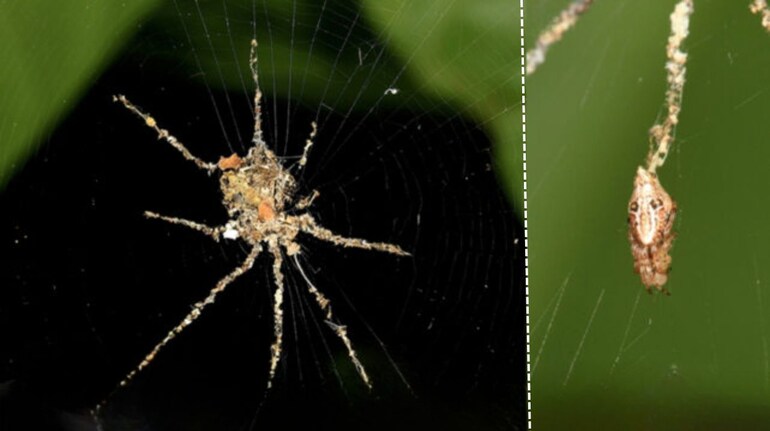

In a discovery that sounds almost unreal, tiny tropical spiders are building giant decoys of themselves. These puppets may help protect the spiders from predators in surprising ways. The behaviour was recently documented by scientists studying orb-weaving spiders in Peru and the Philippines. The spiders craft webs filled with silk, prey remains and debris.
The Discovery That Defies Belief
Researchers observed that some spiders create stabilimenta which is web decorations shaped like spiders. The decoys are often much larger than the real spider itself. They sometimes include egg sacs or spiderlings hidden inside debris. Both male and female spiders were seen living with these puppets.
Where are these spiders from?
The behaviour was studied in tropical forests in Peru and the Philippines. The spiders belong to the genus Cyclosa, known for web decorations. Scientists analysed webs over months, noting size, composition and placement. This is one of the first formal observations of this behaviour. Both male and female spiders participated in building these webs.
How the Puppets Work?
The spiders jiggle silk threads, making the decoy appear alive. The movement mimics a larger spider, creating a fearsome silhouette. Predators may be deterred by the illusion of a bigger threat. The combination of silk, prey carcasses and debris enhances realism.
The puppets sometimes hid egg sacs or spiderlings, adding protection. The team observed movement tricks, where spiders made the decoys sway realistically.
Why study on these spiders matters so much?
These spiders reveal how tiny creatures solve big survival challenges. Their puppet-building shows unexpected intelligence and creativity in simple animals. Learning these strategies helps scientists study predator-prey interactions in ecosystems.
It may inspire new ideas in robotics, camouflage and biomimicry. Studying them highlights how species adapt to threats over time.
What Scientists Say About It?
Researchers call the behaviour “a clever survival adaptation” in harsh habitats. They are studying whether predators actually avoid the puppet spiders more. Understanding these strategies may reveal new insights into ecological interactions. Further research will examine how this behaviour evolved over generations.
Discover the latest Business News, Sensex, and Nifty updates. Obtain Personal Finance insights, tax queries, and expert opinions on Moneycontrol or download the Moneycontrol App to stay updated!
Find the best of Al News in one place, specially curated for you every weekend.
Stay on top of the latest tech trends and biggest startup news.