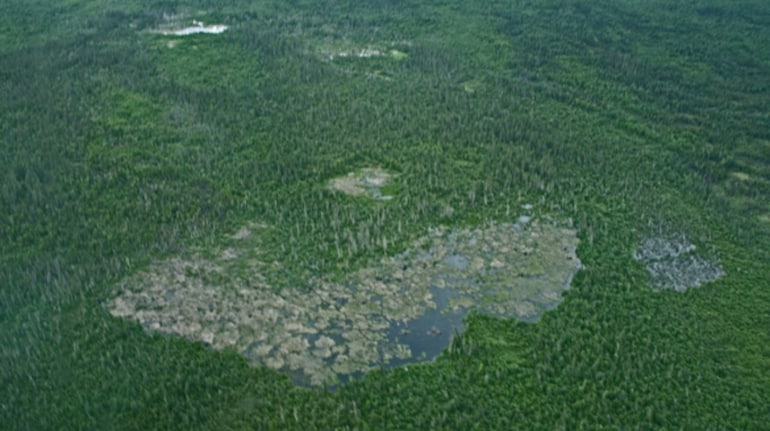

Deep inside northern Canada, satellite images have revealed an extraordinary natural structure built not by machines but by animals working quietly for decades. Hidden within Wood Buffalo National Park, the world’s largest recorded beaver dam continues to reshape land and water far from human presence.
Beaver dam visible from space inside Canada’s largest park
The vast structure lies inside Wood Buffalo National Park. The park spans northern Alberta and Northwest Territories regions. It remains Canada’s largest national park by area. The dam sits far from roads or marked trails. No nearby towns exist anywhere close to location. Reaching the site on foot takes several days. Wetlands and muskeg slow movement across terrain. Dense boreal forest limits visibility and access. Most visitors have only seen it airborne. Small sightseeing planes revealed its true scale below.
The beaver dam stretches roughly 775 metres across. That equals nearly seven football fields aligned together. Its surrounding perimeter measures close to 2,000 metres. The structure covers about 70,000 square metres total. Water pooled behind averages roughly one metre deep. This means about 70,000 cubic metres retained. That volume equals more than 90,000 dump trucks. Frozen solid, it could fill 1,600 hockey rinks.
Satellite discovery shows decades of quiet animal engineering
The dam was not found by explorers. Rangers did not document it during patrols. It first appeared in satellite imagery during 2007. Images from NASA confirmed remarkable visibility from space. Earlier satellite records showed no dam before 1980. That suggests construction occurred over several decades. Beavers returned repeatedly to the same location. Each generation added materials where water demanded reinforcement. The site’s isolation helped keep the structure unnoticed.
Why the massive beaver dam matters ecologically
Beavers are known as ecosystem engineers. Their instinctive building reshapes waterways and landscapes. Wood, mud, stones and vegetation redirect flowing water. Here, runoff from Birch Mountains feeds system. The dam forms wetlands supporting diverse plant life. It slows water movement across the wider delta. The park already shelters wood bison populations. Whooping cranes depend on nearby wetland habitats. The dam supports biodiversity without human supervision. It stands quietly, continuing its work unseen.
Discover the latest Business News, Sensex, and Nifty updates. Obtain Personal Finance insights, tax queries, and expert opinions on Moneycontrol or download the Moneycontrol App to stay updated!
Find the best of Al News in one place, specially curated for you every weekend.
Stay on top of the latest tech trends and biggest startup news.