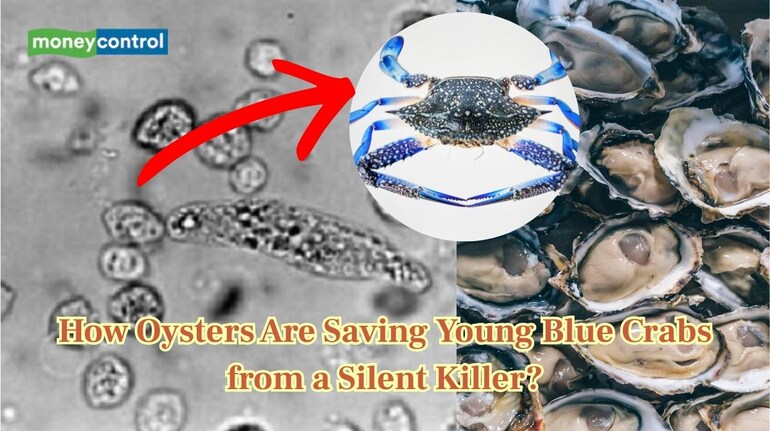

Oysters are best known for cleaning polluted water. Now, scientists have discovered something even more remarkable. They can also help protect young blue crabs from a deadly parasite.
New research shows that living oyster reefs reduce the spread of a dangerous infection that kills thousands of juvenile crabs every year. This unexpected finding highlights the vital role oysters play in keeping coastal ecosystems healthy.
This Parasite is a Silent Threat to Blue Crabs
Blue crabs are one of the most important species in coastal waters. They support major fishing industries and play a key role in marine food chains. But they face a serious threat.
A parasite called Hematodinium Perezi infects young crabs, especially in warm and salty waters. Once inside the body, the parasite weakens the crab. Many infected crabs die before reaching adulthood.
Scientists discovered this Hidden Threat
For years, scientists noticed that young blue crabs were dying in large numbers. Many failed to reach adulthood. Fishing communities began to feel the impact. After detailed investigation, researchers identified the cause.
Scientists from the Virginia Institute of Marine Science and William & Mary’s Batten School of Coastal and Marine Sciences led the research. They studied infected crab populations along Virginia’s Eastern Shore. Their findings revealed how serious the problem had become.
Oysters: An Unexpected Marine Protector
While studying the disease, researchers made a surprising discovery. A familiar sea creature was helping the crabs. Living oyster reefs were found to reduce parasite infections. But how? Oysters are natural water filters. Each one cleans large volumes of seawater every day.
As water flows through their bodies, oysters trap tiny particles. This includes parasite spores. In laboratory experiments, oysters removed more than 60 per cent of the parasite within an hour. In coastal bays, this filtering creates cleaner, safer water for young crabs.
Blue Crabs are healthy in Oyster-Rich Waters
Field experiments confirmed the effect. Scientists placed juvenile blue crabs in different environments which included living with oyster reefs, in empty shells and in open water The results recorded were striking. Crabs living near live oysters were about one-third less likely to become infected. They showed stronger movement. Better growth rates and high survival chances were seen.
Why Restoring Oysters Matters?
Oyster populations have fallen dramatically over the past century. Overharvesting, pollution and coastal development all these factors have destroyed natural reefs. Today, only a small fraction of historic oyster beds remains.
This weakens the natural protection system. Without oysters, parasite levels risen. There were a sudden decline in crab populations and fisheries also suffered. Restoring oyster reefs can reverse this trend.
Nature’s Own Defence System
This study changes how science see oysters. By filtering parasites, they protect vulnerable species and supporting blue crabs, they sustain food chains. As climate change warms oceans, diseases will spread faster.
Natural solutions will become even more valuable. In the quiet waters of coastal bays, oysters are proving that sometimes, the smallest creatures offer the strongest protection.
Discover the latest Business News, Sensex, and Nifty updates. Obtain Personal Finance insights, tax queries, and expert opinions on Moneycontrol or download the Moneycontrol App to stay updated!
Find the best of Al News in one place, specially curated for you every weekend.
Stay on top of the latest tech trends and biggest startup news.