






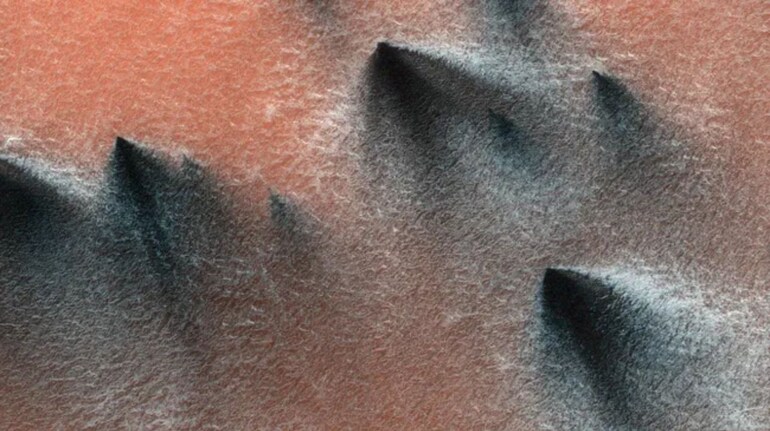
Something unusual happens on Mars when spring arrives. Geysers of gas and dust erupt near its south pole, leaving behind jagged patterns. These formations appear only in springtime, making them a fascinating sight for scientists.
How the geysers form
During winter, carbon dioxide ice builds up on Mars' surface. Unlike Earth's ice, this frozen carbon dioxide is transparent. Sunlight passes through it, warming the ground beneath. As temperatures rise, the ice turns into vapour, escaping through cracks. This process creates geysers, releasing gas and dust into the air. The streaks left behind are called "spiders on Mars" because of their spindly shapes.
The seasons of Mars
Like Earth, Mars experiences four seasons due to its tilted axis. However, a Martian year lasts 687 Earth days, making each season twice as long. Mars’ elliptical orbit also affects its climate. The planet moves faster when closer to the Sun, making southern summers shorter and hotter. Winters in the south are longer and colder because Mars moves slower when farther from the Sun.
The image of these geysers was captured by the Mars Reconnaissance Orbiter (MRO) in 2018. NASA recently reshared it, sparking interest in these seasonal Martian events. The MRO, launched in 2005, continues to study the Red Planet from orbit, revealing more about its changing landscape.
Discover the latest Business News, Sensex, and Nifty updates. Obtain Personal Finance insights, tax queries, and expert opinions on Moneycontrol or download the Moneycontrol App to stay updated!
Find the best of Al News in one place, specially curated for you every weekend.
Stay on top of the latest tech trends and biggest startup news.








