






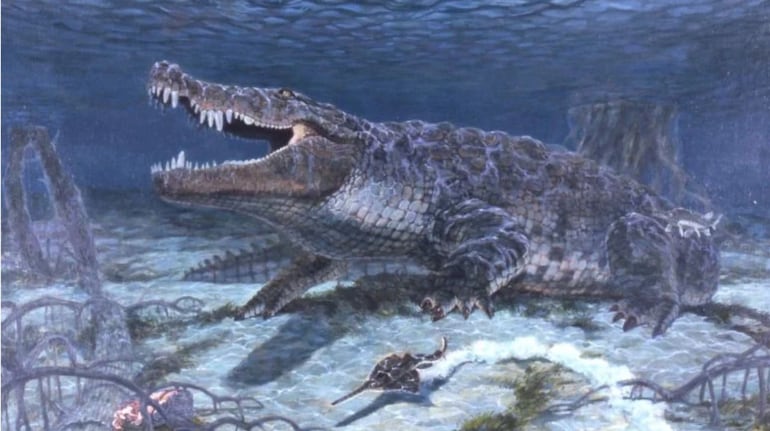

A life sized replica of Deinosuchus schwimmeri has been unveiled at the Tellus Science Museum in Georgia, offering visitors a rare look at one of North America’s largest prehistoric predators and highlighting decades of palaeontological research behind the reconstruction.
Deinosuchus replica brings ancient predator to public view
Museum officials say the addition deepens understanding of regional prehistoric ecosystems. Thousands of students visit Tellus Science Museum annually. Many arrive through organised school field trips. They seek to understand local geological and ecological history. Education director Hannah Eisla said the replica enhances learning experiences. She explained it shows how the region evolved during Cretaceous times. The display presents a clearer picture of ancient food chains. It also highlights apex predators once dominating southeastern North America. The museum noted strong interest following the installation announcement.
Research and recognition behind Deinosuchus schwimmeri
Curatorial coordinator Rebecca Melsheimer stressed the replica’s uniqueness. Tellus is currently the only museum holding this cast. She said scale is difficult to communicate through images alone. Seeing the creature in person leaves stronger impressions. Deinosuchus schwimmeri measures about 30 feet long. The species was formally named in 2020. A team of palaeontologists published the identification in July 2020. Their study appeared in the Journal of Vertebrate Paleontology. The name honours researcher David Schwimmer’s extensive fossil work. Authors cited decades of peer reviewed research contributions. They praised his studies across the southeastern United States.
 A replica of Deinosuchus schwimmeri displayed at the Tellus Science Museum. (Image: Tellus Science Museum)
Decades of fieldwork shape scientific understanding
Schwimmer has spent over 40 years studying Deinosuchus fossils. His fieldwork covered Alabama, Georgia, and Texas. National Geographic grants supported portions of his research. Fossils he recovered are held by major institutions. These include the Smithsonian and American Museum of Natural History. Tellus Science Museum also houses several key specimens. Creating the replica required advanced technical reconstruction. Triebold Paleontology used high resolution 3D fossil scans. The model reflects current scientific understanding of anatomy. Schwimmer said replicas support serious scientific interpretation. He explained predators reveal evolutionary survival strategies. Studying them shows how ancient ecosystems adapted.
Education and future research opportunities
Schwimmer’s interest began near New York’s natural history museum. He discovered his first Deinosuchus fossil in 1979. His research helped identify several Georgia palaeontological firsts. These include early dinosaurs and flying reptiles. Schwimmer documented findings in a 2002 book. The book gained international attention and readership. He later advised several major museum collections. In 2010, his fossil studies gained international notice. Research appeared in New Mexico Museum publications. Undergraduate researcher Samantha Harrell contributed to key findings. Schwimmer said regional universities offer strong field research access. He believes hands on learning benefits emerging scientists. Several fossil sites lie within 40 miles of Columbus. This proximity influenced the replica’s placement at Tellus. Schwimmer said assembled replicas complete incomplete fossil stories.
Discover the latest Business News, Sensex, and Nifty updates. Obtain Personal Finance insights, tax queries, and expert opinions on Moneycontrol or download the Moneycontrol App to stay updated!
Find the best of Al News in one place, specially curated for you every weekend.
Stay on top of the latest tech trends and biggest startup news.










