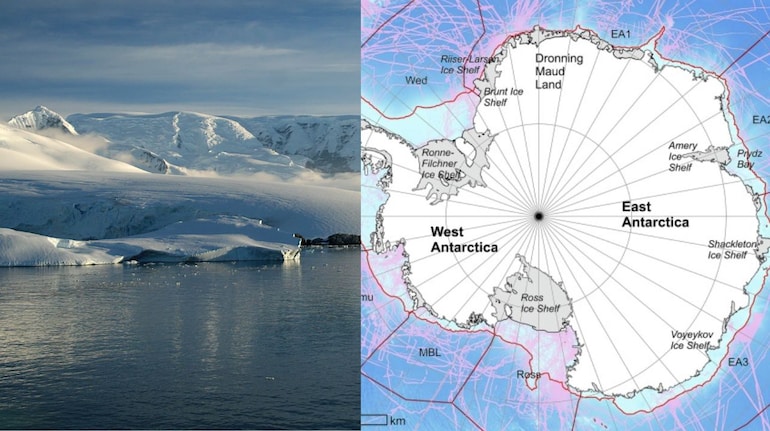

Antarctica has long appeared, at least on maps, as a vast white shield. It is frozen, remote and seemingly immovable. But beneath its icy edges, the ocean floor tells a far more different story. Scientists have now revealed the existence of more than 300 enormous submarine canyons carved into the seabed around the continent.
This discovery could alter the understanding of global climate circulation. These are not minor geological features. They are deep, sprawling valleys beneath the Southern Ocean, some plunging thousands of metres downward. Until recently, many of them were invisible to science.
A Hidden Landscape Revealed
Using improved seafloor mapping techniques, researchers identified 332 submarine canyons surrounding Antarctica. This is nearly five times more than previously recorded.
The new data paints a completely different picture. Instead of a flat underwater plain, the seabed resembles a rugged maze of steep-sided valleys, cutting deep into the continental shelf and slope.
Who is behind this Discovery?
Researchers from University of Barcelona and University College Cork compiled extensive scientific datasets. They used high resolution bathymetric measurements collected globally during expeditions. Over 40 international research missions contributed critical data to mapping.
Multibeam sonar systems mapped seafloor beneath thick ice-covered waters. These surveys reached regions previously inaccessible to vessels and researchers. Some canyons exceed 4,000 metres in depth making them.
How Did Scientists Find 300 Canyons?
The finding of 300 canyons was made possible through advanced multibeam echo-sounder technology. This echo sounder sends sound pulses to the seabed and measures how long they take to return. This allows scientists to build precise 3D maps of underwater terrain.
By combining thousands of sonar measurements collected over years of expeditions, researchers were able to identify deep, steep-sided valleys slicing through the continental shelf and slope. Some of these canyons plunge thousands of metres downwards, forming vast underwater corridors.
Do These Underwater Canyons Tell Us Something?
Far from being static geological scars, these canyons appear to act as powerful oceanic gateways. They can channel relatively warm ocean water towards the base of Antarctica’s floating ice shelves, accelerating melting from below.
At the same time, they provide pathways for cold, dense water to flow back into the Southern Ocean, feeding into global ocean circulation systems.
What Does This Mean for Climate Change?
Ocean currents play a vital role in distributing heat around the planet. If submarine canyons intensify or redirect those currents, they could significantly affect how quickly Antarctic ice melts.
Melting ice contributes to global sea-level rise. Therefore, understanding the true complexity of Antarctica’s underwater landscape is essential for improving climate projections.
Is There More to Discover?
Almost certainly. Large portions of the Antarctic seabed remain poorly explored due to harsh conditions and logistical challenges. Scientists still need to measure how actively water flows through these canyons today and how their role may evolve as the climate warms. Antarctica may appear still and silent on the surface. But beneath its frozen edge, a complex and dynamic world is shaping climate.
Discover the latest Business News, Sensex, and Nifty updates. Obtain Personal Finance insights, tax queries, and expert opinions on Moneycontrol or download the Moneycontrol App to stay updated!
Find the best of Al News in one place, specially curated for you every weekend.
Stay on top of the latest tech trends and biggest startup news.