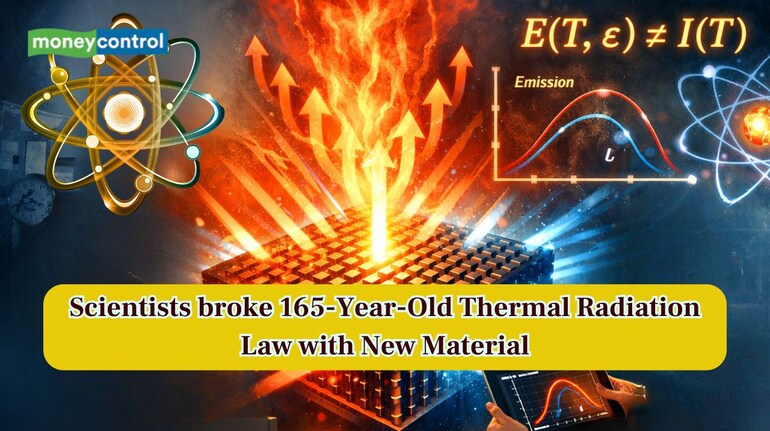

A team of researchers at Penn State has achieved a historic breakthrough. They strongly violated Kirchhoff’s 165-year-old law of thermal radiation. This discovery could revolutionize solar energy harvesting, infrared sensing and heat management, pushing technology closer to thermodynamic efficiency limits once thought impossible.
What is Kirchhoff’s Law?
Formulated in 1860, Kirchhoff’s law of thermal radiation states that a material’s ability to emit heat must equal its ability to absorb it under identical conditions. For over a century, this principle guided physics and engineering, forming the foundation for thermal devices, sensors and energy systems.
🔌 A team of researchers at Penn State has made a historic breakthrough by strongly violating Kirchhoff’s 165-year-old law of thermal radiation—unlocking exciting possibilities in energy harvesting, infrared sensing, and heat management.Kirchhoff’s law, formulated in 1860,… pic.twitter.com/4pYkLJmkiT — Shining Science (@ShiningScience) February 2, 2026
Breaking the Rules
A team of researchers at Penn State has made a historic breakthrough by strongly violating Kirchhoff’s 165-year-old law of thermal radiation. They engineered a metamaterial just two micrometers thick. This is composed of five tailored semiconductor layers, that breaks the law.
This material emits significantly more heat in one direction than it absorbs, creating nonreciprocal thermal radiation. The thermal radiation is a phenomenon never seen at this scale before.
What was record‑breaking?
Before this work, the strongest nonreciprocity measurements were much smaller. It was about 0.22 over a narrow ~1 µm band and another team had reached ~0.34 previously. But the team of Penn State achieved a nonreciprocity contrast of 0.43 across a broad 10‑micron infrared wavelength range. This made the discovery record breaking.
How this principle Works?
The secret lies in the thin-film metamaterial design. The semiconductor layers interact with the magnetic field, allowing heat to flow preferentially in one direction. The material is transferable to various surfaces, opening doors for integration into real-world devices.
Why Scientists Are Excited?
Experts say this could redefine thermal technologies. The solar panels could capture energy more efficiently. Infrared sensors could detect heat with unprecedented accuracy and thermal diodes could control heat flow in electronics and spacecraft.
It is a major leap in applied physics, showing that even centuries-old laws can be challenged with clever engineering.
Discover the latest Business News, Sensex, and Nifty updates. Obtain Personal Finance insights, tax queries, and expert opinions on Moneycontrol or download the Moneycontrol App to stay updated!
Find the best of Al News in one place, specially curated for you every weekend.
Stay on top of the latest tech trends and biggest startup news.