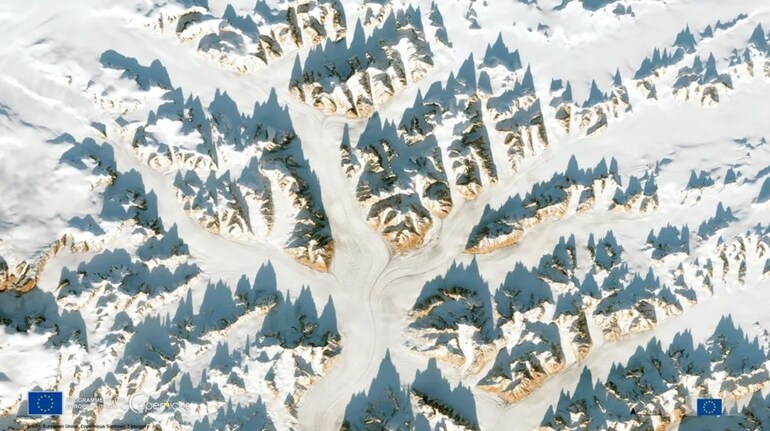

A European satellite captured Greenland’s snow-covered mountains vividly. The peaks rise steeply above glaciers and icy plains. Shadows cast by cliffs create striking contrasts across the landscape. The area imaged includes the famous Helheim Glacier in southeast Greenland. The image offers a rare perspective on rugged polar terrain.
Image captured by Sentinel-2 Satellite
The image was taken by Copernicus Sentinel‑2, part of Europe’s Earth-observation programme. Sentinel-2 captures high-resolution images in multiple spectral bands daily. Scientists use it to track changes in land, snow and ice. It helps monitor Greenland’s ice sheet and surrounding mountain regions. The satellite provides vital data for climate science and research.
What Lies Beneath the Snow?
Snow hides cracks and melting ice below. Glaciers move slowly towards the sea. Hidden fractures weaken ice sheets silently. Meltwater speeds up glacier flow. What looks stable may actually be fragile.
Why Are Scientists Monitoring Greenland?
Greenland holds one of Earth’s largest ice reserves today. Its ice sheet affects global sea levels directly. Scientists track melting to predict future coastal risks. Even small changes can impact millions worldwide. Space data helps spot dangerous trends early.
Is This Snow a Climate Warning?
Fresh snow looks beautiful from space. But it can hide deeper climate changes below. Warming air increases unusual snowfall patterns sometimes. Ice beneath may still be melting rapidly. The image captured shows beauty, but also silent danger.
How Greenland’s Snow Affects Lives?
Melting ice raises sea levels globally. Coastal cities face flooding risks increasingly. Ocean currents change due to fresh meltwater. Weather patterns shift across continents. Greenland’s snow influences life far beyond the Arctic.
Will Satellites Help Climate Science?
Yes. Satellites watch Earth without disturbing nature. They collect data from remote icy regions. Scientists study snow, ice and temperature changes. This improves climate models and future predictions. Space technology makes invisible changes visible.
Discover the latest Business News, Sensex, and Nifty updates. Obtain Personal Finance insights, tax queries, and expert opinions on Moneycontrol or download the Moneycontrol App to stay updated!
Find the best of Al News in one place, specially curated for you every weekend.
Stay on top of the latest tech trends and biggest startup news.