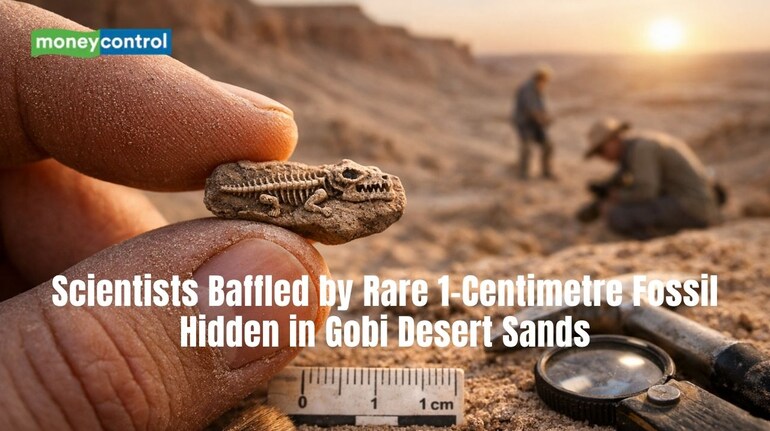

Palaeontologists have uncovered a remarkably preserved miniature fossil in the Gobi Desert, offering rare insight into early mammalian life during the Late Cretaceous period. The discovery, reported by the American Museum of Natural History, highlights a nearly complete skeleton measuring just one centimetre.
Rare micro mammal fossil from Late Cretaceous
Researchers identified the fossil at Ukhaa Tolgod in Mongolia. The skeleton measures roughly one centimetre in total length. It is considered among the smallest known mammalian fossils. Such complete specimens are extremely rare in scientific records. Most discoveries typically include only isolated teeth or fragments. This fossil includes a skull and limb structures intact. The specimen resembles a small shrew-like insect eating creature. It lived alongside dinosaurs during the Late Cretaceous era. Scientists classify it as an advanced Mesozoic insectivore species. The find offers a fuller picture of ancient biodiversity patterns.
How the tiny fossil survived extreme conditions
Scientists believe environmental factors helped preserve this delicate skeleton. The region experienced long periods of increasing dryness millions ago. Rising mountains triggered widespread arid conditions across the basin. Sudden sandstorms buried small animals quickly beneath fine sediment. Rapid burial protected bones from decay and environmental damage. The fossil remained preserved like a natural time capsule. This process helped maintain fine skeletal details for millions years. Researchers estimate the fossil dates between 75 and 100 million years. The discovery highlights survival strategies during harsh climate changes.
What the fossil reveals about early mammal life
The fossil provides clues about adaptation in extreme environments. Small insect eating mammals survived without steady water sources. They occupied ecological niches not fully understood before discovery. The region itself continues experiencing major environmental changes today. Scientists compare past survival patterns with present climate conditions. This helps explain resilience among early mammalian ancestors. Advanced imaging tools are used to study the specimen. Traditional excavation methods are unsuitable due to its fragility. High resolution micro CT scanning reveals internal structures clearly. Researchers created a digital three dimensional model for analysis. This allows global study while preserving the original fossil safely.
The finding expands knowledge about life during the dinosaur era. It also deepens understanding of how early mammals evolved.

Discover the latest Business News, Sensex, and Nifty updates. Obtain Personal Finance insights, tax queries, and expert opinions on Moneycontrol or download the Moneycontrol App to stay updated!
Find the best of Al News in one place, specially curated for you every weekend.
Stay on top of the latest tech trends and biggest startup news.